

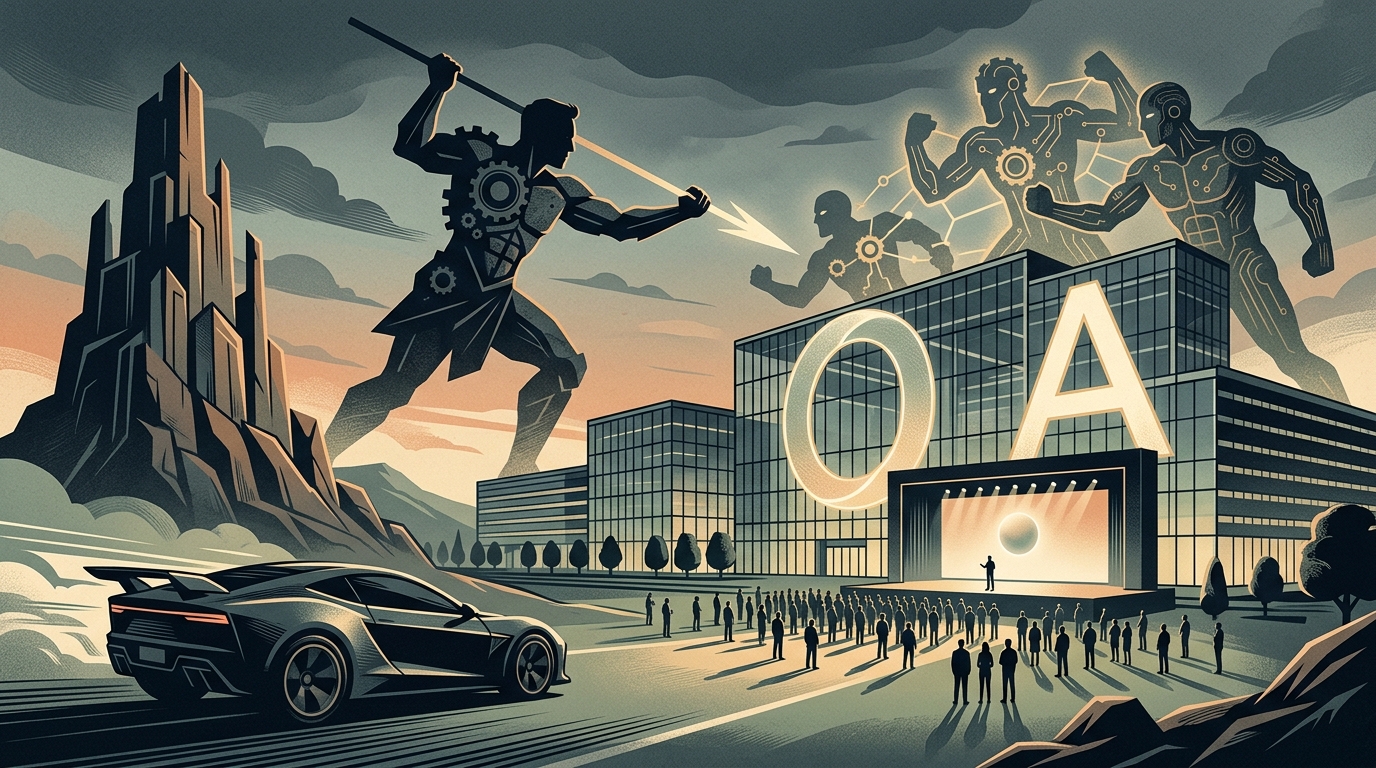
In the shifting landscape of global technology, few conflicts possess the intensity and stakes of Elon Musk's confrontation with OpenAI and Apple. What began as an ideological disagreement over the direction of Artificial Intelligence has, by the summer of 2026, evolved into an all-out war involving multi-billion dollar legal battles, cybersecurity threats, and a profound existential debate over who controls humanity's 'digital mind'.
The Legal Siege of OpenAI
Musk, a co-founder of OpenAI who left in 2018, has filed a series of lawsuits alleging that the company betrayed its original mission: creating AI for the benefit of humanity without the pursuit of profit. With OpenAI having transformed into a de facto closed organization under Microsoft's influence, Musk claims that the 'Open' in its name is now an irony. His legal team focuses on the fact that technology developed with his own resources and vision is now being used to create a monopoly that threatens free competition.
OpenAI, for its part, responds with harsh language, releasing past correspondence suggesting that Musk himself wanted full control of the company before his departure. This conflict is not just about the past, but the future of Artificial General Intelligence (AGI). If Musk succeeds in proving that OpenAI already possesses AGI technology, it could void its commercial agreements with Microsoft, causing an earthquake in Silicon Valley.
The 'Red Flag' of Apple Intelligence
Apple's recent decision to integrate OpenAI's ChatGPT into its operating system (Apple Intelligence) acted as a catalyst for Musk's fury. The billionaire publicly threatened to ban all Apple devices from his companies (Tesla, SpaceX, xAI), citing 'unacceptable security vulnerabilities'. Musk argues that Apple lacks the capacity to ensure that user data will not end up on OpenAI's servers, creating a 'backdoor' for privacy violations on a scale of billions of users.
- Apple claims that processing happens locally on the device or via 'Private Cloud Compute'.
- Musk counters, saying Apple has 'no clue' what happens once data is handed over to OpenAI.
- xAI, his own AI company, is now promoted as the only 'secure' and 'truth-seeking' alternative.
This move by Musk is interpreted by many analysts not only as a security concern but as a strategic attempt to protect his own ecosystem. With Grok developing rapidly, Musk needs to weaken the dominance of the Apple-OpenAI duo to find market space.
The xAI Strategy and the Future
At the heart of this conflict lies xAI. Musk is investing billions in infrastructure, including the 'Giga-factory of Compute', to train models that will surpass GPT-5. His rhetoric regarding 'anti-woke' AI that will not be constrained by political correctness resonates with a significant portion of the public but also raises concerns about the spread of misinformation.
"Artificial Intelligence is the most significant existential risk we face. If we allow a closed elite to control it without transparency, the future of our freedom is at stake," Musk recently stated.
As we head toward the end of 2026, the outcome of these legal and business battles will determine whether AI remains a tool in the hands of a few giants or if a more fragmented and competitive world will emerge. Musk is betting everything on deconstructing his rivals, knowing that in the new digital age, whoever controls information, controls reality.





