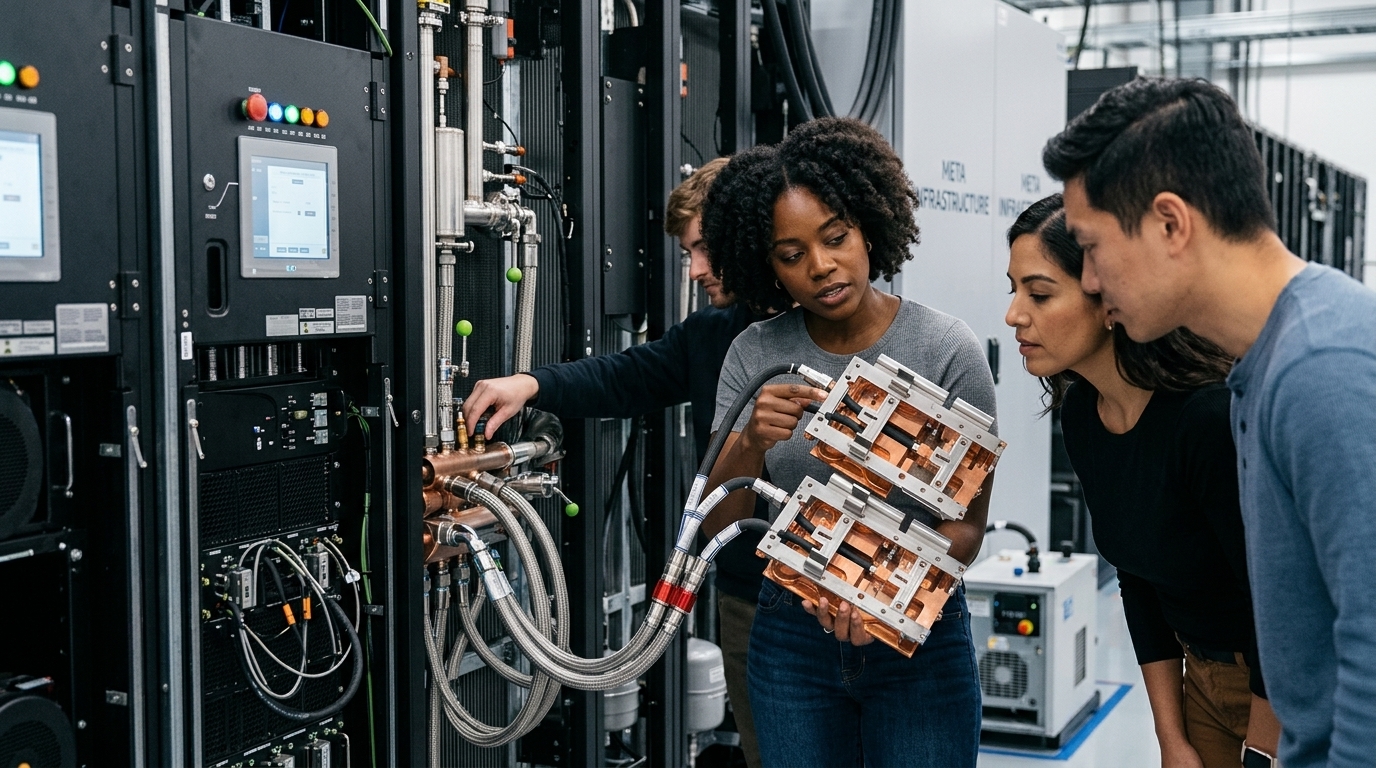
As AI hardware becomes increasingly powerful, the heat it generates has become a significant engineering hurdle. Meta is addressing this by moving beyond traditional air cooling toward advanced closed-loop liquid cooling systems for its data centers.
The Mechanics of Closed-Loop Systems
Unlike traditional data centers that rely on air to regulate temperature, Meta’s closed-loop design uses a mixture of water and glycol circulated through the server hardware. This coolant absorbs heat and carries it to heat exchangers where it is dissipated before being recirculated. This sealed process allows the same mixture to be used for up to a decade without replacement.
Meta reports that a typical AI-optimized data center using this system with dry coolers consumes less water annually than a couple of full-service restaurants, challenging the misconception that AI facilities are inherently massive water consumers.
Efficiency and Space Optimization
Liquid cooling offers more than just resource efficiency; it also optimizes physical space. Attempting to cool modern GPUs with air would require nearly double the server tray size to accommodate the necessary fans and vents. By using direct-to-chip liquid cooling, engineers can pack more GPUs into the same rack, allowing facilities to scale capacity without increasing their physical footprint.
Consistent with its history in the Open Compute Project, Meta is sharing these infrastructure designs. In 2025, the company introduced
IcePack, a liquid-cooled network rack platform shared openly to encourage industry-wide efficiency and sustainability.
Using AI to Optimize Cooling
In a recursive turn, Meta is employing reinforcement learning (RL) to manage its cooling infrastructure. Engineers developed a physics-based simulator to model weather conditions and server loads, allowing RL models to find the most efficient cooling strategies without risking live operations.
Initial pilots of this AI-driven approach resulted in a 20% reduction in energy used by air-cooling supply fans and a 4% reduction in water usage, demonstrating significant efficiency gains when applied across a large data center fleet.