

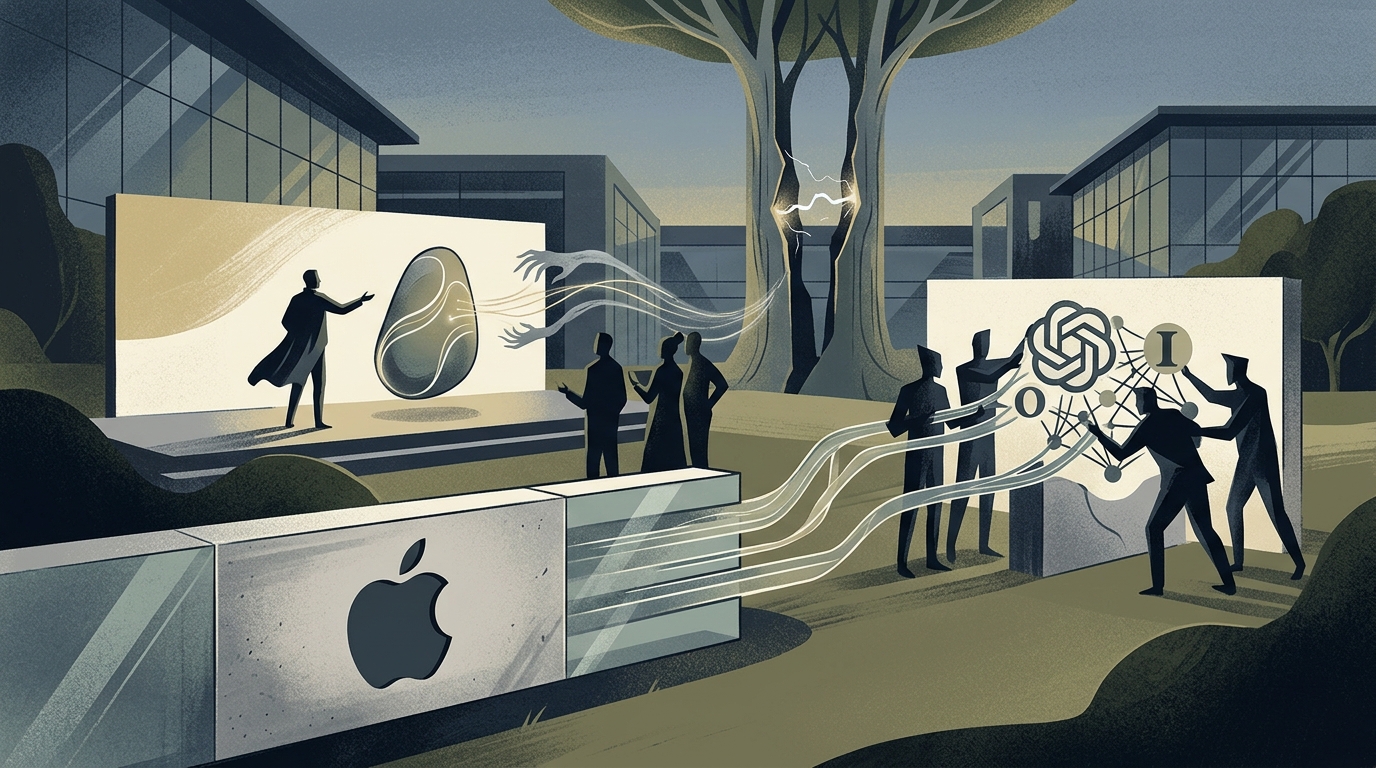
July 10, 2026, will be remembered in tech history as the day the "cold peace" in Cupertino shattered in the most spectacular fashion. Apple has filed a massive lawsuit against OpenAI and "io Products," the startup founded by its former design chief Jony Ive, alleging an orchestrated campaign to steal trade secrets related to next-generation AI hardware.
The Betrayal of Design DNA
At the heart of the lawsuit are two former Apple engineers who defected to OpenAI in early 2025. According to documents filed in the U. Northern District of California, these employees allegedly exfiltrated gigabytes of highly confidential data before their departure. The data includes technical specifications for advanced thermal management systems, low-power neural processing unit (NPU) architectures, and, most critically, the blueprints for an unreleased wearable device that Apple had been developing under extreme secrecy.
The involvement of Jony Ive adds a layer of Shakespearean drama to the case. The man who defined the aesthetic of the iPhone and the Mac is now accused of using his firm, io Products, as a vessel to integrate stolen Apple technology into a new category of AI devices being developed in partnership with Sam Altman. Apple contends that the "convergence" between io Products' designs and its own internal prototypes is "statistically impossible to be coincidental."
The Stakes of the Next Great Device
Why has Apple chosen to strike now? The answer lies in the race for the "Post-Smartphone" future. As artificial intelligence moves from the cloud to edge devices, controlling the hardware becomes paramount. OpenAI, despite its dominance in software with GPT-5 and beyond, lacks the infrastructure to build physical products. A partnership with Ive, coupled with alleged access to Apple’s hardware secrets, could give them a multi-year head start.
Apple claims the stolen information specifically concerns the use of novel materials that allow for passive cooling in ultra-slim form factors—a "holy grail" for AI wearables. If OpenAI can release a device that runs heavy AI models locally without overheating, using Apple’s multi-billion dollar R&D, the power balance in Silicon Valley will be permanently altered.
Legal and Business Implications
Legal analysts suggest that Apple is seeking not only astronomical damages but also a preliminary injunction to halt OpenAI and io Products from continuing work on any hardware utilizing the disputed technologies. Such a move could freeze Jony Ive’s project for years, granting Apple the necessary window to launch its own competing products.
For its part, OpenAI issued a terse statement, calling the allegations "baseless claims intended to stifle competition." However, the internal turmoil is palpable. This case highlights the most significant challenge in the modern tech industry: protecting intellectual property in an era of rapid talent mobility where knowledge is the ultimate currency. The trial, expected to begin in late 2026, will serve as a landmark for how trade secrets are defined in the age of AI.





