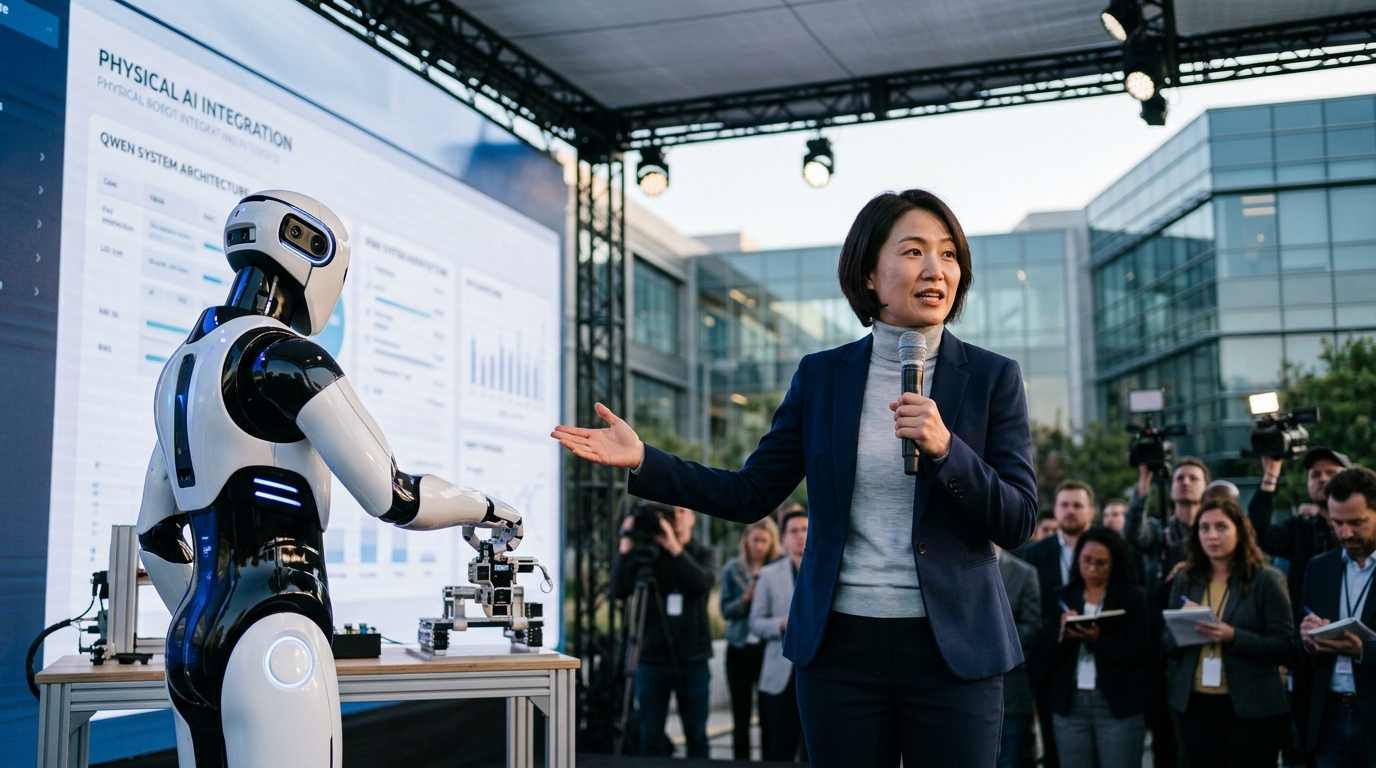
In the ever-evolving landscape of global technology, few moments can be truly described as "inflection points." Alibaba's recent announcement regarding the full-stack integration of its Qwen model into robotic systems—dubbed the Qwen-Robot—appears to be one of them. This is not merely a software update; it is the emergence of "Physical AI," where digital intelligence gains a physical form, directly impacting supply chains, manufacturing, and, naturally, the stock value of the Chinese conglomerate.
The Convergence of Digital and Physical Worlds
Alibaba's strategy with Qwen-Robot transcends the boundaries of traditional chatbots. While the Tongyi Qianwen (Qwen) model began as a competitor to GPT-4 in the linguistic domain, its evolution into a "brain" for robotic platforms changes the game. Physical AI, or Embodied AI, refers to systems that can perceive, reason, and interact with the physical environment in a manner that mimics human dexterity.
According to market analysts, Alibaba has successfully addressed the "reality gap." By utilizing reinforcement learning techniques and multimodal data, the Qwen-Robot can perform complex tasks in warehouses and production lines without the need for exhaustive programming of every single movement. This full-stack approach—from the silicon and the AI model to the final robotic hardware—gives Alibaba a competitive edge that few companies worldwide possess.
Economic Impact and the Wall Street Verdict
The market reacted with enthusiasm, with many rating agencies, including Seeking Alpha, reiterating a "BUY" recommendation for Alibaba stock. The reason is not just technological superiority but scalability. Alibaba Cloud, the backbone of this effort, is seeing its profit margins expand as it offers "Robotics-as-a-Service" (RaaS) to thousands of enterprises across China and Southeast Asia.
- Operational Cost Reduction: Automation via Qwen-Robot is expected to slash expenses for Cainiao (Alibaba's logistics arm) by 30% over the next two years.
- New Revenue Streams: Licensing the Qwen-Robot OS to third-party hardware manufacturers creates a new, highly profitable market segment.
- Geopolitical Hedging: By investing in cutting-edge domestic technology, Alibaba aligns with Beijing's goals for technological self-reliance, mitigating the risk of further regulatory crackdowns.
The Challenge of International Competition
Despite domestic success, Alibaba must face global players like Tesla with its Optimus project and Figure AI, backed by OpenAI. However, China possesses a unique advantage: its manufacturing ecosystem. The Qwen-Robot is not being tested in sterile labs but in the most demanding industrial environment on the planet. This continuous feed of real-world data allows the model to improve at a pace that Western competitors find difficult to match.
"We are not just seeing a robot executing commands. We are seeing a system that understands the physics of the world and adapts to it in real-time," notes the Seeking Alpha report.
In conclusion, Alibaba seems to have found the "sweet spot" between the digital economy and physical production. For investors, the current stock valuation may not yet fully reflect the potential of this transformation. If Qwen-Robot manages to dominate industrial applications, Alibaba will no longer be just the "Amazon of China," but the foundational infrastructure provider for the next industrial revolution.