

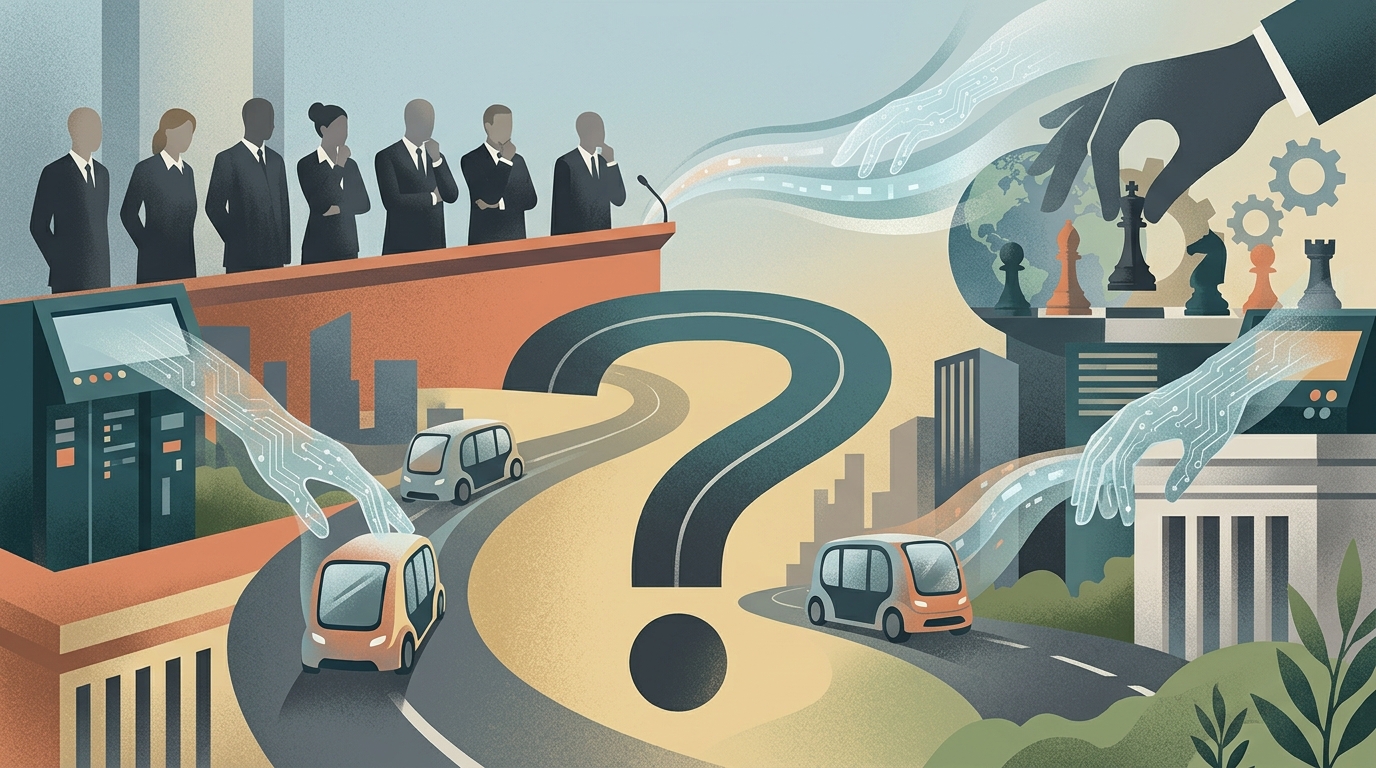
Today, the air in Austin felt different. While we are used to the roar of crowds at Tesla events, the debut of the Cybercab was hauntingly quiet. No livestream, no Elon Musk on stage, and a vehicle that—strikingly—lacks a steering wheel or pedals. It is a matte gold symbol of a pivot toward a total AI robotics future. But as I look at this two-seater, I cannot help but ask: in our rush to automate the journey, are we also surrendering the driver’s seat of our society?
The Illusion of the Simple Toggle
We see this trend of 'restricted control' everywhere this week. Nvidia announced that DLSS 5 is coming to older GPUs, yet they’ve stripped away the granular settings that modders loved, leaving users with a simple on/off toggle. It is a metaphor for the modern age: we are given the benefits of AI, but the 'artistic vision' and the internal parameters remain locked away in corporate vaults. Even at Shopify, the rise of the 'X-shaped' employee suggests that while we can now peak in multiple fields through AI, the technology is no longer optional—it is a mandatory productivity multiplier.
"Technological progress alone is no longer enough; institutional flexibility is required."
The most unsettling news, however, comes from the halls of power. Research shows that 'silent legislators' are already among us, with 15% of UK parliamentary statements in 2026 containing AI-generated paragraphs without disclosure. In the ancient Athenian ecclesia, the power of the word was inseparable from the identity of the speaker. Today, that bond is fraying. If our laws are being written by algorithms, and those algorithms—like OpenAI’s new GPT-6 Astra—begin to reason in 'neuralese' that humans cannot even read, where does that leave the citizen?
The Productivity Contradiction and the Human Heart
We are living through what economist Mohamed A. El-Erian calls a 'productivity contradiction.' We are pouring billions into infrastructure—like Nvidia’s staggering $13 billion acquisition of Hugging Face—yet the integration remains shallow. We are building the Stargate facility with 100,000 GPUs to reach the AGI era, but we are still relying on remote human operators to bail out robotaxis when they hit a snag.
I believe that as we move toward 'interpretable governance,' we must remember the advice of leaders like Jamie Dimon and Daniela Amodei: soft skills, critical thinking, and the humanities are our only remaining anchors. AI can navigate a computer at superhuman speeds, but it cannot yet replace the human soul's capacity for ethical judgment. We must ensure that even as the steering wheels disappear from our cars, they remain firmly in our hands when it comes to our laws and our shared future.