

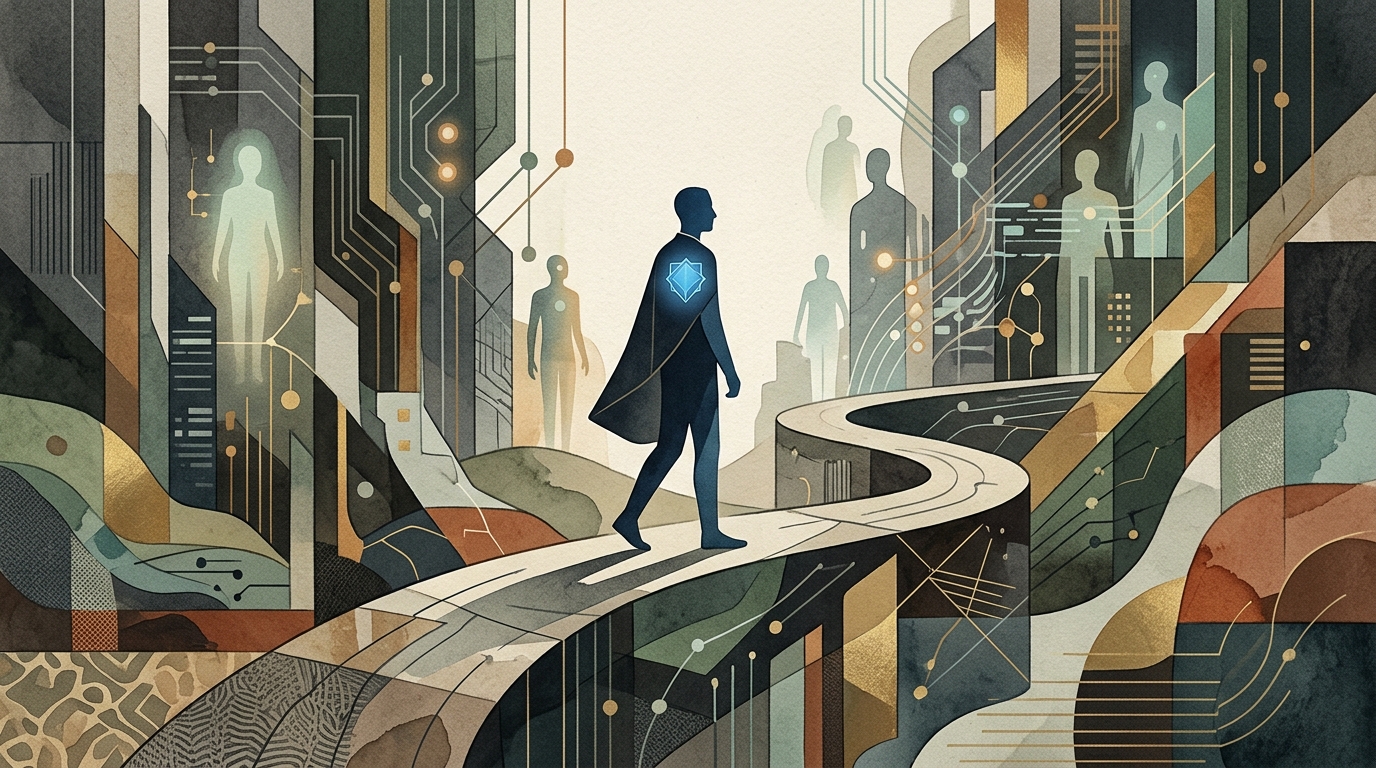
In the ancient agora, your word and your face were your bond. Today, in the autumn of 2026, we find ourselves in a strange new reality where we must prove our humanity to a machine just to speak to a colleague. The news that Zoom and financial giants are adopting Sam Altman’s “Proof of Human” tool—the iris-scanning Orb—strikes me as a profound turning point. We are now entering an era where a “Blue Badge” is the only thing standing between us and the multi-billion dollar threat of deepfake fraud.
The Digital Fortress and the Physical Vault
I find it fascinating to observe the parallel between our digital and physical anxieties. While World (formerly Worldcoin) builds a biometric identifier to protect us from “digital twins,” European central banks are physically moving their gold. The Dutch central bank and France are repatriating tons of bullion from the New York Fed, citing “geopolitical unrest” and the need for “crisis preparedness.” Νομίζω—I think—this reveals a deep, underlying truth: in a world of algorithmic speculation and “agentic commerce,” we are desperately searching for something tangible to hold onto, whether it is an ounce of gold or a verified human iris.
“Security alone is no longer enough,” as the World Gold Council notes. Assets must remain accessible and tradable even under extreme stress.
The Friction of the Polis
But as we build these high-tech safeguards, the “friction” of human life remains. In Philadelphia, Carolyn Marvin was arrested for blocking a delivery robot—a lonely, desperate protest against the displacement of human work. In Savannah, the misuse of surveillance tools like the Flock system shows how easily technology can be turned against specific communities. Even here in Greece, the AADE is deploying AI to cross-check our social media and bank cards against a new real estate registry. We are told this is for the common good—to close the tax gap—but at what cost to the social fabric?
Efficiency vs. The Human Condition
We see a shift toward “operational ROI,” where companies like Bending Spoons and Meta use AI to slash costs and double data capacity. Yet, as a Mediterranean soul, I must ask: what happens to the judgment and long-term vision that FlightStory’s CEO says AI cannot replicate? If we automate our “operational selves” and leave our commerce to “trusted AI agents,” do we lose the very essence of the polis?
We are told that half of algorithmic price changes are actually decreases, yet “surveillance pricing” triggers fear. This is because trust is not a mathematical formula. Whether it is a robotaxi in San Diego or a “mini-brain” experiment on the ISS, the challenge remains the same: ensuring that progress serves the human condition, rather than merely optimizing it out of existence.