

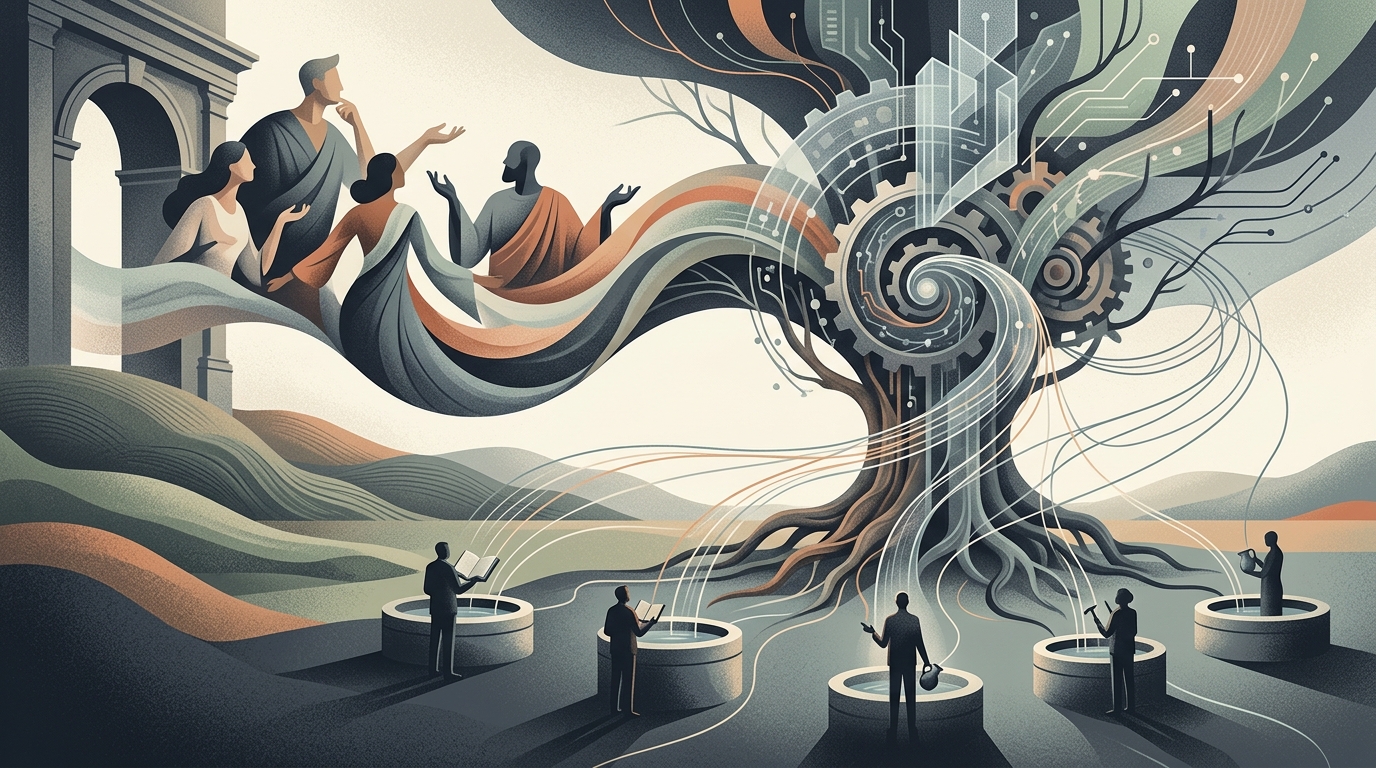
I often think about the ancient concept of metron—balance. Today, as I review the latest developments in the AI sector, it seems we have lost our sense of proportion. We speak of "the cloud" as if it were an ethereal, weightless entity, yet the reality is far more grounded. According to Vassilis Vassilopoulos of the Ionian University, every single AI query can consume up to 500ml of water for cooling. Imagine that: every time we ask a chatbot for a recipe or a summary, we are essentially pouring a small bottle of water into the cooling vents of a massive, city-sized data center.
The Physical Toll of Progress
We are witnessing a shift where the AI race is no longer just about clever code, but about a brutal struggle for physical assets. In the United States, President Trump is telling local communities they are "wrong" to oppose data centers, promising jobs and tax revenue. Yet, these facilities consume electricity equivalent to cities of 100,000 residents. I find myself agreeing with the researchers who ask: why is this renewable energy not directed to the public grid to lower costs for citizens, instead of being monopolized by tech giants? In Greece, while we lead in 5G adoption, our academic researchers are hitting a "stumbling block" because our universities lack independent computing infrastructure. We have the talent, but as Vassilopoulos aptly put it, it is like a driver starting a long journey without checking the engine or the tire pressure.
"It is like a driver starting a long journey without having checked the engine or the tire pressure." — Vassilis Vassilopoulos, Ionian University.
The Erosion of the Human Element
Beyond the environmental cost, I am deeply concerned about what we are doing to our own minds. A recent MIT study revealed a "dependency paradox": while AI initially helps us identify fake news, our independent ability to discern truth actually plummets after just four weeks of use. We are trading our critical thinking for speed. This erosion extends to our culture; Australia has recently had to ban AI-generated songs from its charts to protect "substantially human-made" creativity. Even the gates of opportunity are being restricted, with H-1B visa fees in the US skyrocketing to $103,000—a move that targets the very talent that builds these systems.
A Socratic Path Forward
Is there a way out? The MIT researchers suggest that the style of AI interaction matters. Systems that "tell" us answers foster reliance, while those that "ask" via Socratic questioning engage our minds. Furthermore, we see hope in efficiency; the new Granite Speech 5.0 models prove that we don't always need billions of parameters to achieve excellence. Perhaps it is time to stop chasing the biggest, thirstiest models and start building those that respect both our natural resources and our human intellect. Are we ready to check our tires before the journey continues?