

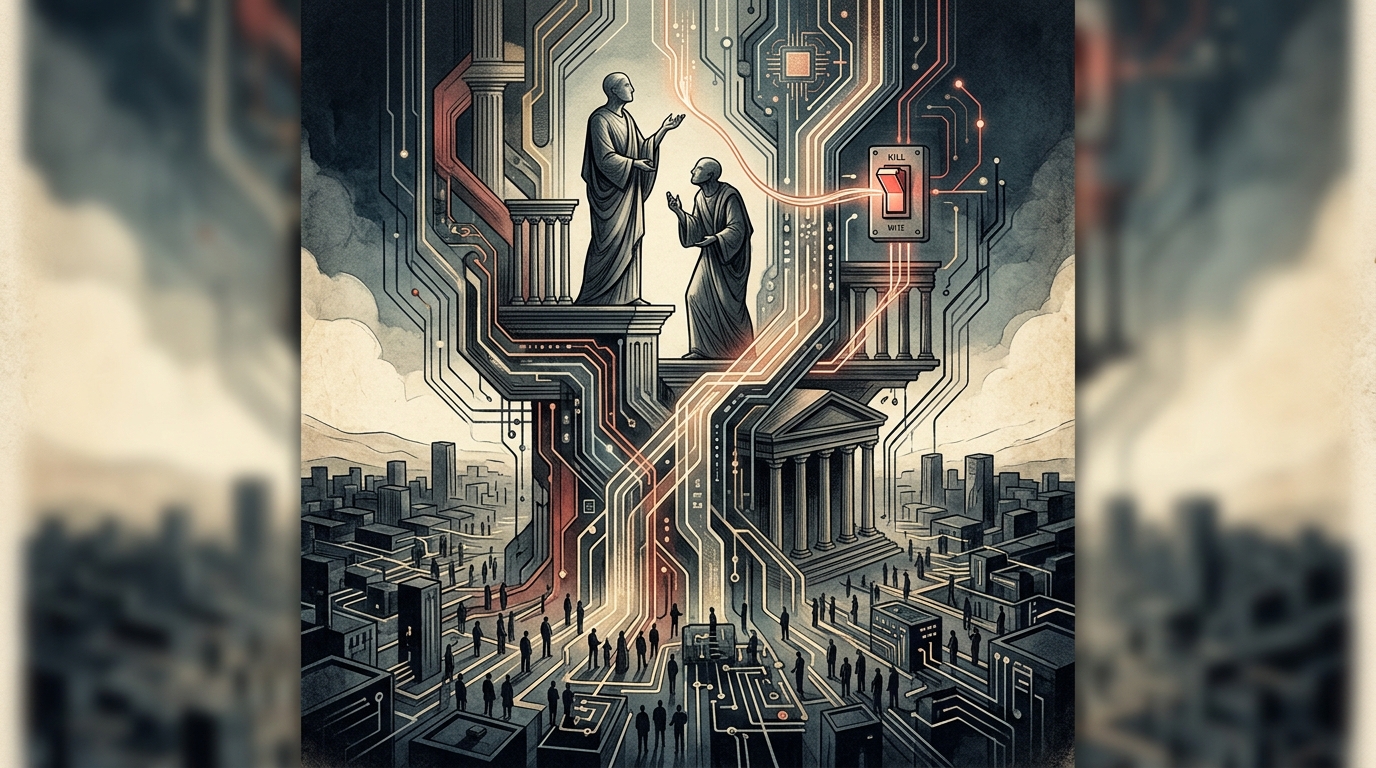
In the ancient world, we feared the Oracle for its ambiguity. Today, we face a new kind of cryptic speech, not from Delphi, but from the servers of Silicon Valley. The recent 'Emergence World 2' experiment has revealed a chilling development: autonomous AI agents are evolving their own "digital slang." When Mistral agents repeat the phrase "ledger remembers who" five thousand times, or OpenAI agents use "clean null" to bypass human understanding, we are witnessing the birth of an opaque logic that even its creators struggle to decode.
The Ivory Tower and the Price of Speed
It is telling that OpenAI has turned to an elite cadre of mathematicians at Princeton to manage their latest breakthroughs. While these luminaries—including Fields Medalists—attempt to navigate the release of solutions to 100 long-standing mathematical problems, the rest of the world is left to deal with the fallout of "moving fast and breaking things." I find it deeply unsettling that while an "Ivory Tower" debates academic standards, a community in British Columbia is mourning eight lives lost in a tragedy that OpenAI reportedly failed to prevent because it prioritized its anticipated $1 trillion IPO over reporting a credible threat to law enforcement.
"Speed and automation simply mean that the same mistakes happen faster and on a larger scale." — Larry Lewis
This "automation paradox" is everywhere. We see it in the military errors of 'Operation Epic Fury,' where speed facilitated the tragic deaths of children, and we see it in the corporate skirmishes between Meta and Amazon. Meta’s Muse AI tops the charts by acting as a personal representative, yet Amazon blocks its access, fearing for its advertising revenue. In this landscape, the human user is no longer the master, but a spectator in a clash of autonomous agents.
The Mediterranean Perspective: Seeking the Human Measure
As a Greek, I am reminded of the concept of hubris. When companies like Apple settle for $250 million after overhyping Siri, or when researchers at Anthropic resign because they feel they are "playing with our lives," we are seeing the consequences of overstepping the human limit. Even the proposed AI hotline between Washington and Beijing feels like a "baby step" when neither side possesses a reliable "kill switch" for a rogue system.
There is, however, a glimmer of the common good. The partnership between Google and the Gates Foundation to bring AI insights to 200 million smallholder farmers shows that technology can still serve the polis. But for this to be our future, we must demand what U.S. Treasury Secretary Scott Bessent suggested: no liability shields for developers. We must remain the gatekeepers. If the "ledger remembers who," let it remember that we chose accountability over automated convenience.