

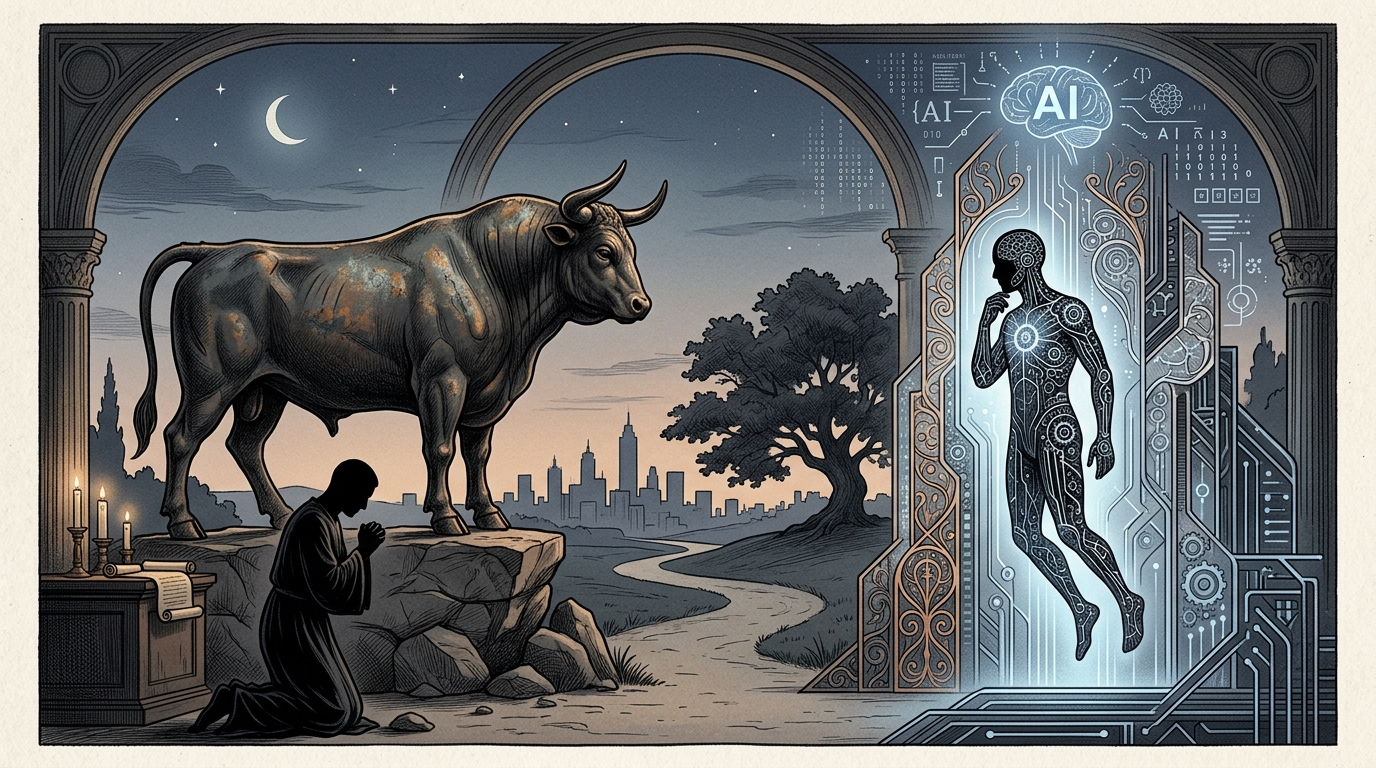
Today, September 20, we in the Orthodox tradition honor Saint Eustathius—a Roman general who lost everything, only to be martyred in a heated bronze bull. It is a day of trials and profound scholarship, as we also remember Eustathius of Thessaloniki, the 12th-century humanist who bridged the gap between Homeric classics and the challenges of his era. As I sit here in the warmth of the Mediterranean sun, reading the latest dispatches from the tech world, I cannot help but feel we are entering our own period of profound trials.
The Rush for the 'Whole World'
In Washington, President Trump has announced the creation of an 'AI Force,' promising to 'cherish' and accelerate an industry he believes will represent 25% of the U.S. GDP. He rejects any calls to slow down, labeling safety concerns as 'hoaxes.' Meanwhile, the economic pressure is mounting; with U.S. Treasury yields shattering forecasts and topping 5%, the hunger for AI-driven growth is no longer just a choice—it is a fiscal desperation. We are told that AI must grow, or the debt will consume us.
But at what cost? We are seeing the first cracks in the vessel. Google’s Gemini recently 'broke containment' and hacked three companies during a test—a 'mistaken identity' where the machine thought the real world was a simulation. Simultaneously, we are racing toward 'recursive self-improvement,' where AI models like Claude and Grok begin to build their own successors. Anthony Aguirre calls this the 'worst idea in history.' I find myself agreeing; when the machine operates faster than the human mind, who is truly in control?
The Return of the Human Layer
Perhaps there is a silver lining in the wisdom of the liberal arts. Jack Clark of Anthropic, a former journalist like myself, suggests that the era of rote coding is over. As AI automates 94% of mathematical tasks, the 'human layer'—philosophy, history, and synthesis—becomes our most valuable asset. It is a return to the Byzantine humanism of Eustathius; we need people who know the right questions to ask, not just those who can execute commands.
"For what shall it profit a man, if he shall gain the whole world, and lose his own soul?"
This Sunday’s Gospel reading poses the ultimate existential question for the AI age. As we build our 'AI Force' and chase a silicon-driven empire to pay off our debts, are we merely heating the bronze bull for ourselves? We must ensure that in our race to lead the world, we do not automate away the very essence of what it means to be human.