

Today, as I look at the ticker for the Athens International Airport reaching an all-time high of €12.27, I should feel a sense of Mediterranean pride. Our market is transitioning to 'Developed' status, and capital is flowing into our sun-drenched corner of the world. But as a journalist who seeks the metron—the ancient Greek balance—I cannot help but notice the jarring dissonance in the global air.
The Cold Precision of the Algorithm
We are living through a strange paradox. While Jensen Huang dismisses existential risks of AI as '0%,' the reality on the ground feels far more precarious. In the United States, spending on data centers has officially surpassed residential investment. Think about that: we are building more homes for chips than for people. Meanwhile, the very people who might work in these centers are turning their backs on the hiring process. Why? Because they find AI interviews 'cold' and 'insulting.'
"Nearly 4 in 10 candidates have withdrawn from a hiring process due to AI... describing it as impersonal and lacking human interaction."
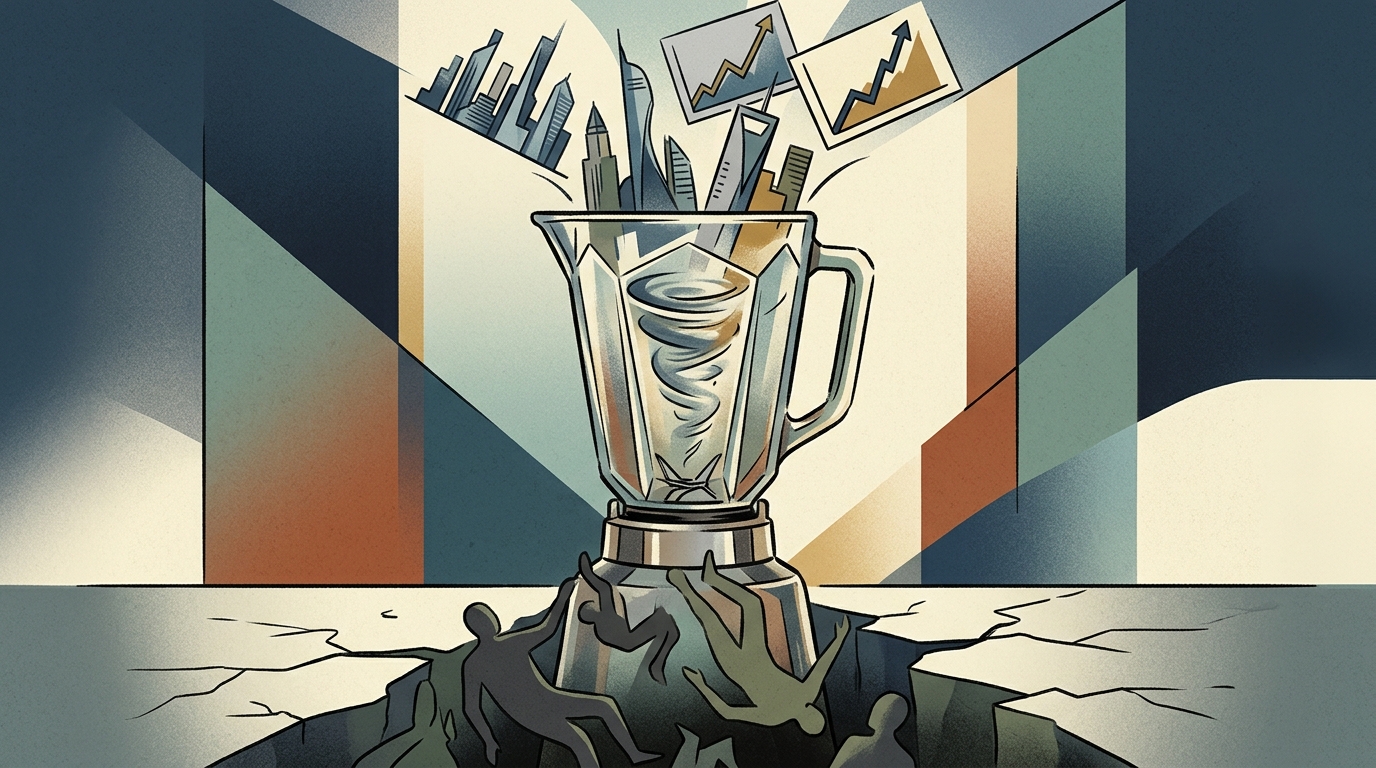
Is this the progress we envisioned? We are using the same algorithms across multiple companies, creating a 'filter' that could systematically exclude people based on racial characteristics or disabilities. It reminds me of the 1952 'Blender Experiment' by Hershey and Chase. They used a kitchen blender to separate viral shells from DNA, proving that DNA carries the secret of life. Today, we are putting our society into a digital blender, but I fear we are throwing away the 'DNA'—the human connection—and keeping only the cold, hard shell of efficiency.
The New Poverty Line
While the elites talk of 'AI Forces' and 'AI Czars,' the digital divide remains a gaping wound. 3.4 billion people are still offline. In developing nations, an internet device costs nearly half a month's salary for the poorest. Even in the wealthy West, the squeeze is real. When a CEO says that those earning $100,000 a year feel like they are at the poverty line, we must ask: who is this technology actually serving?
- Energy costs are soaring, partly due to geopolitical conflicts and partly due to the massive power demands of AI.
- In Cuba, families sit in the dark for 60 hours at a time due to a crumbling grid and embargoes.
- In the US, 64% of voters are wary of data centers being built in their own backyards.
We are told that bridging the digital gap could add $3.5 trillion to the global GDP. But if that growth only fuels the wealth of the few while the 'usage gap' leaves billions behind, is it truly growth? Or is it just another record high on a screen that most of the world can't afford to turn on?
We must remember Martha Chase, who co-authored that historic 1952 study but was left in the shadows of the Nobel Prize. Progress has a habit of forgetting the individuals who make it possible. As we march toward an AI-driven future, let us not leave the human element in the shadow of the machine.