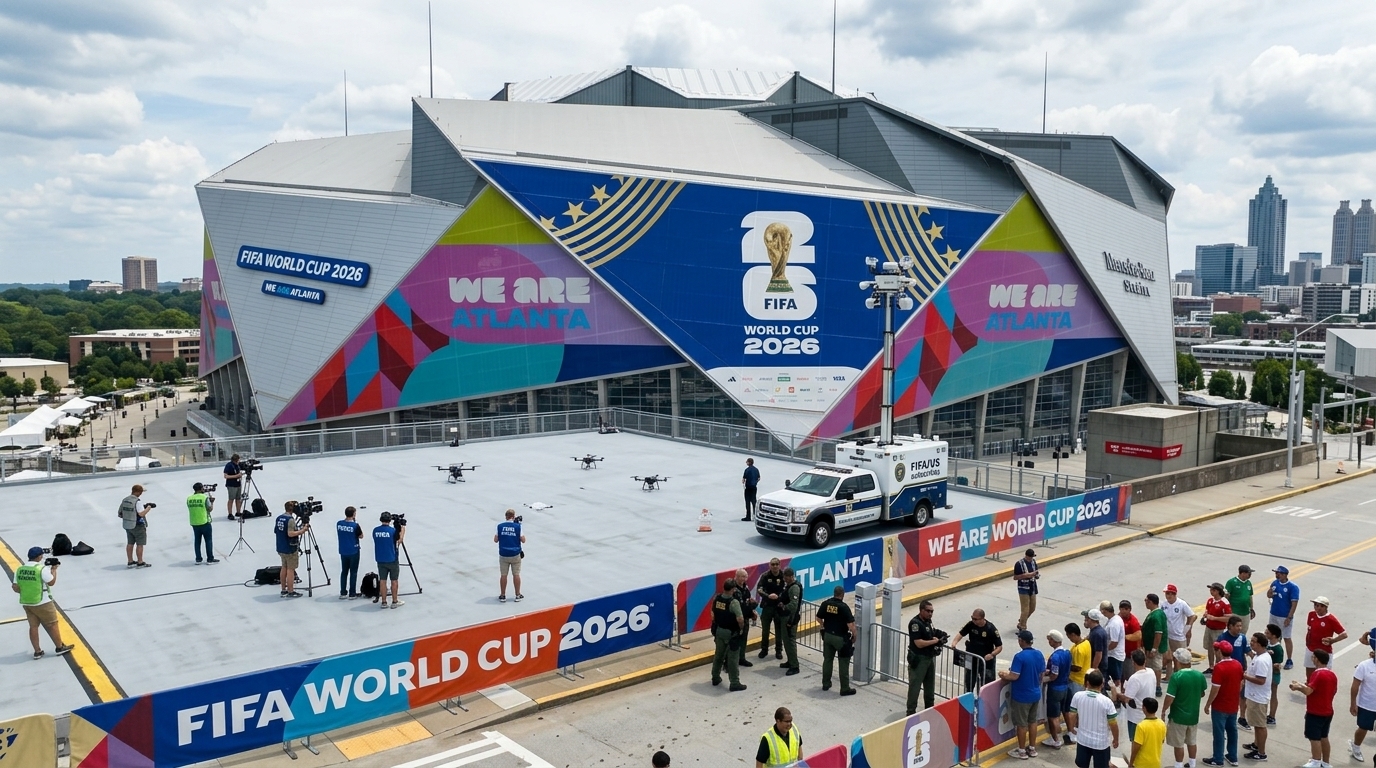
As the 2026 FIFA World Cup unfolds across the stadiums of North America, an invisible battle is being waged above the heads of millions of fans. The news that US authorities have already detected and intercepted over 1,100 unauthorized drones in the vicinity of tournament venues is not merely a statistical footnote; it is a stark confirmation of a new era in major event security. The 2026 World Cup, the first to be hosted across three nations with an expanded 48-team format, has effectively become a massive testing ground for Counter-UAS (Unmanned Aircraft Systems) technologies. The FBI and the Department of Homeland Security (DHS) are working tirelessly to ensure that the same technology providing breathtaking aerial views does not become a tool for disruption or terror.
The Digital Threat from Above
The proliferation of commercial drones in recent years has made airspace access easier than ever. For World Cup organizers, this represents a logistical and security nightmare. Not all of the 1,100+ drones detected were malicious; many belonged to hobbyist photographers, YouTubers, or casual fans seeking a unique perspective of the match. However, from a security standpoint, every unauthorized drone is a potential threat. The capability of a drone to carry explosives, chemical agents, or simply to cause mass panic by crashing into a crowded stand forces authorities to adopt a zero-tolerance policy.
According to security analysts, the challenge in the United States is particularly complex due to the legal landscape. While the technology to shoot down or electronically jam drones exists, its use is strictly limited to federal agencies to prevent interference with commercial aviation communications or emergency services. This necessitates a level of synchronization between local police departments and federal agents that is being tested to its limits in a tournament of this unprecedented scale.
Counter-UAS Technologies and AI Integration
To combat these incidents, the US has deployed a multi-layered defense shield involving high-definition radar, acoustic sensors, and radio frequency (RF) scanners capable of detecting a drone's signature from miles away. Artificial Intelligence plays a pivotal role here, as systems must instantaneously distinguish between a bird, an authorized broadcast drone, and an intruder. Once an intruder is identified, authorities typically employ 'soft-kill' techniques, such as hijacking the drone’s control frequency to force a safe landing or a 'return to home' maneuver, where an arrest team is often waiting.
- Implementation of Aeroscope systems to track operator locations in real-time.
- Deployment of 'geofencing' around stadiums, which triggers software locks in most commercial drones to prevent entry.
- Mobile electronic warfare units patrolling the perimeters of key athletic facilities.
However, experts warn that 'lone wolf' actors or organized groups could utilize drones that do not rely on RF signals but on pre-programmed GPS navigation, making them significantly harder to detect and neutralize through traditional jamming methods.
The Balance Between Security and Privacy
The intense surveillance of the skies also raises profound questions regarding privacy and civil liberties. Critics argue that the systems used to track drones could potentially be repurposed for mass surveillance of fans' mobile devices. The integration of facial recognition technology with security drones hovering over crowds creates a 'Big Brother' atmosphere that some feel is an overreach for a sporting event.
"World Cup security is no longer just about what happens at the turnstiles; it’s about what is happening two miles above the pitch," says a high-ranking FIFA security official.
In conclusion, the 1,100 drones detected in the US are just the tip of the iceberg. As the tournament moves toward the final matches, the pressure on authorities will only intensify. The 2026 World Cup will be remembered not just for the goals and the drama on the field, but as the moment when global society realized that public safety has permanently moved into a three-dimensional plane, where controlling the skies is just as vital as controlling the gates.