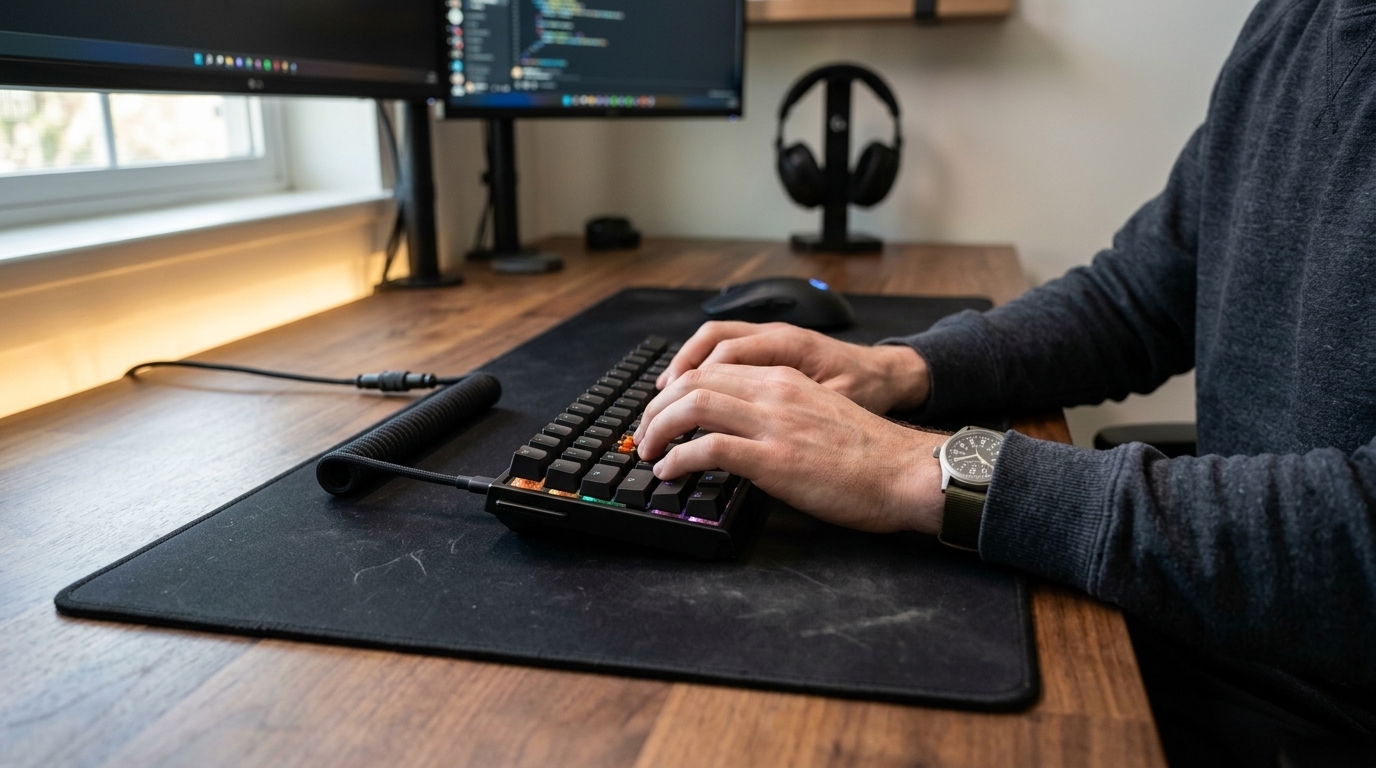
In the high-stakes world of computer peripherals, it is rare for a small company to disrupt the hegemony of industry giants. Wooting, a Dutch-based firm, achieved exactly that a few years ago with the 60HE, introducing Hall Effect technology to the mainstream gaming audience. Today, with the release of the 60HE v2, the company isn't just trying to hold its ground; it is perfecting a formula that many have tried to copy, but few have managed to emulate.
The Hall Effect Revolution
The essence of the Wooting 60HE v2 lies beneath its keycaps. Instead of traditional mechanical switches that rely on physical metal contact, the 60HE utilizes Lekker switches powered by magnets. This allows the keyboard to know exactly how far a key has been pressed throughout its entire 4mm travel distance. This precision isn't just a technical spec; it's a structural shift in how we interact with software.
The standout feature here is Rapid Trigger. Unlike traditional keyboards where a key must travel back up past a fixed reset point to deactivate, the Wooting deactivates the moment your finger begins to lift—even by as little as 0.1mm. For players of games like Valorant or Counter-Strike, where stopping character movement instantly is vital for shooting accuracy, this technology provides an advantage that feels almost like a 'cheat code' while remaining entirely within the rules of fair play.
The v2 Upgrade: Refining the Details
While the original 60HE was technologically superior, some keyboard enthusiasts critiqued its build quality and acoustic profile. The v2 version addresses these criticisms with surgical precision. The addition of screw-in stabilizers and an improved internal structure featuring a gasket mount system provides a much more solid and 'premium' typing experience.
The sound, which in the first iteration could be described as 'hollow' or 'pingy,' is now fuller and more satisfying. Furthermore, compatibility with third-party cases has been enhanced, allowing users to swap the Wooting internals into luxury aluminum or polycarbonate chassis. Wooting seems to understand that a keyboard is not just a performance tool, but also an object of personal aesthetic expression.
Wootility: A Masterclass in Software
Perhaps the most underrated element of Wooting’s success is Wootility. In an era where major manufacturers (Razer, Logitech, SteelSeries) force users to install bloated software suites that require registration and consume system resources, Wootility runs directly from a web browser. It is lightweight, largely open-source, and incredibly intuitive.
Through this interface, users can set the actuation point for every single key individually, create macros based on press depth (Mod-tap), or even simulate analog controller stick movement. The ability to have a keyboard that behaves like a gamepad in racing or flight sims, without switching devices, remains one of the most impressive features of the lineup.
The Future and the Competition
With the arrival of the 60HE v2, Wooting faces stiff competition. Razer’s Huntsman V3 Pro and SteelSeries’ Apex Pro have integrated similar magnetic technologies. However, Wooting maintains its lead through community dedication and the purity of its vision. They don't add unnecessary bells and whistles; they focus on absolute responsiveness and long-term durability.
The question remains: Is the investment worth it for someone who isn't a professional gamer? The answer lies in the feel. Using a Hall Effect keyboard is akin to moving from a 60Hz monitor to a 144Hz one. Once you grow accustomed to the immediacy and smoothness of the input, returning to traditional mechanical switches feels like a regression. The 60HE v2 isn't just a gaming accessory; it is the evolution of the human-machine interface, offering an experience that is as functional as it is delightful.