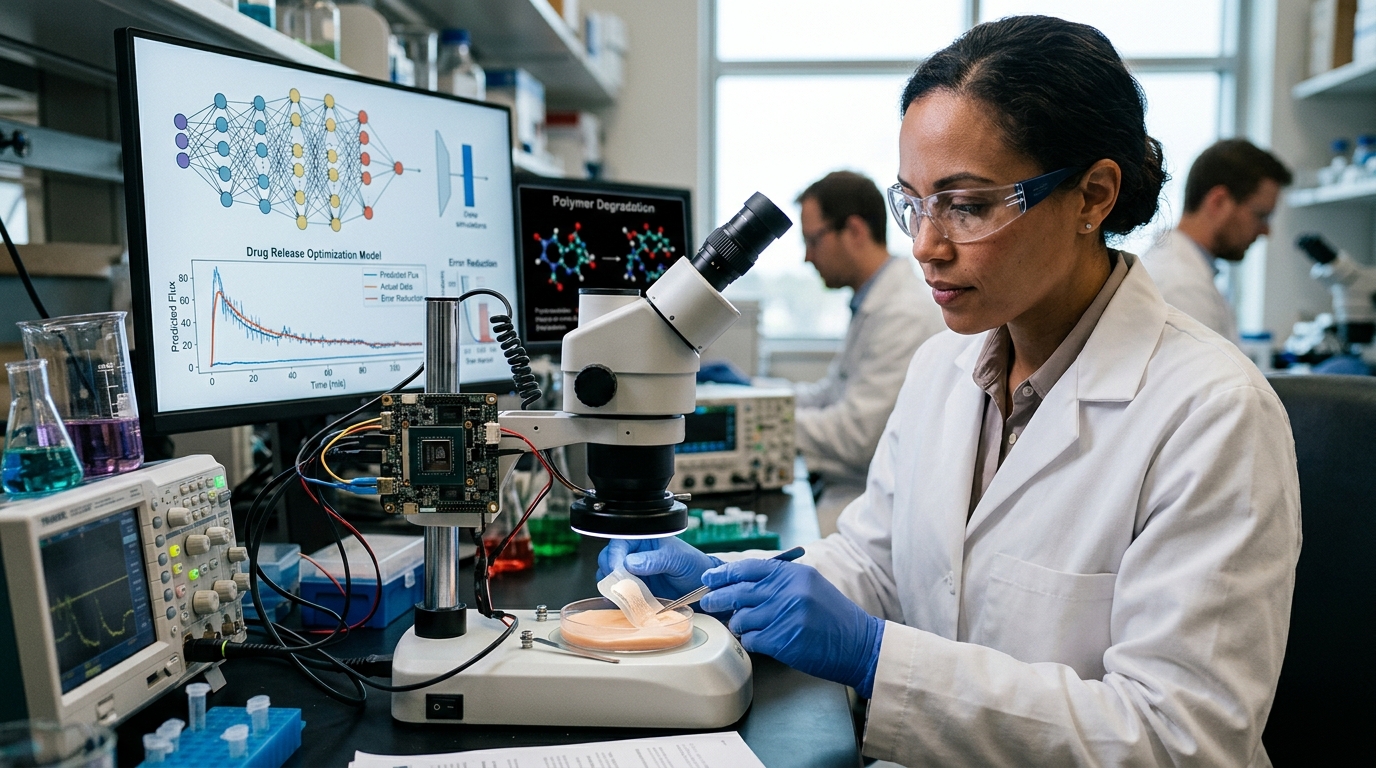
Modern medicine stands at the precipice of a revolution where traditional pharmacology meets computational intelligence. Recent research from Brown University highlights how Physics-Informed Artificial Intelligence (Physics-Informed Neural Networks or PINNs) can dramatically accelerate the design and development of controlled-release drug patches and bandages. This advancement promises not only faster access to new therapies but also unprecedented precision in personalized care.
The Challenge of Controlled Release
For decades, the primary challenge in transdermal drug delivery—administering medication through patches—has been maintaining a steady, therapeutic dose in the bloodstream over an extended period. This process relies on diffusion: the physical movement of drug molecules from a polymer matrix into the skin. However, determining the optimal combination of materials, drug concentration, and release rates has traditionally required countless hours of laboratory experimentation, a process often characterized by tedious trial and error.
The hydrogels and biocompatible polymers used in these patches behave according to strict physical laws, such as Fick’s laws of diffusion. Nevertheless, the complexity of the interaction between the drug and human tissue often makes simple mathematical predictions insufficient. This is exactly where Brown University’s new approach steps in, bridging the gap between theoretical physics and biological reality.
What are Physics-Informed Neural Networks (PINNs)?
Unlike traditional AI, which often operates as a 'black box'—processing vast amounts of data without understanding the underlying rules of the physical world—PINNs integrate the laws of physics directly into their algorithms. This means the model does not just learn from statistical patterns; it is constrained by equations governing fluid dynamics, thermodynamics, and mass transfer.
In the Brown University study, scientists trained neural networks to predict how drugs migrate through complex polymer lattices. "We aren't just feeding data into the system; we are giving it the universe's rulebook," the researchers explain. This allows the AI to simulate thousands of scenarios in seconds, discarding designs that are physically impossible and focusing exclusively on the most promising chemical formulations.
From Laboratory Bench to Clinical Practice
The applications of this technology are vast and transformative. Imagine a smart bandage for diabetic patients that releases insulin or growth factors only when it detects specific changes in the wound's pH levels. Or a transdermal patch for chronic pain management that adjusts its dosage based on the patient’s circadian rhythm.
- R&D Acceleration: Reducing development cycles from years to months translates to lower costs for pharmaceutical companies and faster relief for patients.
- Dosing Precision: The ability to predict exact drug concentrations minimizes the risk of side effects from overdosing or treatment failure from underdosing.
- Personalized Materials: AI can design patches tailored to the skin type, age, or metabolism of specific patient demographics.
"The use of PINNs transforms the drug delivery design process from an empirical art into an exact engineering science," the research team notes.
The Future of Computational Pharmacology
The Brown University study is more than an academic exercise; it represents a fundamental shift in biomedical engineering. As computational models become more sophisticated, the necessity for extensive animal testing may decrease, while the safety of human clinical trials will increase. Researchers will have already 'run' millions of digital trials before a single physical prototype is even manufactured.
However, significant hurdles remain. Integrating these AI models into regulatory frameworks (such as the FDA or EMA) requires ensuring that AI predictions are entirely reliable and transparent. The 'physical grounding' of PINNs assists in this regard, as it provides a logical, physics-based explanation for why the model suggests a specific solution—something traditional deep learning often struggles to provide.
In conclusion, the convergence of physics and artificial intelligence at Brown University paves the way for a new generation of 'smart' medical devices. These tools will no longer be passive drug carriers but active systems that understand the body's biology and respond with mathematical precision. We are moving toward a future where the bandage on your arm is as intelligent as the computer in your pocket.