

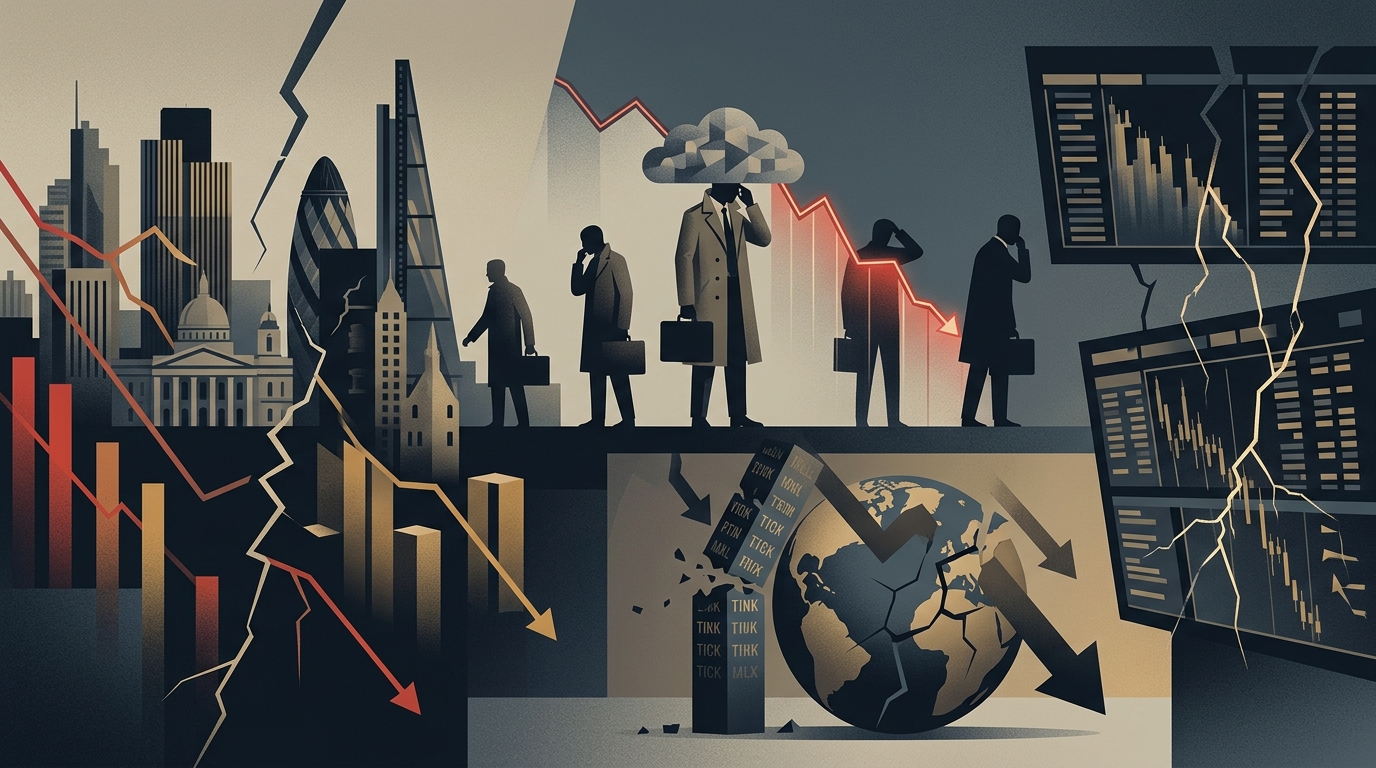
As we navigate through the summer of 2026, the euphoria that characterized the first three years of the Artificial Intelligence (AI) revolution appears to be hitting a hard wall of economic data. Torsten Slok, Chief Economist at Apollo Global Management, has issued a stern warning echoing through the corridors of Wall Street and international financial hubs: AI, despite its grand promises, has yet to deliver the expected productivity gains, making a 'painful repricing' of markets not just possible, but nearly inevitable.
The Productivity Paradox and the Shadow of 1987
Slok’s core thesis rests on a troubling observation: while capital expenditures (Capex) by tech giants have skyrocketed to unprecedented levels, macroeconomic productivity indicators remain stubbornly stagnant. This brings to mind the famous 'Solow Paradox' of 1987, when Nobel laureate economist Robert Solow famously remarked, 'You can see the computer age everywhere but in the productivity statistics.'
Today, history seems to be repeating itself. Companies are investing billions in GPUs, data centers, and Large Language Models (LLMs), hoping for a structural shift in production methods. However, Slok points out that labor productivity in the US and Europe has not shown the explosive growth that would justify current stock valuations. If AI does not soon begin to produce measurable results in business efficiency, investors will be forced to re-evaluate the worth of the companies that led the rally of recent years.
The Hype Bubble and the Risk of Repricing
The problem, according to Apollo’s analysis, lies in the gap between expectations and reality. Markets have priced in a 'soft landing' scenario where AI would serve as the magic wand to combat inflation by increasing supply and reducing labor costs. However, when corporate balance sheets start showing that the cost of maintaining and training these systems exceeds the benefits, market sentiment could flip violently.
Slok emphasizes that the top ten companies in the S&P 500 represent a disproportionately large share of total capitalization. This concentration means that if confidence in the 'AI narrative' falters, the fallout will not be limited to the tech sector but will drag down the entire global financial system. The 'painful repricing' he refers to involves adjusting price-to-earnings (P/E) ratios to levels that reflect real, rather than imaginary, growth.
Structural Barriers to Technology Adoption
Why is AI taking so long to deliver? Apollo's analysis points to several factors. First, the integration of AI into traditional sectors such as manufacturing, healthcare, and public administration is proving much slower than in digital services. Legacy systems, regulatory hurdles, and the need for workforce retraining create significant friction.
Second, there is the issue of energy costs. Running AI models requires vast amounts of energy, the cost of which is rising, thereby squeezing profit margins. Slok argues that many investors ignored the operational costs of AI, focusing solely on revenue prospects. Finally, data quality remains a critical bottleneck. Without clean and structured data, AI produces 'noise' rather than value, delaying the achievement of the much-coveted productivity gains.
Conclusion: A Moment of Truth for the Global Economy
Torsten Slok’s warning is not a condemnation of technology, but a call for realism. The history of technological revolutions—from steam to the internet—teaches us that there is always a time lag between invention and economic fruition. The question for 2026 is whether markets have the patience to wait for this transition or if the hype bubble will burst before AI can become the engine of growth. For investors, the message is clear: the era of blind faith in AI is ending, and the era of proof has just begun.





