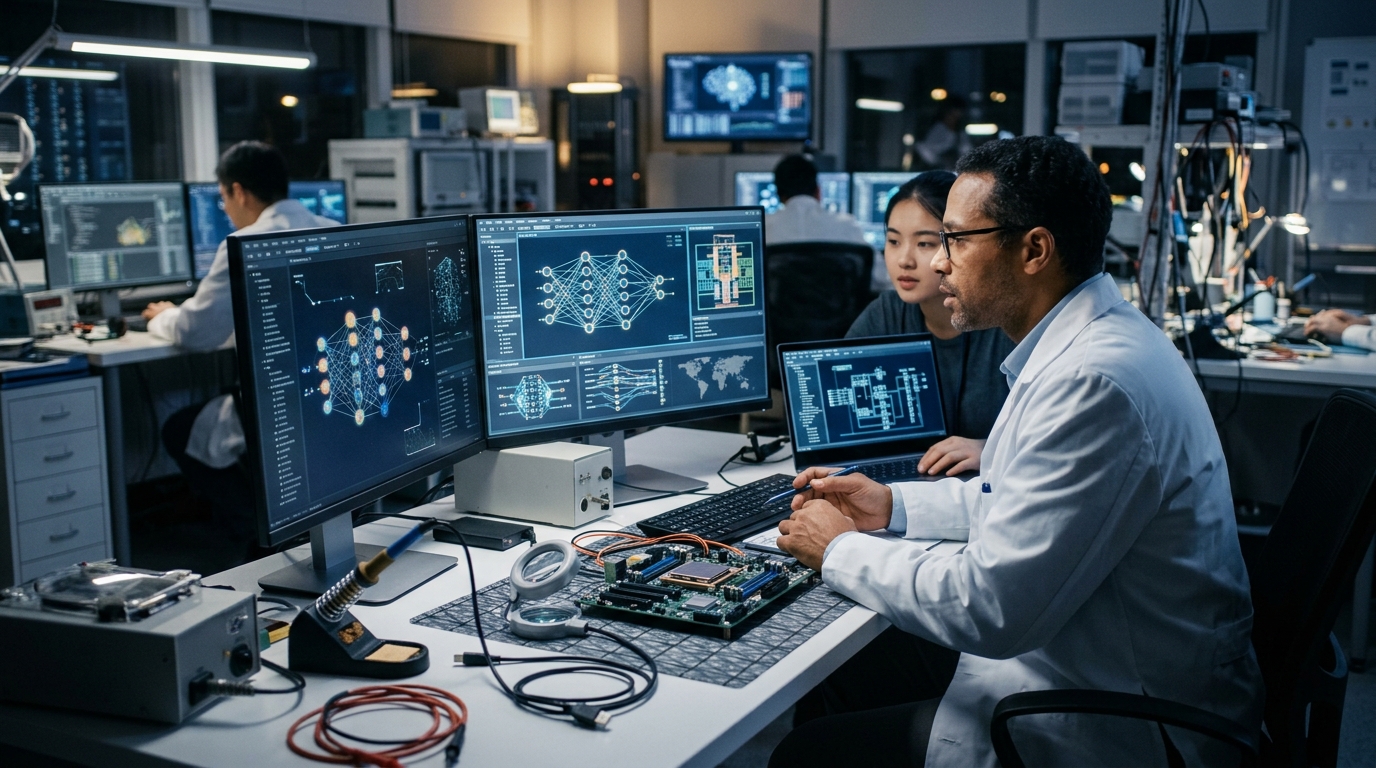
The global semiconductor industry, the bedrock of modern technological prowess, is on the precipice of a structural metamorphosis. For decades, creating a custom silicon chip was a privilege reserved for titans with billions in liquidity and armies of specialized engineers. Today, June 18, 2026, the emergence of a new startup from stealth mode marks the beginning of what analysts are calling the 'Designless Semiconductor Industry.' Leveraging advanced Artificial Intelligence models, this firm promises to make chip design as simple as writing high-level code, disrupting the long-standing dominance of traditional Electronic Design Automation (EDA) tools.
The Transition from Fabless to Designless
Until now, the dominant model has been 'Fabless.' Companies like NVIDIA and Apple design their own chips but outsource manufacturing to external foundries like TSMC. However, the design phase remains the most expensive and time-consuming part of the equation. The journey from initial concept to the final GDSII file (the 'blueprint' sent to the fab) requires hundreds of engineers, thousands of simulation hours, and millions of dollars in software licensing. The new AI-driven approach aims to eliminate this complexity entirely.
The 'Designless' model does not imply a lack of design, but rather that the design process is automated to such a degree that human intervention is limited to defining specifications and performance targets. AI handles transistor layout, power consumption optimization, and thermal management—processes that traditionally required months of trial and error. This enables smaller industrial equipment firms, automotive manufacturers, and med-tech startups to create their own specialized chips, tailored exactly to their needs, without requiring massive internal VLSI (Very Large Scale Integration) departments.
Artificial Intelligence as the Architect
The technological heart of this revolution lies in the use of Generative AI and Reinforcement Learning to solve physical design problems. Placing billions of transistors on a surface of a few square millimeters is a combinatorial optimization problem that exceeds human capacity. The new tools unveiled today can explore millions of potential layouts in a few hours, achieving performance metrics that often surpass those of top-tier human engineers.
- Cost Reduction: Designing a chip at 5nm or 3nm nodes can exceed $500 million. AI promises to reduce this figure by an order of magnitude.
- Time-to-Market: The development cycle is slashed from 18-24 months to just a few weeks.
- Specialization: Instead of general-purpose processors, companies can create chips optimized for specific AI algorithms or industrial automation tasks.
However, the challenge of verification remains the 'holy grail.' A single design flaw in a chip can cost millions in wasted production runs. The new startup claims its AI doesn't just design; it 'understands' the rules of physics and electronics, drastically reducing the probability of errors that would necessitate a costly 'respin' of the silicon.
Geopolitics and Sovereignty in the Silicon Age
The democratization of chip design has profound geopolitical implications. In a world where the US, China, and the EU compete for technological sovereignty, a nation's ability to produce its own chips without relying on a handful of EDA software companies (mostly US-based) is of strategic importance. If design becomes accessible via AI, the center of gravity shifts from possessing specialized design expertise to possessing manufacturing capacity.
"This is not just a new technology; it is the liberation of innovation from the shackles of capital. When every engineer can design a chip, the speed of human progress will accelerate exponentially," the company's statement reads.
In the future, we may see a marketplace where companies 'download' chip architectures, customize them through AI, and send them to local, smaller foundries (micro-fabs), creating a decentralized supply chain. This could be the ultimate solution to the shortages that plagued the global economy in recent years, offering resilience and unprecedented flexibility to the industrial sector.