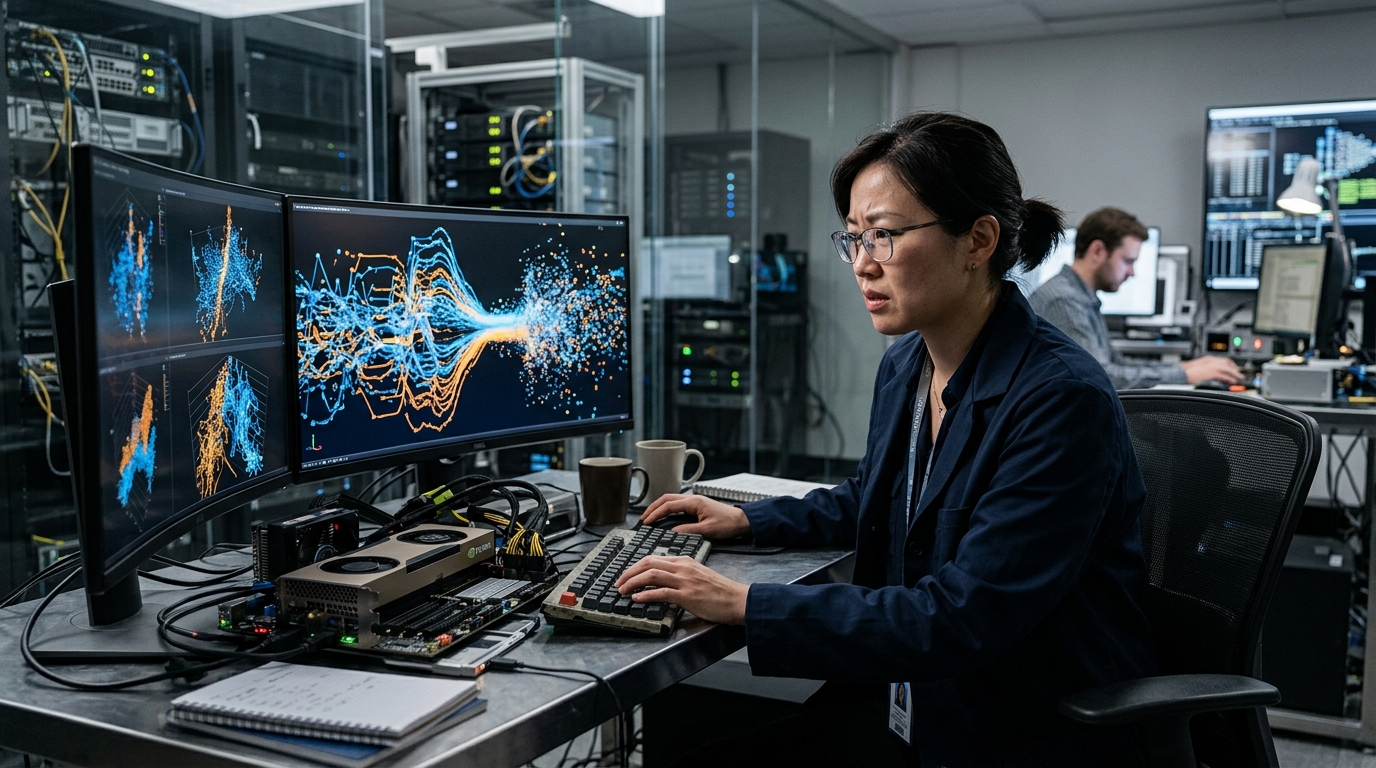
The era of unbridled optimism regarding Artificial Intelligence seems to be hitting an unexpected wall: the very nature of digital "attention." While tech giants like OpenAI, Google, and Anthropic compete over who can offer the largest "context window," a series of new research studies are revealing a disturbing phenomenon. Leading AI models, despite their immense computational power, are showing serious symptoms of "attention deficit" when tasked with managing vast amounts of information.
The 'Lost in the Middle' Phenomenon
The central finding of recent analyses, which has sent shockwaves through the global tech community, focuses on the so-called "Lost in the Middle" phenomenon. Researchers have discovered that the performance of AI models drops dramatically when the critical information they need to process is located in the middle of a long text, rather than at the beginning or the end. This weakness suggests that the Transformer architecture, which serves as the backbone of modern AI, has inherent limitations in how it prioritizes data significance.
In practice, this means a lawyer feeding a model a 500-page case file or an analyst inputting an annual financial report risks receiving answers that ignore fundamental elements buried in the middle pages. The "shock" lies not just in the retrieval failure, but in the fact that models often answer with unwavering confidence, producing hallucinations that appear perfectly logical.
The Illusion of Massive Context Windows
In recent months, we have seen context window sizes skyrocket from 32,000 tokens to 128,000, and even 1,000,000 or 2,000,000 tokens in models like Gemini 1.5 Pro. However, quantity does not translate to quality. The study reveals that as the window grows, "attention density" dilutes. It is akin to asking a human to read an entire book in ten minutes and then asking a specific question about a footnote on page 245.
- Cognitive Overload: Models struggle to maintain reasoning consistency when parameters increase exponentially.
- Noise vs. Signal: As more data is introduced, "noise" increases, making it harder for the algorithm to identify the "signal."
- Cost and Efficiency: Processing massive windows requires disproportionately large computational resources without always offering a corresponding benefit in accuracy.
"A model's ability to 'read' a million words is useless if it cannot remember the most important one when needed," the study notes.
Implications for Business and Science
For the banking sector and investment firms, where detail is everything, these findings serve as a warning signal. Relying on AI for drafting complex contracts or risk analysis must be accompanied by rigorous oversight mechanisms. It is no longer enough to ask the AI "what does this document say"; we must know how to structure the prompt to direct its attention to the right places.
Furthermore, the research highlights the need for a return to RAG (Retrieval-Augmented Generation) techniques. Instead of "stuffing" the model with all the information, it is preferable to use external databases that feed the AI only the relevant snippets. This hybrid approach seems to be the only solution to the "attention deficit" problem of large models.
The Future: From Quantity to Quality
The challenge for 2026 and beyond will not be creating even larger models, but developing architectures that possess "selective attention." Biological intelligence works with filters; we do not process every stimulus with the same intensity. Artificial Intelligence must learn to do the same. This study is a milestone that forces developers to rethink the foundations of machine learning, shifting focus from raw computational power to the fine art of cognitive prioritization.