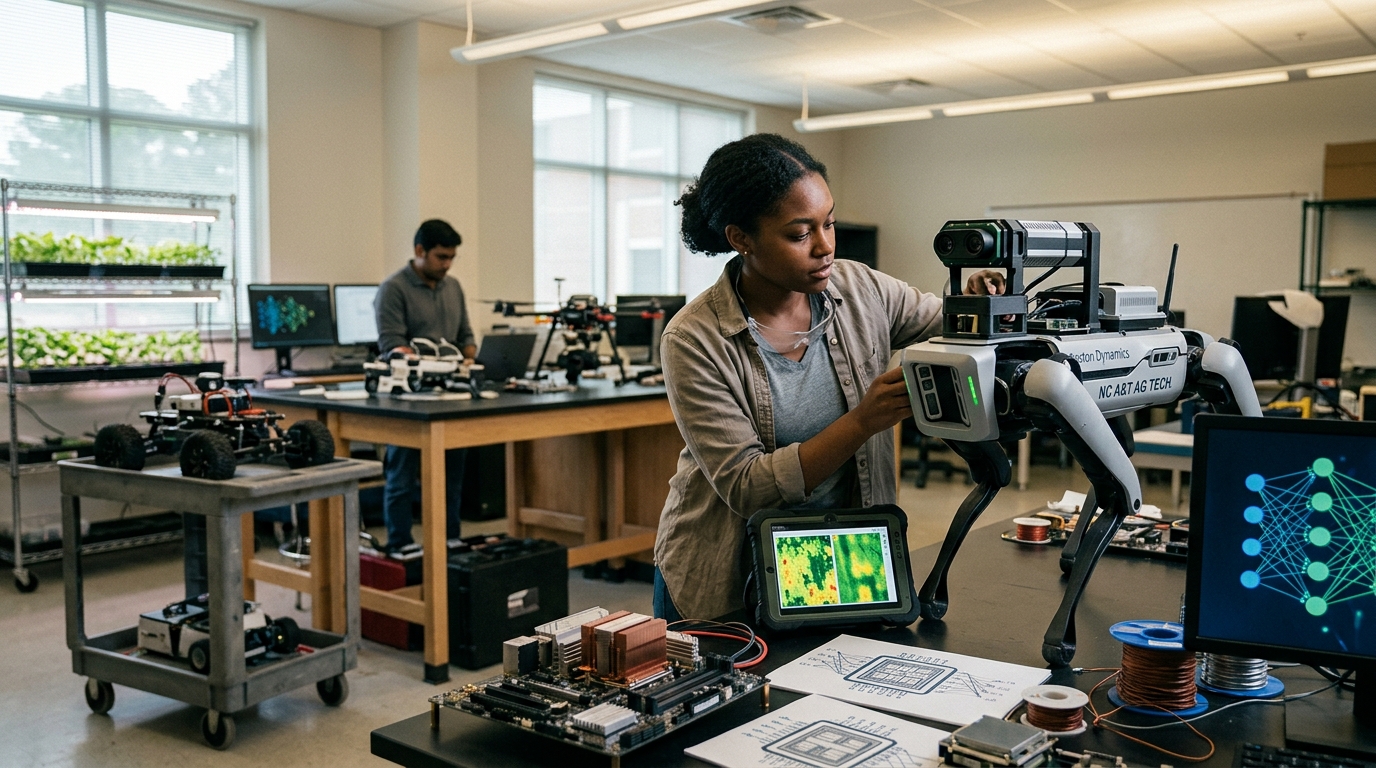
In the sprawling experimental fields of North Carolina Agricultural and Technical State University (NC A&T), a familiar yet eerie silhouette moves between rows of crops. This is no living creature, but a quadruped robot, bristling with state-of-the-art sensors, promising to fundamentally change how we understand and manage our food supply. The deployment of so-called 'robot dogs' in agriculture is not merely a display of technological prowess; it is a necessary response to the challenges of climate change, labor shortages, and the urgent need for sustainable production.
The Technology Behind the Mechanical Gaze
The research program at NC A&T focuses on integrating Artificial Intelligence (AI) and machine learning into quadrupedal mobility platforms. Unlike traditional drones, which offer a panoramic but often superficial bird's-eye view, ground robots can navigate beneath the plant canopy. This allows them to examine the stems, the underside of leaves, and soil quality with unprecedented detail.
Equipped with LiDAR cameras for 3D spatial mapping and multispectral sensors, these robots can 'see' things the human eye cannot. They can identify early signs of water stress, nutrient deficiencies, or the presence of pests before they even become visible to the farmer. Data processing often happens 'on the edge'—directly on the robot—allowing for real-time decision-making in the field.
- Autonomy: The robots can follow pre-set paths or navigate autonomously while avoiding obstacles.
- Precision: The ability to take samples and images from the exact same angle every day allows for precise time-series data on plant growth.
- Versatility: Quadrupeds can traverse muddy or uneven terrain where wheeled robots would likely get stuck.
Precision Agriculture and Sustainability
The significance of this research lies in the shift toward 'Precision Agriculture.' Currently, most farmers apply fertilizers and pesticides uniformly across an entire field. This is not only expensive but also places a significant burden on the environment and groundwater. With the help of robot dogs, intervention can occur at the level of an individual plant.
"The ability to know exactly which plant needs help and when is the 'holy grail' of modern agronomy," the researchers note.
Furthermore, the research at NC A&T, a historically Black university (HBCU) with a deep tradition in agricultural sciences, carries a unique social impact. It aims to make these technologies accessible to smaller-scale producers who are often left behind in the technological race dominated by agribusiness giants.
Challenges and the Future of the Digital Farm
Despite the impressive capabilities, the path to full adoption is not without hurdles. The cost of these machines remains high, although it is gradually decreasing. There are also issues regarding battery life and the need for robust software that can withstand harsh field conditions—dust, moisture, and extreme temperatures.
However, the vision is clear: a digital farm where ground robots, drones, and satellites collaborate in a unified data ecosystem. In this future, the farmer is no longer a manual laborer fighting the odds but a data manager and strategic analyst, with an army of 'mechanical assistants' monitoring the health of the harvest. The work at NC A&T shows us that this future is not just science fiction but a reality already walking the fields of North Carolina.