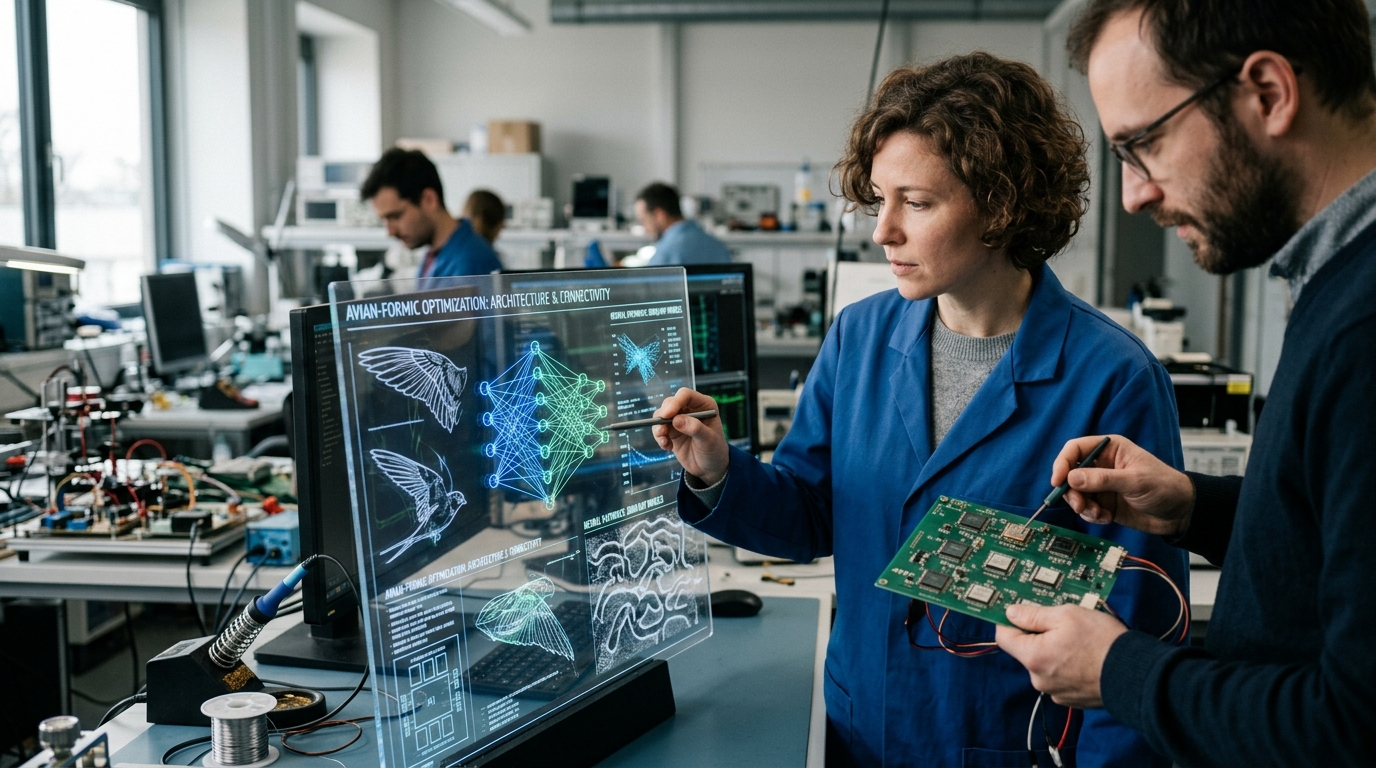
In the relentless pursuit of perfecting Artificial Intelligence, scientists are increasingly looking toward the most sophisticated laboratory the planet has ever known: nature itself. Groundbreaking research from Missouri University of Science and Technology (Missouri S&T) is bringing a fresh perspective to the field, blending lessons from the behavior of ants and birds to tackle some of the most complex challenges in modern computing.
The Convergence of Biological Systems
The core concept behind this research, led by distinguished scholars such as Dr. Sajal Das, is "Swarm Intelligence." While traditional AI often relies on massive brute-force computational power, bio-inspired AI seeks efficiency through decentralized cooperation. Ants are masters of exploitation, using pheromone trails to carve out the shortest paths to food sources with surgical precision. In contrast, birds within a flock excel at exploration, rapidly shifting their collective trajectory to discover new territories or evade predators.
Combining these two distinct strategies addresses one of the most persistent hurdles in algorithmic development: the problem of "local optima." Many AI algorithms find a reasonably good solution and settle there, failing to realize that a vastly superior solution might exist just beyond their current search parameters. By integrating the exploratory nature of avian swarms with the methodical optimization of ant colonies, the new Missouri S&T model allows systems to maintain a global perspective while fine-tuning local results.
From the Lab to the Global Economy
The applications for this hybrid approach are vast and immediate. In the logistics sector, managing a fleet of thousands of delivery vehicles requires constant recalibration based on traffic patterns, weather conditions, and real-time order influxes. An algorithm mimicking bird flock dynamics can reroute an entire fleet instantaneously, while ant-colony logic ensures that each individual path remains energy-efficient. This synergy reduces overhead costs and carbon footprints simultaneously.
Furthermore, in the realm of cybersecurity, the ability to detect anomalies across massive data networks is being transformed. "Digital ants" can patrol specific segments of code, leaving markers when they encounter suspicious activity, while the "bird's-eye view" of the swarm allows the system to recognize coordinated, multi-vector attacks that span the entire network. This dual-layered defense offers a security posture that is both granular and holistic, adapting as threats evolve.
The Imperative of Energy Efficiency
Another critical dimension of this research is the reduction of AI's environmental impact. Today’s Large Language Models (LLMs) require staggering amounts of electricity to train and maintain. Nature, however, solved the problem of low-resource information processing eons ago. An individual ant consumes negligible energy, yet the colony as a whole solves optimization problems that would tax a supercomputer. Translating this "efficiency-per-unit" into chip architecture and software design is a primary objective for the Missouri-based team.
The Future of Collaborative Intelligence
As we move deeper into 2026 and toward 2027, the paradigm in AI is shifting from "bigger is better" to "smarter and more agile." The work at Missouri S&T highlights that intelligence is not necessarily the product of a massive central processor, but can emerge from the simple interactions of many smaller, autonomous units. This paves the way for drone swarms in search-and-rescue missions, smart energy grids that self-regulate with organic fluidity, and an AI that functions less like a rigid tool and more like an evolving organism.
In an increasingly complex world, returning to the fundamentals of biology may be our most viable path forward. The researchers at Missouri S&T are not merely copying nature; they are decoding its ancient wisdom to build a future where technology and biology speak the same language: the language of survival, efficiency, and collective excellence.