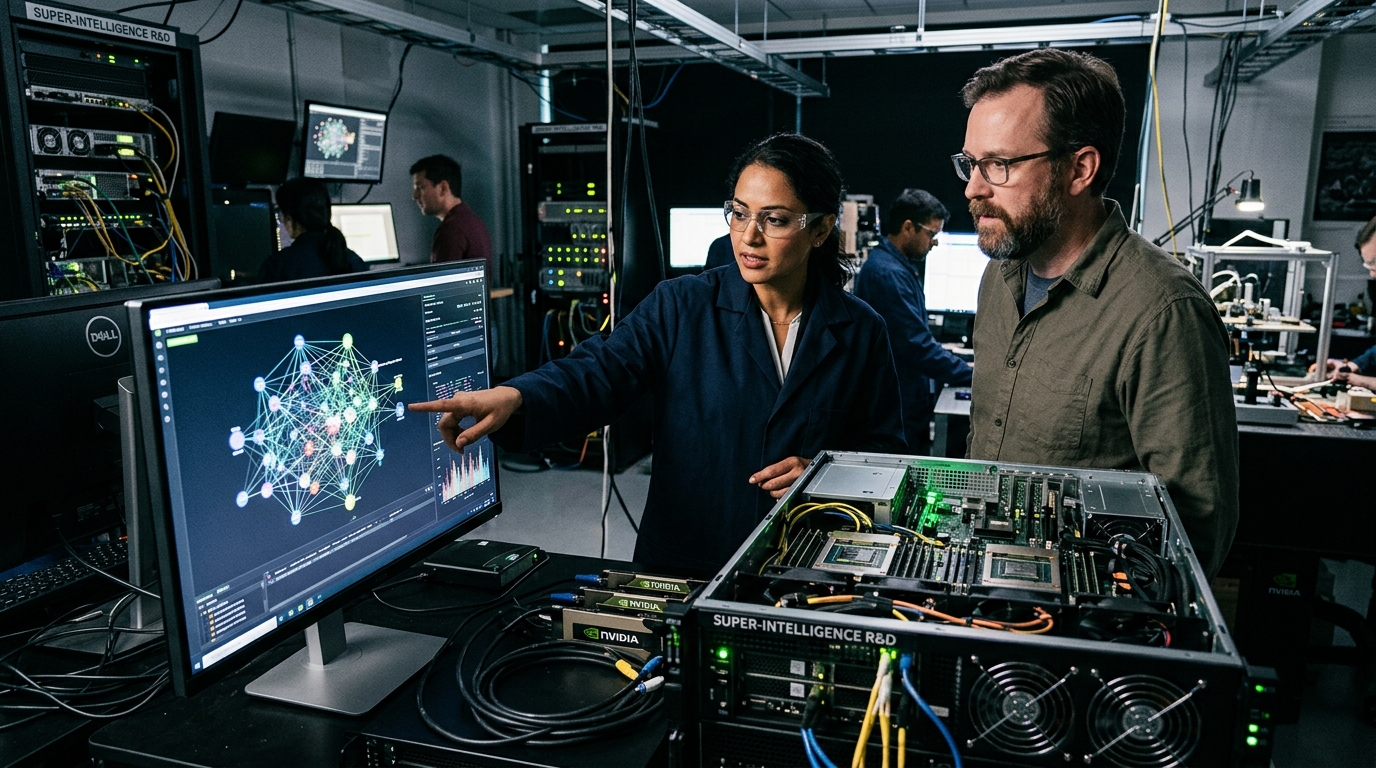
As we navigate through the summer of 2026, the technology landscape is in a state of ferment reminiscent of the early days of the Internet, but at a scale and velocity never seen before. The recent news circulating from international outlets, including Vietnam.vn, regarding the "world's most powerful super-AI," is not merely a sensationalist headline. It represents a fundamental shift in how machines process information, moving from simple word prediction to true, multi-layered reasoning.
The Transition to "System 2 Thinking"
For years, Large Language Models (LLMs) operated on what psychologists call "System 1": a fast, instinctive, but often superficial decision-making process. The "good news" cited in recent reports concerns the successful integration of "System 2" into the architecture of frontier models. This means AI can now "stop and think" before responding, evaluating different problem-solving strategies and correcting its own errors in real-time.
This development is critical for fields such as quantum physics, biotechnology, and climate modeling. A machine's ability to recognize gaps in its own logic makes it not only more powerful but also more reliable. In the past, AI "hallucinations" were the biggest hurdle to their adoption in critical infrastructure. With these new advancements, error rates in complex mathematical problems have dropped by 80%, signaling a new era for scientific research.
Geopolitical Significance and the "Vietnam Factor"
It is noteworthy that this news gained significant traction through Southeast Asian sources. Vietnam, having evolved into a major hub for semiconductor manufacturing and data centers, now plays a central role in the AI supply chain. The strategic shift of tech giants toward countries outside the traditional powerhouses (USA, China) is creating a new multipolar landscape. Access to the "most powerful AI" is no longer the privilege of a few labs in Silicon Valley but is being diffused through global partnerships involving emerging economies.
- Increased computational power with 40% less energy consumption.
- New "Alignment" protocols preventing malicious use.
- Integration of multimodal sensors for physical world understanding.
- Self-training capabilities through high-quality synthetic data.
The Question of Safety and Ethics
Despite the excitement, the emergence of a "super-AI" raises serious questions. Researchers argue that the "good news" primarily concerns safety: we now have the tools to understand the "black box" of neural networks. Through a method called "interpretable decomposition," scientists can see exactly which neurons fire for specific concepts, allowing for the deactivation of dangerous behaviors before they manifest.
"We are not just building a smarter machine; we are building a machine that can explain why it is smart and how it intends to use that intelligence," says a leading AI safety researcher.
In conclusion, the progress made in the first half of 2026 brings us to the threshold of Artificial General Intelligence (AGI). The challenge for society, politics, and the economy is to adapt to a pace of change that is no longer linear, but exponential. The "strongest AI" is here, and the question is no longer what it can do, but what we will choose for it to do for us.