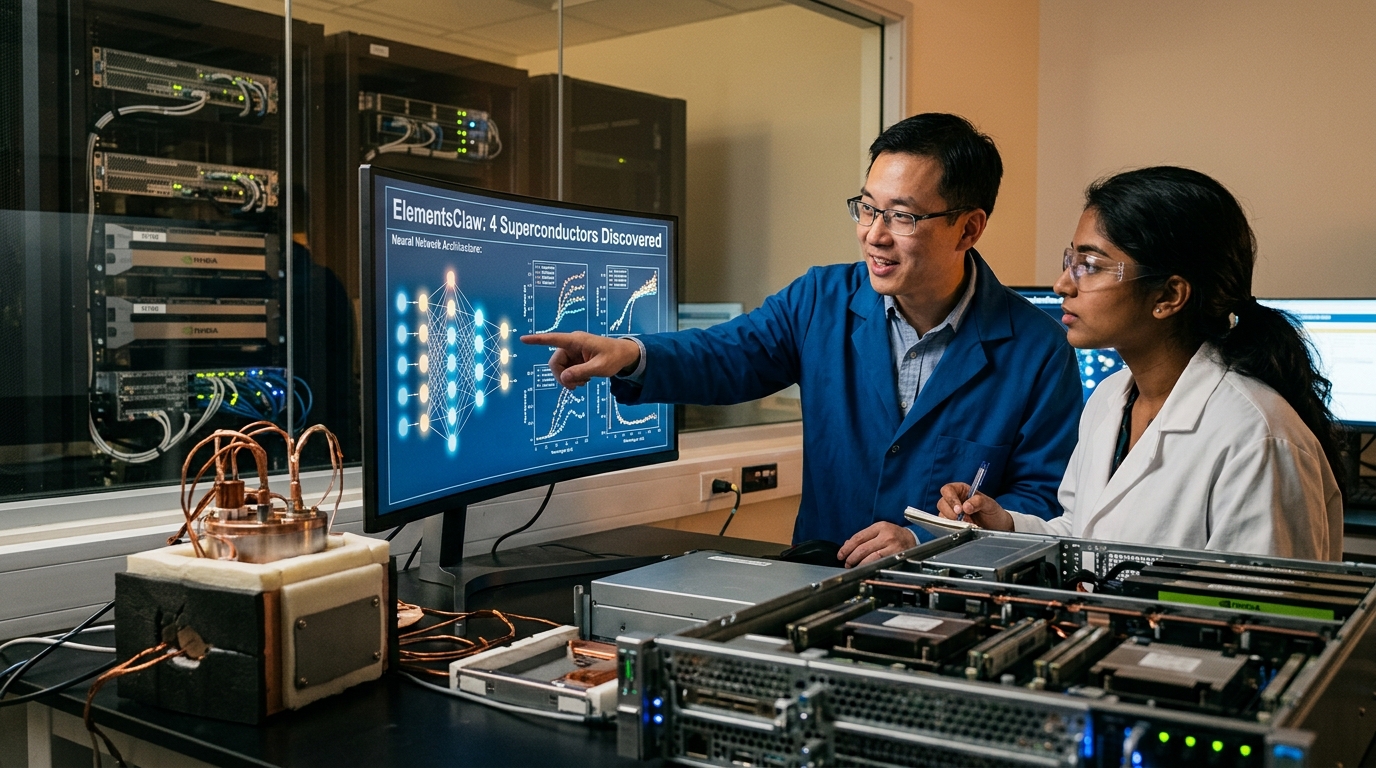
In an era where the global scientific community is desperately searching for the next great leap in materials technology, China appears to be taking the lead through artificial intelligence. Alibaba’s DAMO Academy, the research arm of the tech giant, recently announced a discovery that sounds like science fiction: ElementsClaw, a specialized AI agent, managed to identify four new superconductors in just 28 hours of GPU computing time.
Accelerating History: From Decades to Hours
The discovery of new superconductors—materials that can transmit electricity with zero resistance—is the "Holy Grail" of modern physics. Traditionally, this process relied on a trial-and-error method, with scientists spending years in laboratories synthesizing alloys and measuring their properties at extremely low temperatures. ElementsClaw completely shifts this paradigm.
According to the DAMO Academy report, the AI agent didn't just suggest theoretical structures. By using a hybrid model that combines Large Language Models (LLMs) with advanced quantum chemistry simulations and Density Functional Theory (DFT), the system was able to comb through millions of potential elemental combinations. The 28-hour timeframe is staggering, considering that discovering a single new superconductor in the past could have been the life's work of an entire research department.
How ElementsClaw Works
ElementsClaw is not a simple chatbot; it is an autonomous researcher. Its architecture allows it to read existing scientific literature, understand the laws of thermodynamics, and design experiments in a digital environment. The system utilizes a "self-correction" process, where the results of one simulation are fed back into the model to refine the next prediction.
- Crystal Analysis: The AI examines the stability of crystal lattices at an atomic level.
- Tc Prediction: It calculates the critical temperature (Tc) below which the material becomes superconductive.
- Synthesis Optimization: It suggests the exact elemental ratios for laboratory production.
"The use of AI in materials science (AI4S) is no longer a promise for the future, but a present reality reshaping our industrial capacity," stated DAMO Academy researchers.
Implications for the Global Economy and Technology
The significance of these four new superconductors extends far beyond the laboratory walls. Superconductors are essential for building more efficient power grids (where up to 10% of energy is currently lost to resistance), developing quantum computers, and creating magnetic levitation (Maglev) trains that travel at airplane speeds.
Furthermore, Alibaba’s success highlights China's dominance in the "AI for Science" sector. While the West often focuses on AI for content generation (Generative AI), China is systematically investing in using AI to solve fundamental problems in physics and chemistry. This creates a new field of geopolitical competition, where a nation's power will be measured by its ability to discover new molecules and materials in record time.
Challenges and the Next Step
Despite the excitement, the challenge remains laboratory verification. While ElementsClaw predicted the superconductors with high accuracy, their physical synthesis requires specialized equipment and time. However, DAMO Academy has already begun collaborating with universities to bring these materials into the real world. The next step is the search for room-temperature superconductors, which would change our civilization as we know it.