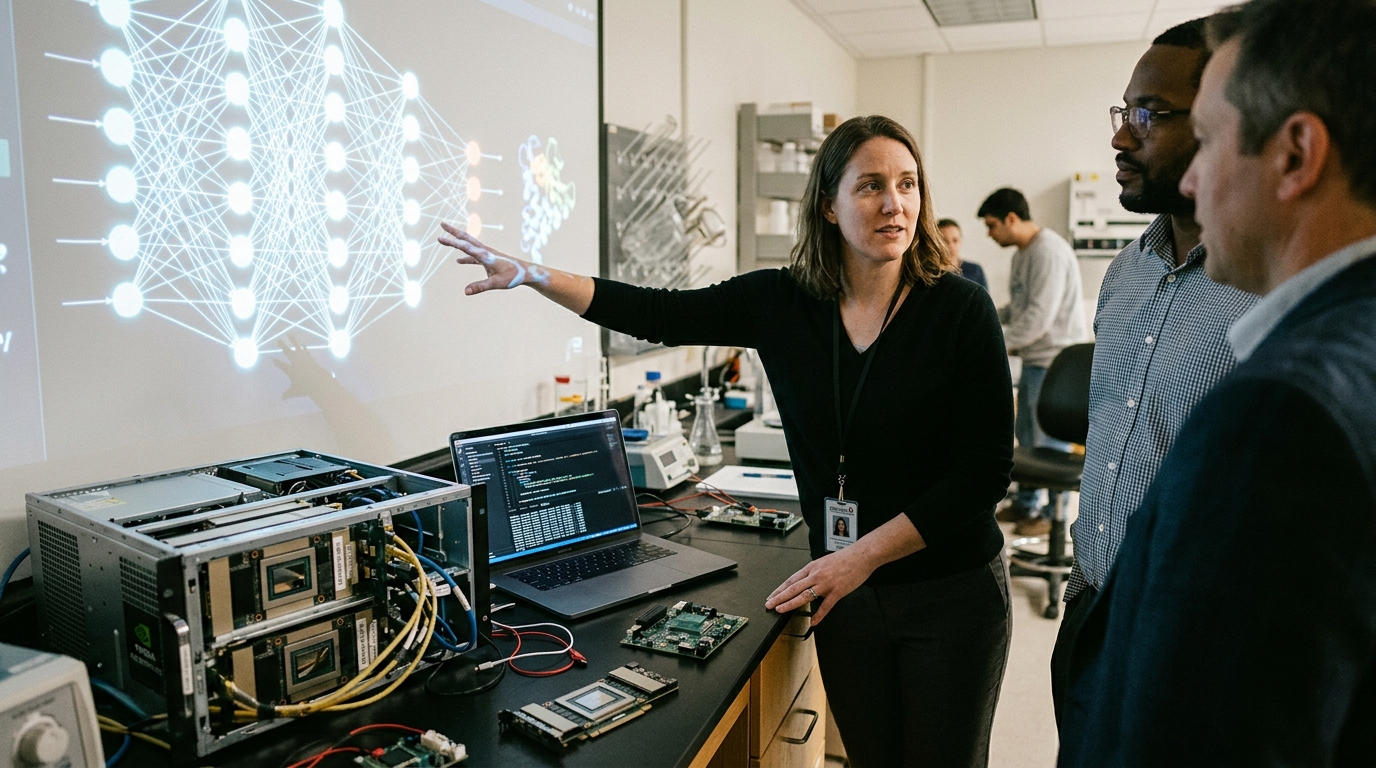
In the heart of Illinois, Argonne National Laboratory (ANL) is not merely a research hub but the epicenter of a technological revolution that promises to fundamentally reshape the landscape of human health. The recently unveiled "AI Roadshow" initiative highlights the role of Artificial Intelligence (AI) as an indispensable "ally" for scientists, transforming the process of medical research from a laborious search for needles in haystacks into a targeted, digitally-guided mission.
The Power of Aurora: The Heart of New Biology
The backbone of this effort is the Aurora supercomputer, one of the world's most powerful machines, capable of performing over an exaflop of calculations per second. During the AI Roadshow, Argonne researchers explained how this unimaginable computational power is being used to simulate biological systems at scales previously impossible. AI does not function merely as a data analysis tool, but as a creative partner that can predict how proteins fold or how drugs interact with cells at an atomic level.
The use of AI in structural biology allows scientists to bypass years of laboratory testing. Instead of physically testing thousands of chemical compounds, Argonne’s AI models can "sift" through billions of potential molecules, identifying those with the highest probability of treating diseases such as cancer or Alzheimer’s. This acceleration is not just quantitative; it is qualitative, enabling the exploration of chemical spaces that human intuition could never fathom.
From Data to Clinical Practice: Personalized Medicine
One of the central pillars of the AI Roadshow is the shift toward personalized medicine. AI has the ability to analyze massive datasets from genomic sequences, medical records, and biosensors, creating a "digital twin" of the patient. This allows physicians to predict an individual's response to a specific treatment before it is even administered.
- Predicting Cancer Mutations: Deep learning models analyze tumor evolution in real-time.
- Dosage Optimization: AI calculates the ideal drug dose to minimize side effects based on an individual's metabolism.
- Epidemiological Surveillance: Predicting new pandemics through the analysis of global health trends.
However, the application of this technology brings serious questions regarding data privacy to the forefront. Argonne addresses this issue through "federated learning," a method where AI models are trained on decentralized data without the need to move sensitive patient information from hospitals. This ensures that medical progress does not come at the expense of personal liberty.
Ethics and the Future of Human-Machine Collaboration
Despite the excitement, scientists at Argonne remain cautious. AI is not intended to replace the biologist or the physician, but to liberate them from the drudgery of data analysis, allowing them to focus on strategic thinking and ethical judgment. The "AI Roadshow" also serves as a platform for public dialogue, attempting to demystify the technology and build trust.
"Artificial Intelligence is the magnifying glass that allows us to see the invisible within the human cell," noted one of the lead researchers during the presentation.
In conclusion, Argonne’s initiative shows that we are on the threshold of a new era. The convergence of supercomputing power, big data, and biology promises not only better drugs but a deeper understanding of life itself. The challenge for the coming years will be the integration of these tools into the public health system in a manner that is equitable and accessible to all.