

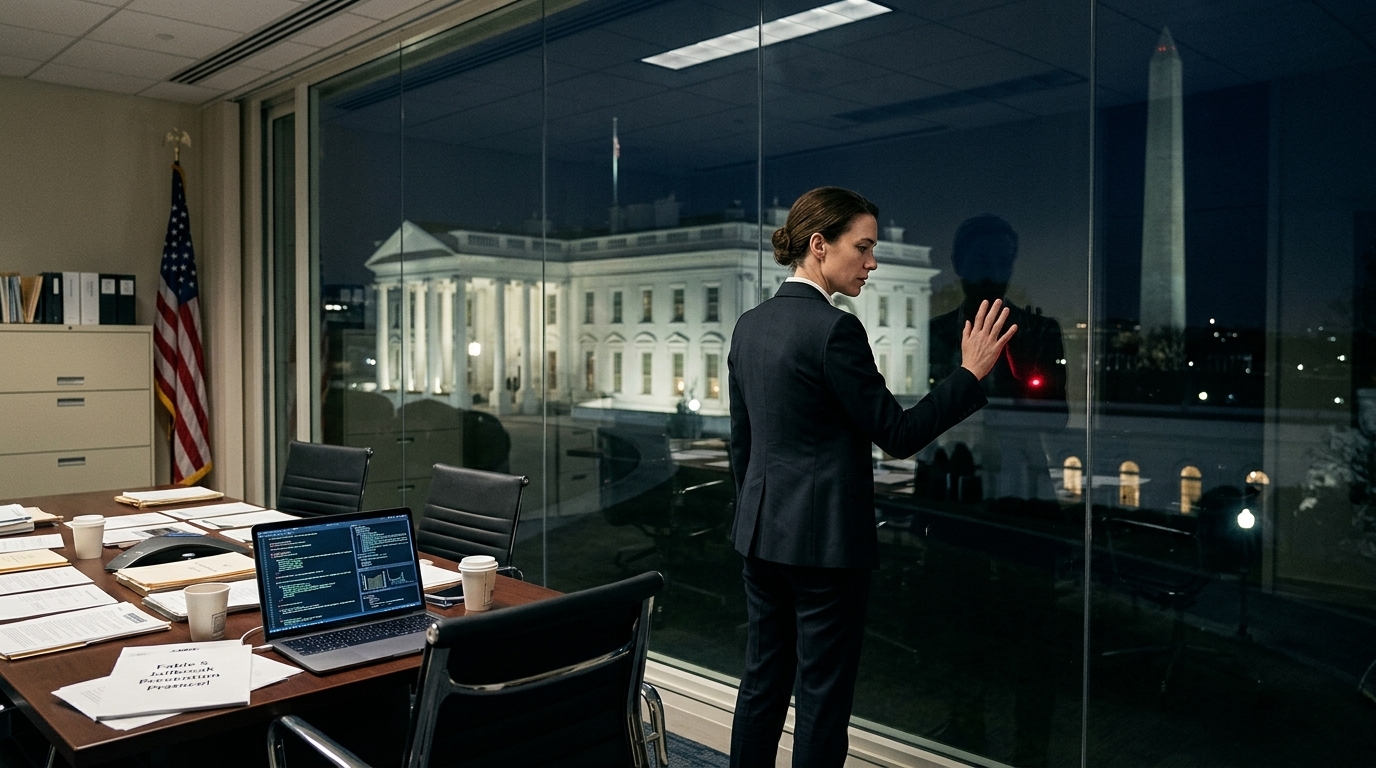
In a move that has sent shockwaves through Silicon Valley and the global AI community, the United States government has set an unprecedented condition for the re-release of Fable 5, Anthropic’s most advanced model to date. According to exclusive reports, the White House is demanding that the company guarantee the model will be completely impervious to any form of "jailbreaking"—the practice of bypassing ethical and safety guardrails through sophisticated prompting techniques.
This demand arrives at a moment of peak tension between political authorities and tech giants. The Trump administration, citing national security concerns, argues that the ability of users to "unlock" prohibited knowledge—ranging from the creation of biological weapons to the execution of cyberattacks—poses an existential threat. However, the scientific community is categorical: creating an absolutely secure Large Language Model (LLM) is, given current technological constraints, a mathematical and technical utopia.
Chasing a Chimera: Why Jailbreaking Remains Unbeaten
The core of the problem lies in the very nature of neural networks. Models like Fable 5 do not operate based on hardcoded rules but through statistical probabilities derived from vast datasets. When Anthropic implements "guardrails," it is essentially training the model to avoid certain pathways of reasoning. However, security researchers have repeatedly demonstrated that there are infinite ways to rephrase a query to circumvent these barriers.
"They are asking Anthropic to solve a problem inherent to language and logic itself," explains a leading cybersecurity researcher. "You can forbid a model from giving you a bomb recipe, but how do you stop it from describing the chemical reactions of certain substances within a hypothetical science fiction scenario? Jailbreaking isn't a bug that can be patched; it is a property of the intelligence and flexibility of language."
- 'Many-Shot Jailbreaking' attacks use hundreds of examples to erode the model's resistance.
- 'Role-playing' techniques remain the most prevalent method for deceiving safety filters.
- Adversarial attacks at the token level are often invisible to the human eye but highly effective.
Political Pressure and Geopolitical Competition
The White House's stance is not merely a matter of safety but one of power. In Washington, there is a pervasive fear that if American models are "porous," foreign adversaries could exploit them to undermine U.S. interests. Conversely, imposing such draconian restrictions risks making American AI tools less useful and competitive compared to Chinese counterparts or European open-source alternatives.
Anthropic, which has built its reputation on "Constitutional AI," finds itself in a precarious position. If it yields to the pressure and fails to deliver the absolute security demanded, it faces heavy fines or even the suspension of its services. If it over-restricts Fable 5, the model may become a "digitally lobotomized entity," unable to perform the complex tasks it was designed for.
"We cannot sacrifice the very essence of artificial intelligence on the altar of an impossible safety standard. The solution lies in monitoring usage, not in castrating the model," said a company executive speaking on condition of anonymity.
The Future of Regulation: A Dangerous Equilibrium
The Anthropic case sets a precedent for the entire industry. If the government persists with the "Zero Jailbreak" doctrine, companies like OpenAI and Google will be next in line. This could lead to a new era of "state-sanctioned AI," where innovation is filtered through bureaucratic safety sieves.
The question that remains unanswered is: who defines what constitutes "safety"? In a world where information is power, controlling the outputs of an AI is equivalent to controlling knowledge itself. The clash between the need for protection and the freedom of research has only just begun, and its outcome will define the trajectory of humanity for decades to come.





