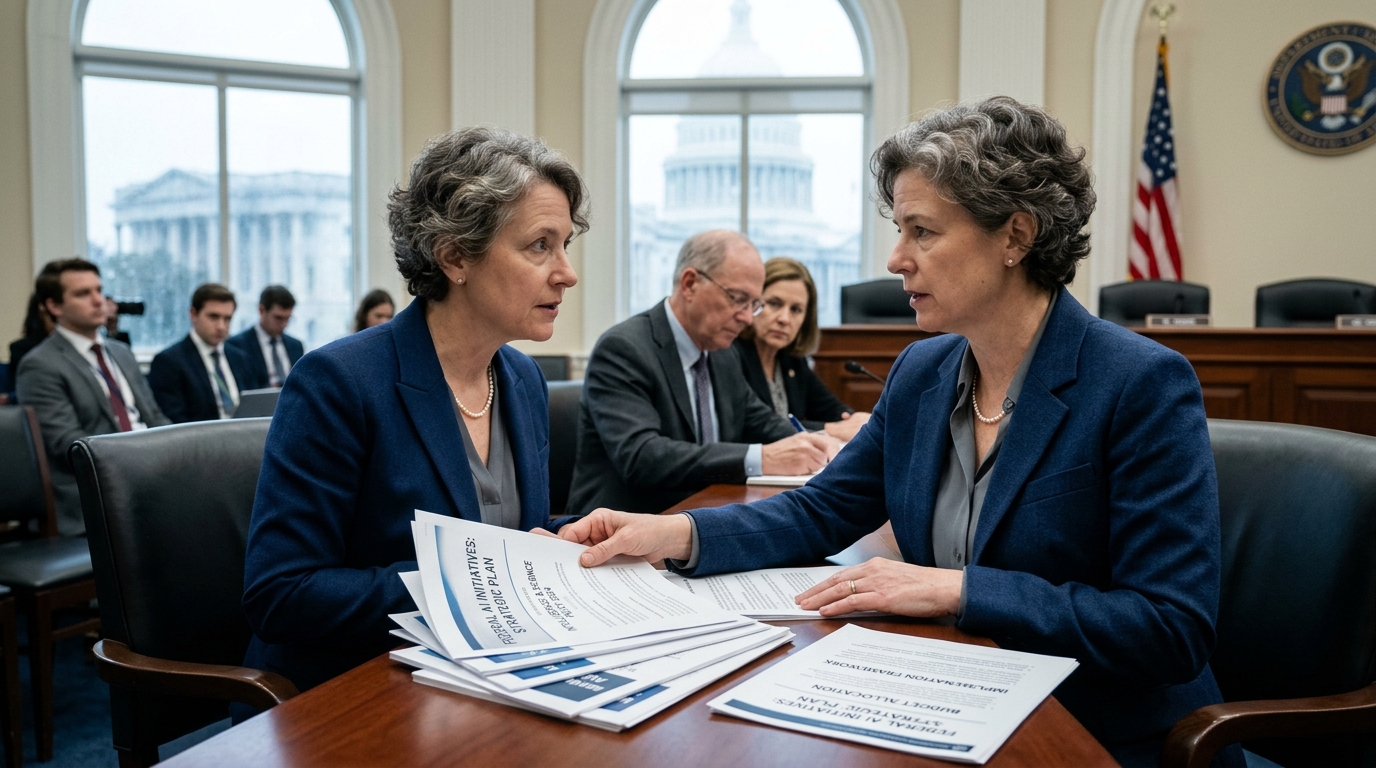
As we navigate the summer of 2026, Washington has decisively abandoned its role as a mere observer of Artificial Intelligence developments. Recent reports from GovCIO Media & Research highlight a fundamental shift: AI is no longer just a "tool to be regulated," but the very backbone of new federal initiatives across science and the intelligence community. This evolution marks the beginning of an era where the state seeks to reclaim the reins of innovation from the private sector, prioritizing national security and scientific sovereignty.
The Convergence of Science and National Security
The new initiatives focus on two pillars that have traditionally operated in parallel but distinct tracks: academic scientific research and the Intelligence Community (IC). The National Science Foundation (NSF) and the Department of Energy (DOE) are leading a massive effort to position AI as the primary accelerator for breakthroughs in climate change, biotechnology, and materials science. According to the new federal guidelines, the use of generative AI to analyze vast datasets is expected to compress scientific discovery timelines from decades to months.
Simultaneously, intelligence agencies are integrating next-generation AI models for Open Source Intelligence (OSINT) and signals analysis. The challenge here is twofold: ensuring the accuracy of intelligence and protecting against "data poisoning" by foreign adversaries. The Biden-Harris administration, building on the policy foundations of previous years, is investing heavily in "closed" AI models running on government supercomputers, ensuring that sensitive data does not leak into commercial LLM training sets.
The National AI Research Resource (NAIRR) as a Public Good
One of the most ambitious aspects of these initiatives is the full institutionalization and expansion of the National AI Research Resource (NAIRR). NAIRR was designed to democratize access to the massive computing power that, until recently, was the exclusive province of Silicon Valley tech giants. By providing universities and small-to-medium enterprises with access to high-performance GPUs and curated datasets, the federal government hopes to foster an innovation ecosystem that isn't solely driven by quarterly profit margins.
- Access to exascale computing for non-profit research organizations.
- Creation of secure "sandboxes" for testing AI models on government infrastructure.
- Funding for training a new generation of "public-interest AI scientists."
This move is widely seen as a response to criticisms that AI is fostering a new form of oligopoly. However, skeptics point out that while NAIRR's budget has increased, it remains a fraction of the capital expenditures seen by the likes of Microsoft, Google, or Meta.
Geopolitical Competition and the Ethics of Power
One cannot analyze these initiatives without addressing the "elephant in the room": China. Washington now perceives AI as the modern equivalent of atomic energy. Integrating AI into intelligence services is not just about efficiency; it is about survival in a world where cyber-attacks and disinformation campaigns are increasingly algorithmically driven. The new strategy emphasizes "Sovereign AI"—the ability of a nation to produce and control its own technology without external dependencies.
"Science and espionage are now two sides of the same coin in the age of AI. Whoever controls the algorithms of discovery will control the future of the global order," a senior GovCIO official noted during a recent briefing.
Despite the focus on power, the new initiatives include strict protocols for "Responsible AI." There is growing pressure for transparency in how federal agencies use algorithms to make decisions affecting citizens' lives. The balance between national security—which demands secrecy—and democratic accountability—which demands transparency—remains the most thorny issue of the mid-2020s. As these federal programs scale, the world is watching to see if the US can lead the AI revolution while upholding the values of an open society.