

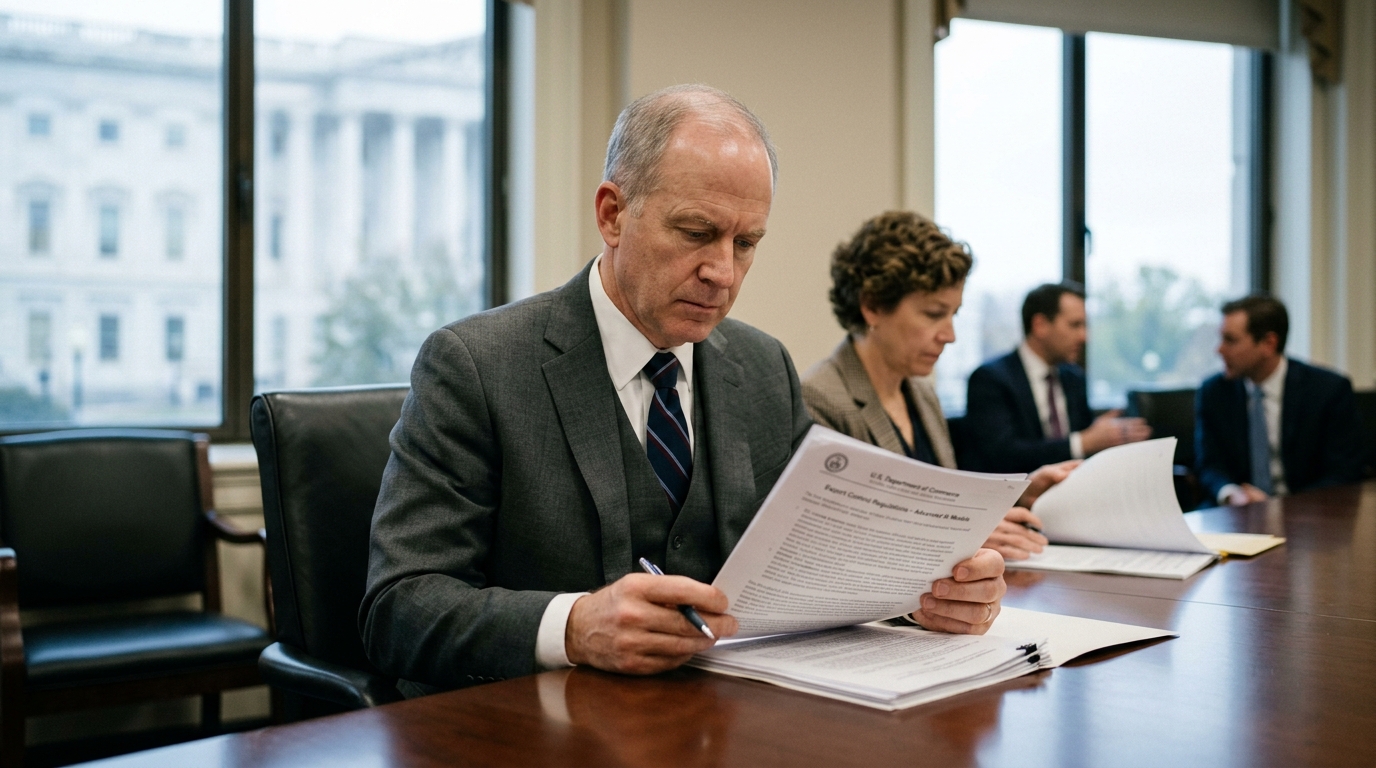
In a move that redefines the boundaries of digital sovereignty, the U.S. Department of Commerce has announced an expansion of export controls, now directly targeting advanced Artificial Intelligence models. Until recently, Washington’s strategy focused primarily on hardware, restricting China’s and other competitors' access to sophisticated semiconductors from the likes of Nvidia and AMD. However, the new directive shifts the weight to software and model weights, acknowledging that the intelligence of code is as much a strategic weapon as the power of processors.
The Transition from Hardware to Software
This decision, implemented through the Bureau of Industry and Security (BIS), marks a historic pivot. New regulations require U.S. AI developers — such as OpenAI, Google, and Anthropic — to obtain specific licenses before exporting models that exceed certain computational power thresholds during training. The criterion is no longer just the physical location of servers, but access to the model parameters themselves.
According to analysts at Mayer Brown, this move closes a significant 'loophole.' Previously, while a hostile power might not have had access to H100 chips, they could theoretically download an open-source model trained in the U.S., thereby gaining the fruits of American innovation without the infrastructure costs. The new controls aim to halt exactly that.
The 'Trusted Partners' Framework
One of the most intriguing aspects of the new policy is the creation of a 'Trusted Partners' list. The Commerce Department is authorizing the release of advanced models only to specific countries and entities that align with U.S. security standards. This effectively creates a 'Digital Alliance,' where access to top-tier AI technology becomes a privilege of geopolitical allies.
- Preferential access for NATO and G7 countries.
- Strict oversight for technology transfers to third parties.
- Mandatory reporting for any security breaches by partners.
This 'walled garden' approach at a national level aims to prevent American AI from being used for military purposes by rival states, such as the development of cyberweapons or biological engineering.
The Open Source Paradox
The open-source community is in turmoil. Many argue that these controls will stifle innovation, as enforcing restrictions on model weights is technically difficult and legally controversial. How can one control the distribution of a digital file that has already leaked? Furthermore, there is a fear that restrictions will lead to a fragmented global AI market, where countries outside the U.S. sphere of influence will be forced to develop their own, less-regulated solutions.
"We are not just restricting trade; we are defining the borders of knowledge in the 21st century," stated a senior Commerce Department official.
Geopolitical and Economic Fallout
China has already reacted, labeling the measures as 'technological hegemony.' However, for U.S. companies, compliance costs are expected to skyrocket. Legal teams at tech giants must now navigate a maze of licensing that resembles arms sales. This move confirms that AI is no longer viewed as a commercial product but as a critical national resource, analogous to nuclear energy or aerospace technology.
In the long term, this decision may accelerate other nations' pursuit of 'technological sovereignty,' reducing their dependence on the American ecosystem. If Washington closes its AI doors, the rest of the world may simply build its own.





