

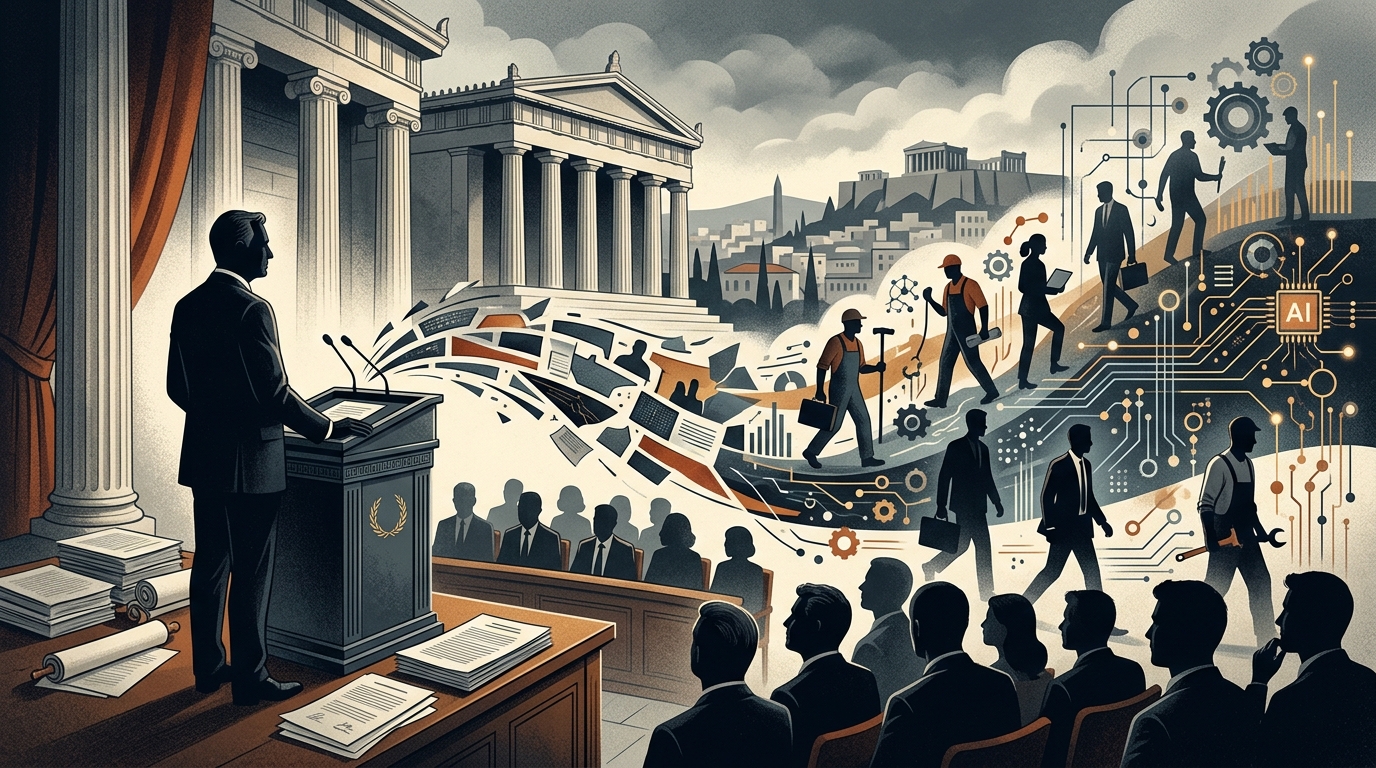
The recent intervention by the Minister of Environment and Energy, Theodoros Skylakakis, regarding Artificial Intelligence (AI) and labor, was not merely a political stance but a profound statement of intent for the nation's future. At a time when Greece is striving to cement its place in the digital economy, Skylakakis emphasized that AI is not just another productivity tool, but a force of "creative destruction" threatening to upend the foundations of the labor market as we know it.
The Nature of the Threat: Moving Beyond Automation
According to the Minister's analysis, AI differs fundamentally from previous industrial revolutions. While 20th-century automation primarily replaced manual labor, Generative AI now targets cognitive functions. This means professions once considered "safe"—from law and accounting to software engineering and business management—are now in the crosshairs. For Greece, an economy heavily reliant on services and Small and Medium Enterprises (SMEs), the challenge is twofold. The lack of heavy industrial bases means the impact will be felt most acutely by the backbone of the middle class.
Skylakakis stressed that the speed of change is the greatest risk. "We do not have decades to adapt," he noted, implying that the period leading up to 2030 will be decisive. The political awakening he calls for is not just about legislation; it involves a radical overhaul of the educational system and the social contract. Greece, still healing from the scars of the economic crisis, is now tasked with managing a transition that requires immense resources and unwavering political will.
The Greek Specificity and the 2030 Stakes
Why is Greece particularly vulnerable? The answer lies in the structure of its economy. With a high percentage of self-employed individuals and micro-businesses, the adoption of AI can act as either a growth accelerator or a catalyst for marginalization. The Minister pointed out that if Greek workers do not acquire the necessary skills (upskilling and reskilling) immediately, the country risks becoming a mere consumer of technology, losing the added value of its labor force.
- Educational Reform: The urgent need to integrate computer science and critical thinking at every level of schooling.
- Business Incentives: Tax and financial incentives for the digital transition of SMEs.
- Social Protection: Designing new forms of benefits and support for those displaced by the shifting market.
The reference to 2030 is no coincidence. It is the milestone for most European strategies regarding the green and digital transition. Skylakakis warns that if the political class remains trapped in petty partisan disputes, the country will find itself unprepared for a wave of technological unemployment that no traditional subsidy policy can stem.
Towards a New Political Paradigm
The "political awakening" the Minister refers to requires transcending traditional ideological lines. AI is neither right-wing nor left-wing; it is a technological reality that demands efficiency. According to analysts, Skylakakis’ proposal implies the need for a "strategic state" that does not limit itself to regulation but actively invests in human infrastructure.
"Jobs are not being lost; they are being transformed. But this transformation can be painful without a safety net and clear guidance,"sources within the Ministry suggest.
In conclusion, Theodoros Skylakakis’ warning serves as a manifesto for Greece in the coming decade. Artificial Intelligence offers unique opportunities to boost GDP and improve public administration, but the cost of inaction will be unbearable. The challenge for the government and society alike is to turn the fear of automation into a driving force for a national digital strategy that places the human element at its core.





