

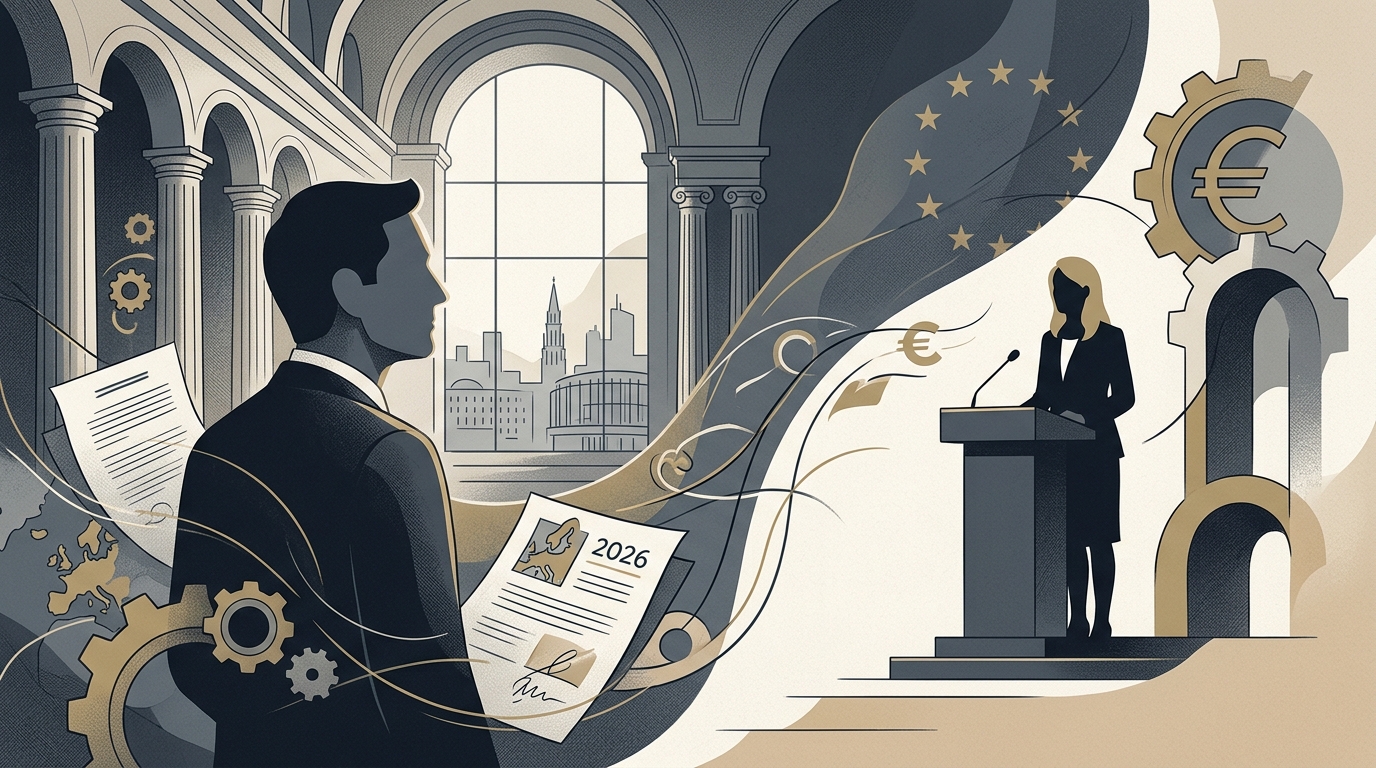
At a critical juncture for European economic integration, the Greek Minister of National Economy and Finance and President of the Eurogroup, Kyriakos Pierrakakis, is conducting a series of high-level meetings in Brussels and France. His meeting with the President of the European Parliament, Roberta Metsola, is far from a mere protocol visit; it signals the dawn of a new era for Eurozone governance, where technocratic efficiency meets political legitimacy.
The Architecture of the Euro in the Digital Age
The central theme of the discussions is strengthening the role of the euro in a rapidly shifting global environment. Pierrakakis, bringing his extensive experience from Greece's digital transformation, is a vocal advocate for the completion of the Digital Euro. According to the Eurogroup President, the common currency must evolve from a simple medium of exchange into a "smart" tool that facilitates cross-border payments and bolsters Europe's financial sovereignty against US and Chinese tech giants.
Roberta Metsola, for her part, emphasized the necessity of democratic accountability within Eurogroup decisions. Cooperation between the Council of Finance Ministers and the European Parliament is now seen as mandatory, especially as Europe prepares for the next Multiannual Financial Framework (2028-2034). Both leaders agreed that investments in innovation and defense must form the backbone of the new European budget, while simultaneously ensuring the fiscal discipline demanded by international markets.
From Crisis to Leadership: The "Greek Paradigm"
The presence of a Greek minister at the helm of the Eurogroup in 2026 carries significant symbolic weight. Greece, once the "black sheep" of the previous decade, has transformed into one of the EU's primary policy shapers. Pierrakakis is leveraging this credibility capital to propose a more flexible yet strictly supervised economic governance model. His strategy focuses on "qualitative growth," which is measured not just by GDP, but by the ability of economies to adapt to climate and technological challenges.
- Fiscal Convergence: The need for common rules that allow for investment without threatening debt sustainability.
- Energy Autonomy: Funding infrastructure that will permanently decouple Europe from unstable suppliers.
- Social Cohesion: Ensuring the green transition does not leave the most vulnerable social groups behind.
Challenges of 2026 and the Road to Paris
Following Brussels, Pierrakakis travels to France for meetings with top economic stakeholders. France remains Greece's closest ally in promoting a "Europe that protects." Discussions there will focus on creating a permanent investment mechanism, modeled after the Recovery and Resilience Facility, which would be activated during systemic crises. The challenge is immense: how to convince the so-called "frugal" Northern countries that common debt issuance for specific purposes (such as defense) is in everyone's best interest?
"The euro is not just a currency; it is the most powerful tool for political integration we possess. Its success depends on our ability to make it resilient to the crises of tomorrow," Pierrakakis stated upon exiting the European Parliament.
In conclusion, the Eurogroup President's tour underscores the need for a Europe that acts proactively rather than reactively. The alignment with Roberta Metsola suggests there is the political will for deep reforms, but it remains to be seen whether these initiatives will be translated into action before the next wave of European challenges arrives.





