

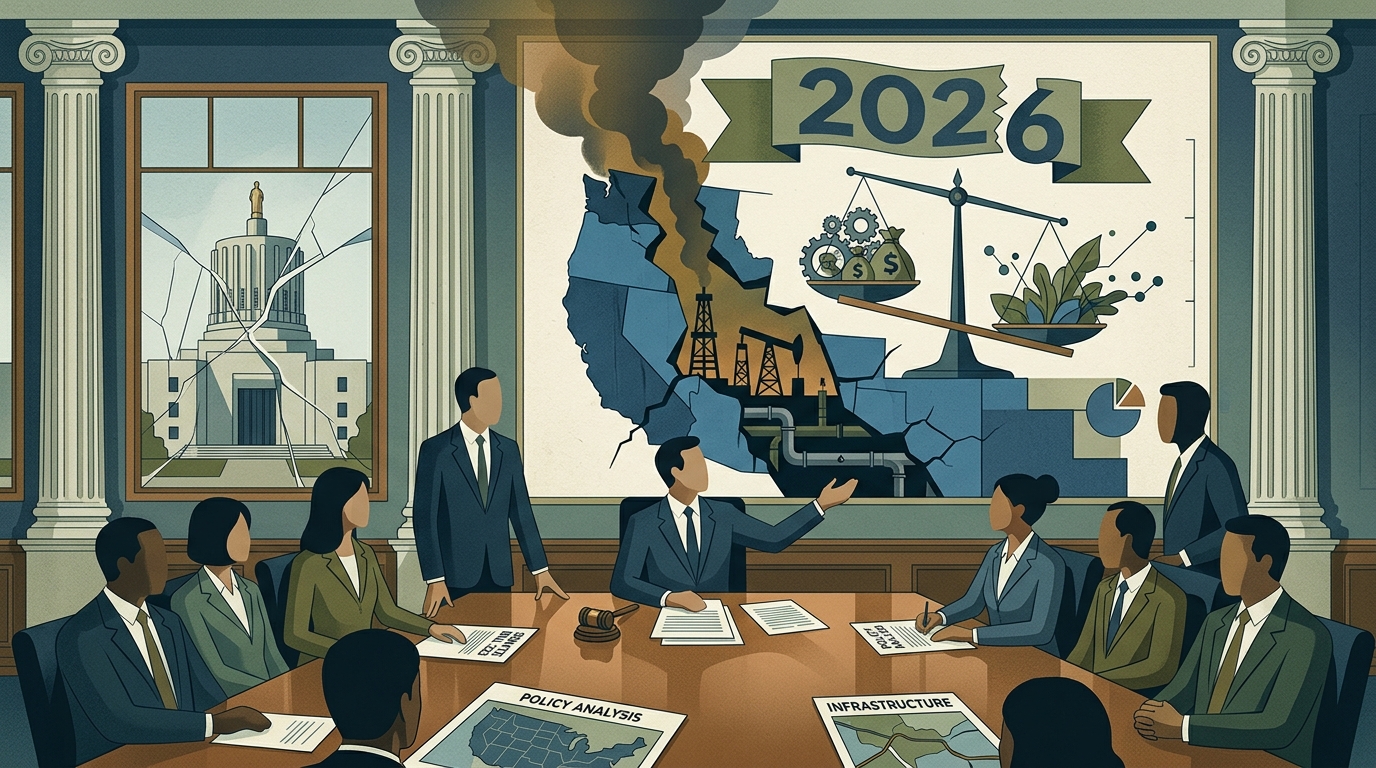
The political geography of the United States rarely offers surprises as resonant as the one currently unfolding in Oregon. A state that hasn’t sent a Republican to the Senate since 2002 is now at the epicenter of an internal collapse of Democratic strategy. The cause? A gas tax that didn’t just fail miserably at the ballot box but left one of the state's most seasoned politicians, Senator Jeff Merkley, dangerously exposed.
The Anatomy of an Overwhelming Defeat
When Democratic lawmakers in Salem decided to push through a new gas tax, their reasoning was perfectly aligned with the state’s green agenda: funding infrastructure and reducing carbon emissions. However, the reality of the pump proved far more potent than ideology. In a recent referendum, a staggering 83% of voters — including thousands of registered Democrats — rejected the measure. This is a rejection that transcends party lines and strikes at the core of middle-class economic survival.
The most striking element of this debacle wasn't the vote itself, but the Democratic Party's behavior after passing the legislation. According to analysts, Democrats effectively "abandoned their own child," failing to publicly defend the tax in the face of mounting consumer rage. This leadership vacuum was swiftly filled by Republican State Senator David Brock Smith, who now emerges as the most serious challenger to Merkley’s seat in decades.
Jeff Merkley Between a Rock and a Hard Place
Jeff Merkley, a politician long identified with the progressive wing and aggressive climate action, now finds himself in a position few would have predicted two years ago. The failure of the gas tax is not merely a fiscal defeat; it is a symbolic repudiation of his political direction. Brock Smith has built his campaign around the theme of "The Elite vs. The Working Class," accusing Merkley of losing touch with citizens struggling with persistent inflation.
- Rising living costs have rendered "green" taxes politically toxic for the average voter.
- The Democrats' failure to defend the tax was interpreted as a lack of conviction and courage.
- Rural areas of Oregon feel increasingly disenfranchised by decisions made in urban hubs like Portland.
Merkley is now attempting to pivot the conversation toward issues like reproductive rights and the protection of democracy — topics that traditionally galvanize his base. However, as pollsters point out, "it’s hard to talk about the sanctity of democracy when a voter can't afford the gas to drive to the polling station."
Brock Smith’s Strategy and the National Stakes
David Brock Smith is not your typical "red state" Republican candidate. He has managed to blend economic grievance with a targeted critique of federal overreach, largely avoiding the extreme cultural battles that often alienate Oregon's moderate and independent voters. His strategy focuses on "common sense" and the need for a balanced energy policy that doesn't disproportionately punish the poor.
"What we saw with the rejection of the gas tax was a cry for help. Oregonians told the Democrats that their patience has run out. Jeff Merkley is the face of an establishment that refuses to listen," Smith recently told a crowd in Coos Bay.
If Merkley loses, or even if the race is uncomfortably close, the message to the national Democratic Party will be catastrophic. If Oregon — the state of forests, bicycles, and environmental stewardship — rejects green taxation by 83%, then no "blue" seat can be considered safe heading into the 2026 midterms.
Conclusion: The End of Ideological Immunity
The Oregon case highlights a broader truth about politics in an era of global economic uncertainty: ideology can no longer mask economic hardship. Oregon Democrats assumed their dominance was absolute and that voters would bear any cost in the name of progress. The reality of the ballot box has proven them painfully wrong. Jeff Merkley must now prove that he can represent not only a "green" future but also the difficult present of people struggling to make ends meet.





