

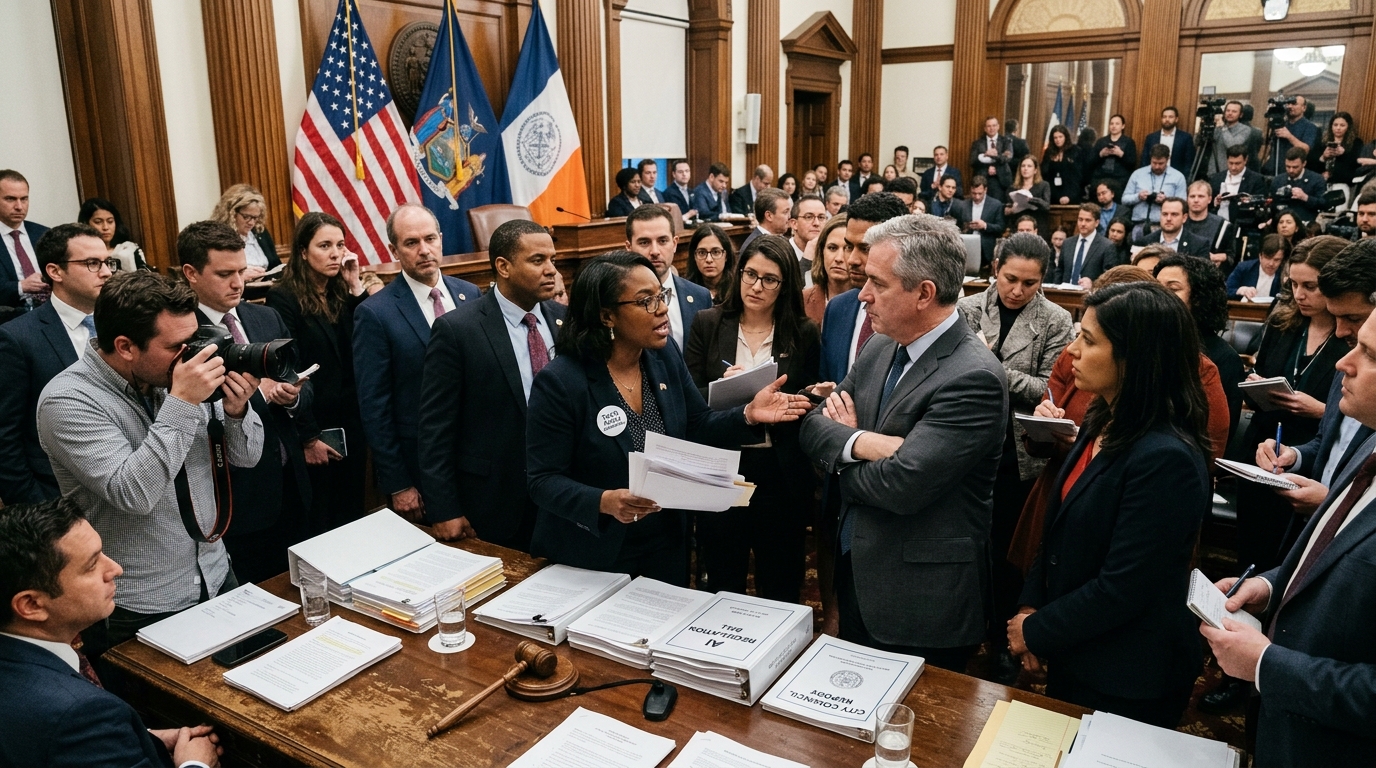
In the heart of New York, a traditional political contest for a House seat has morphed into something far more consequential: the first major proxy battle in the ‘AI Civil War.’ The primary in the 16th district, pitting progressive incumbent Jamaal Bowman against moderate George Latimer, is no longer just about local governance or Democratic party dynamics. It has become ground zero for Silicon Valley’s attempt to seize control of the legislative framework governing tomorrow’s technology.
The Rise of Tech-Fueled Super PACs
What we are witnessing in New York is the evolution of political lobbying. While tech companies traditionally relied on direct candidate donations, we now see the mobilization of massive Super PACs like Fairshake and Protect Progress. Although often associated with the cryptocurrency sector, their agenda has expanded to include ‘innovation without barriers’—a sophisticated euphemism for avoiding stringent AI regulations.
Jamaal Bowman, one of the most vocal critics of Big Tech’s unchecked power, found himself in the crosshairs of these organizations. His rhetoric regarding job protection against algorithmic displacement and the necessity for transparency in AI models made him ‘persona non grata’ for Silicon Valley investors. Conversely, George Latimer is framed as a candidate more open to ‘dialogue’ with the industry, making him the ideal recipient of millions of dollars in outside advertising support.
The Ideological Rift: Accelerationists vs. Regulators
Behind the funding lies a deep ideological schism dividing the tech community itself. On one side are the ‘Effective Accelerationists’ (e/acc), who believe any delay in AI development cedes a critical advantage to geopolitical rivals like China. On the other side are those calling for ‘Alignment’ and safety, fearing the societal and existential implications of the technology.
“We aren't just seeing a campaign; we are seeing an attempt by the tech elite to pre-determine the rules of the game before the public even understands what is at stake,” a political analyst told The AI Chronicle.
The strategy is simple: neutralize critical voices at the primary level. This ensures that regardless of who wins the general election, the victor is someone predisposed to industry-friendly policies. This tactic has sparked internal strife within the Democratic party, with many warning that democracy is effectively being ‘sold to the highest GPU bidder.’
Implications for the Future of Governance
If the ‘New York model’ proves successful, it will serve as the blueprint for the 2026 midterms and beyond. Silicon Valley has realized that while Washington moves slowly, individual states and aggressive legislators can cause immediate friction. By targeting ‘disruptive’ candidates early, the industry ensures the next Congress is populated by lawmakers who owe their seats to tech-funded support.
- Financial Dominance: Over $14 million was spent in this district alone, making it the most expensive House primary in American history.
- Messaging Strategy: Ads rarely mention AI; instead, they focus on polarizing social issues to erode the target's popularity.
- Long-term Goal: Preventing an American equivalent of the EU’s AI Act from gaining legislative traction.
In conclusion, the battle for New York’s 16th is a canary in the coal mine. Artificial Intelligence is not just changing how we work or create; it is fundamentally altering how we elect our leaders. When algorithms and the capital behind them enter the voting booth, the voice of the average citizen risks being drowned out by the digital noise of special interests.




