

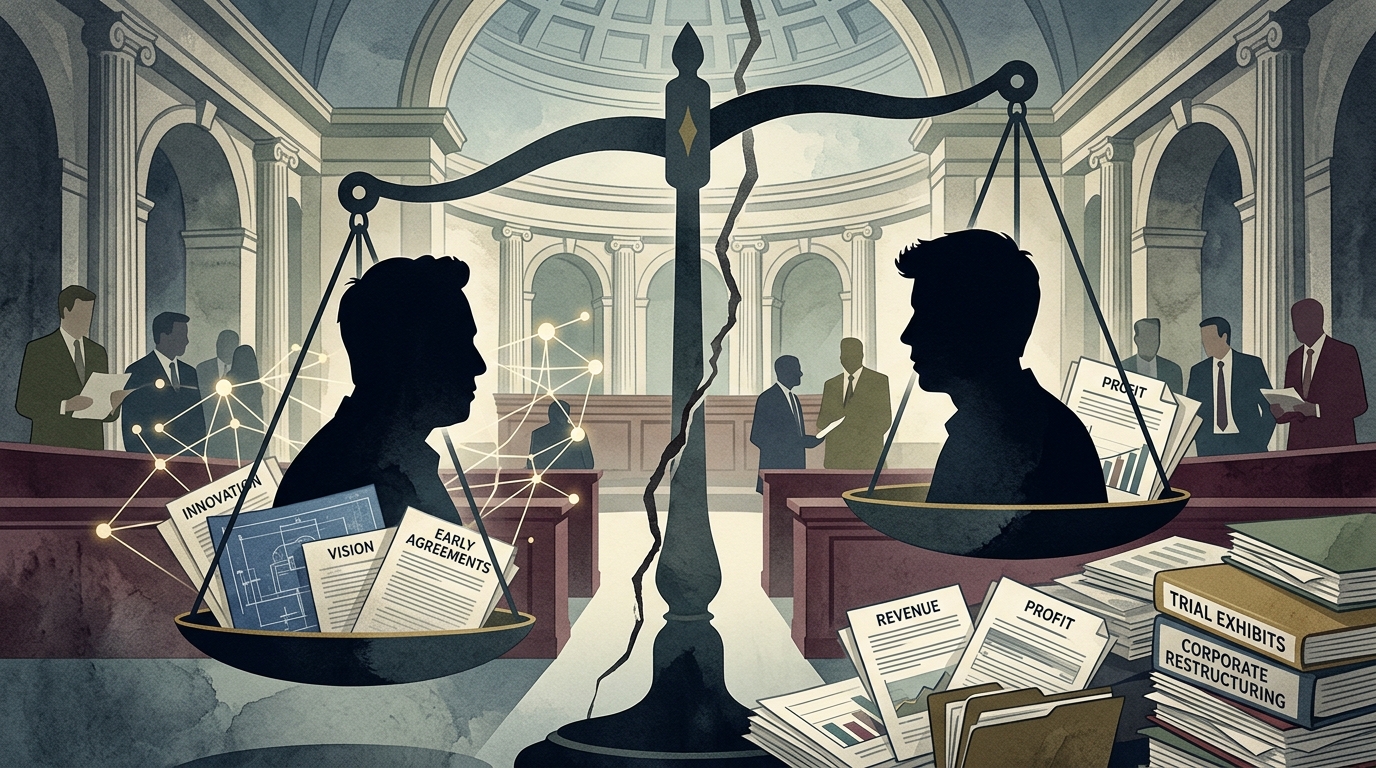
The legal clash between Elon Musk and OpenAI’s Sam Altman and Greg Brockman is no longer just a theoretical debate over AI safety. As the case unfolds in courtrooms in the spring of 2026, a flood of internal documents, personal emails, and meeting minutes is revealing a story of ambition, strategic maneuvering, and the gradual erosion of an idealistic vision. What began in 2015 as a non-profit lab intended to save humanity from "bad" AI has become the epicenter of one of the most bitter corporate feuds in tech history.
The Birth of a Giant: Idealism as a Smokescreen?
The trial exhibits date back to 2015, before OpenAI even had a name. In a pivotal email, Sam Altman proposed to Musk the creation of a lab that would serve as a counterweight to Google (DeepMind), which was then seen as the monopoly of AGI (Artificial General Intelligence). Musk, concerned about Larry Page’s dominance, agreed to fund the venture on the condition that it would be entirely open source and non-profit.
However, the documents show that as early as 2017, tensions had begun to peak. Musk, seeing Google's progress, pushed for a more aggressive approach, even suggesting that OpenAI be acquired by Tesla or merge with it entirely. "OpenAI is going to be eaten by Google unless we do something drastic," Musk wrote in one email. The refusal of Altman and Brockman to hand over the reins to Musk was the beginning of the end for his involvement in the board.
The Mutation: From Open Source to Microsoft Azure
One of the most revealing aspects of the trial is the correspondence regarding OpenAI's transition to a "capped-profit" model. The exhibits show that Ilya Sutskever, then chief scientist, had expressed serious reservations about whether maintaining open source was safe. "As we get closer to AGI, it makes sense to start being less open," Sutskever wrote, a position Musk now claims was used as a pretext to lock the technology behind Microsoft’s walls.
The 2019 deal with Microsoft is presented by Musk’s lawyers as the "ultimate betrayal" of the company's charter. The documents reveal that OpenAI was desperate for compute power, and Microsoft was the only player capable of providing it at such scale. But the price was Microsoft's exclusive access to OpenAI's technology, which Musk argues turns OpenAI into a "de facto subsidiary" of the Redmond tech giant.
The AGI Question: A Legal Riddle
The heart of the legal battle revolves around the definition of Artificial General Intelligence (AGI). According to OpenAI’s charter, Microsoft's license does not include AGI. Musk claims that GPT-4 and subsequent models released in 2025-2026 already constitute forms of AGI, and therefore OpenAI is in breach of contract by continuing to provide exclusive access to Microsoft.
Internal OpenAI assessments of their models' capabilities, presented as evidence, show that the company's own researchers disagreed on whether they had reached the AGI milestone. "If we admit this is AGI, we lose funding and control," reads an anonymous memo attributed to a company executive. This "strategic ambiguity" appears to be the key to Altman's defense strategy.
Conclusions and Implications
The Musk v. Altman trial is not just about the past; it is about the future of AI governance. If Musk prevails, OpenAI could be forced to open-source its code or dissolve its partnership with Microsoft, causing a seismic shift in the markets. If Altman wins, the model of "closed and for-profit" AI development will be validated as the only viable path to achieving super-intelligence. What is certain is that Altman's image as the "golden boy" of tech has been irreparably damaged by the email revelations, which portray him as a shrewd power player who did not hesitate to sideline the very man who helped him start.





