

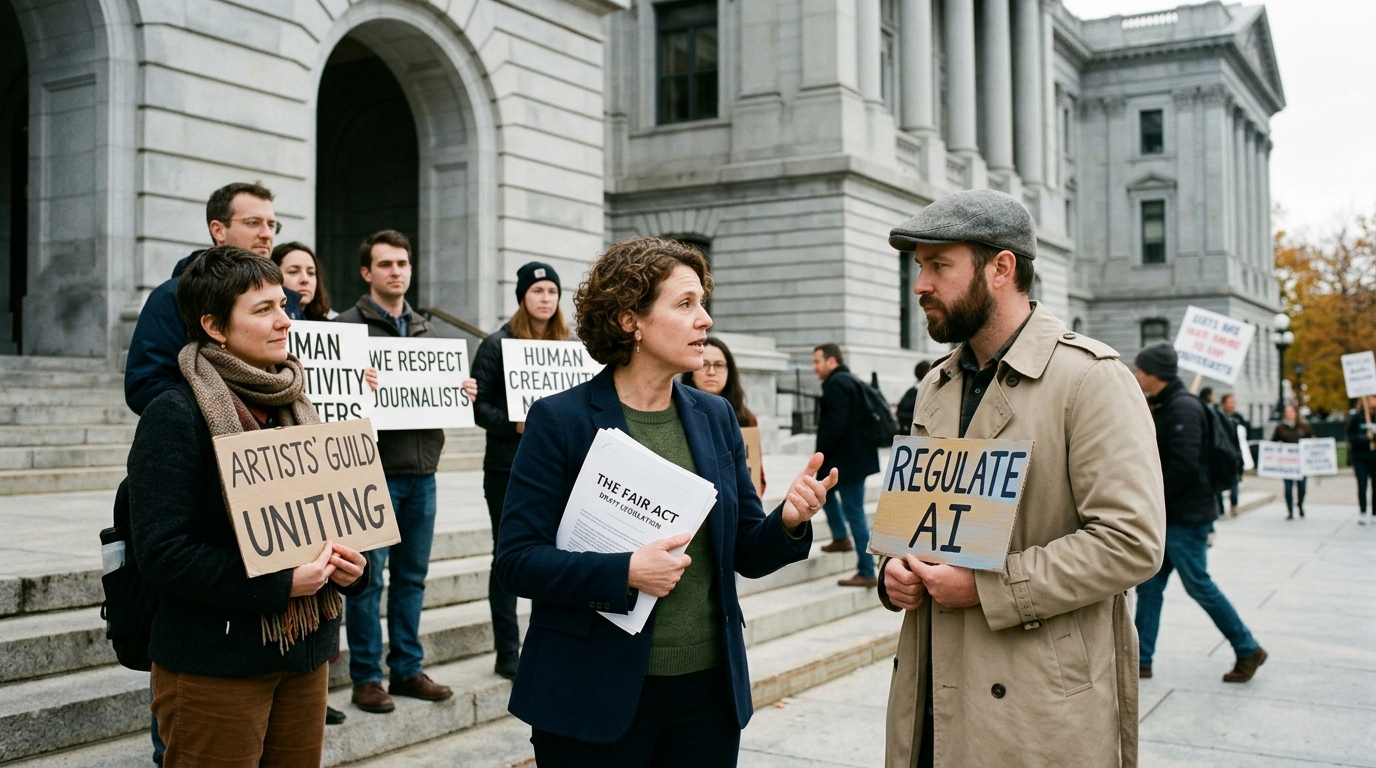
In the heart of New York, the political landscape in Albany has transformed into a battlefield for the future of human creativity and journalistic integrity. A powerful alliance of labor unions, including the Writers Guild of America East (WGAE), SAG-AFTRA, the Directors Guild of America (DGA), and The NewsGuild-CWA, gathered with a unified demand: the immediate passage of the "New York Fundamental Artificial Intelligence Requirements for News" (FAIR Act). This legislative initiative aims to establish the first stringent boundaries on the use of Artificial Intelligence (AI) in the media, ensuring that technology does not replace humans but remains under their control.
The Alliance of Creators vs. The Algorithms
This mobilization is more than just a protest over jobs; it is an existential cry for the very nature of information. Union representatives argue that the unregulated integration of Large Language Models (LLMs) into news production threatens to erode public trust. The FAIR Act focuses on three central pillars: transparency, intellectual property protection, and the preservation of human jobs. According to the proposed bill, any content generated or significantly edited by AI must carry clear labeling, allowing the reader to know the origin of the information.
For The NewsGuild, representing thousands of journalists, the stakes are the survival of local journalism. In an era where "news deserts" are proliferating, publishers are tempted to use AI to fill pages with low-cost, automated content. "Journalism requires judgment, ethics, and physical presence—three things an algorithm cannot possess," a union official stated during the rally. The pressure on New York lawmakers is immense, as the state is considered a global media hub, and such legislation would serve as a blueprint for the rest of the world.
Intellectual Property and the Right to Refuse
One of the most contentious points of the FAIR Act concerns the "training" of AI models on human-created content without consent. SAG-AFTRA and the DGA, having already fought grueling battles in Hollywood over deepfakes and digital replicas, are bringing their expertise to the negotiation table. The law seeks to prohibit the use of archival material from journalists and artists to train models that will eventually replace them, unless there is an explicit agreement and fair compensation.
The legal dimension is complex. Tech companies argue that using publicly available data falls under "fair use." However, the creators in Albany counter that the mass absorption of human intellect to create a competitive commercial product constitutes "digital piracy." New York, with its tradition of protecting labor rights, seems ready to challenge the Silicon Valley status quo. The implications of such a decision would be economically colossal, forcing AI giants to renegotiate their data sources.
The Political Dimension and Publisher Resistance
Despite mass union support, the path to passage is not without obstacles. Some large publishing groups and tech lobbies express concerns that excessive restrictions will make American media less competitive compared to those in other countries adopting AI without limits. They argue that AI can assist in translation, data analysis, and distribution optimization, freeing journalists for higher-quality investigative work.
However, the workers' response is clear: "efficiency" cannot be a smokescreen for the degradation of truth. The rally in Albany highlighted a new form of unionism, where the technical details of code and algorithms become subjects of collective bargaining. If the FAIR Act passes, it will be the first major victory for media workers against the "algorithmic threat," setting a barrier to the corporate tendency to treat news as a simple, automated commodity. The outcome of this legislative battle will determine whether we read news written with blood and ink in the future, or merely with electricity and probabilities.





