

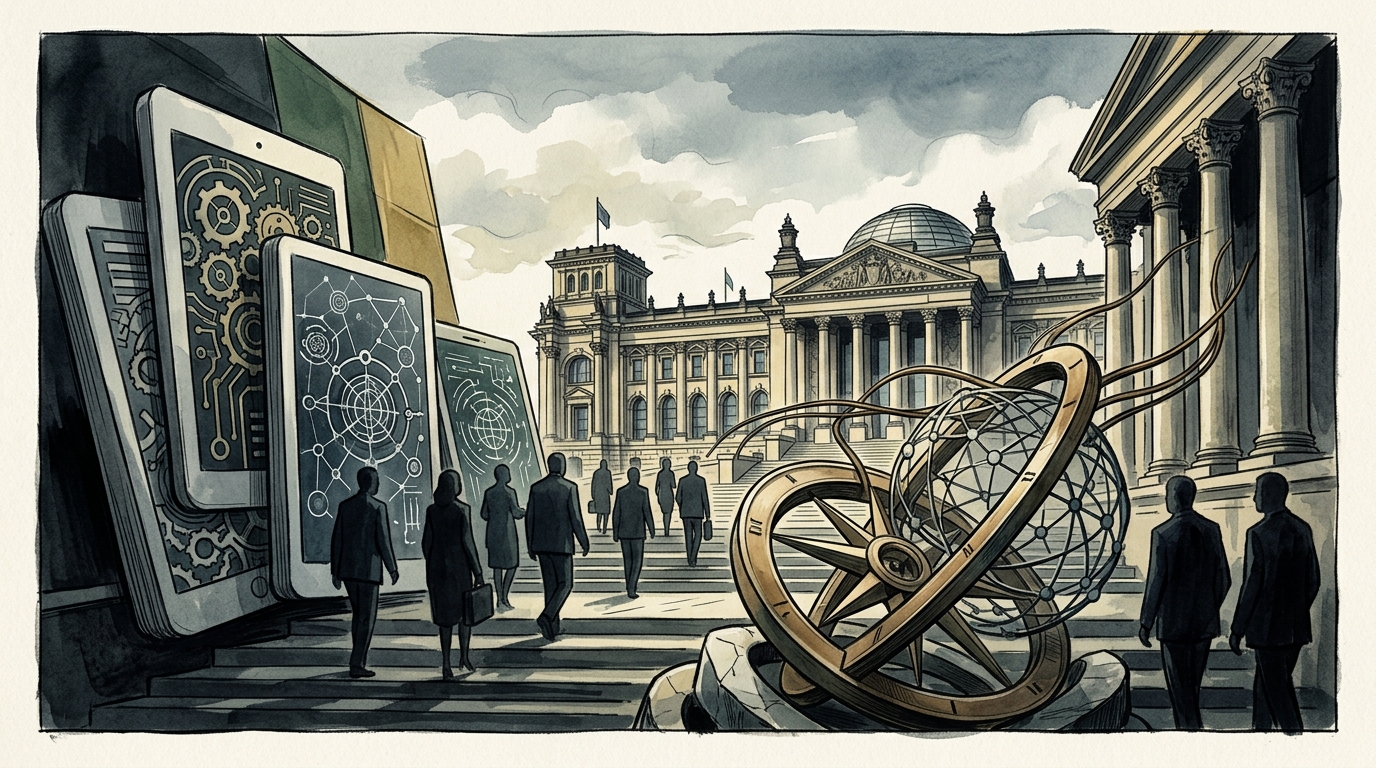
In an era where Artificial Intelligence (AI) is no longer a futuristic scenario but the primary engine of the global economy, Kyriakos Pierrakakis, Greece’s Minister of Education and the architect of the country’s digital transformation, is sounding the alarm for the European Union. His stance is unequivocal: Europe cannot remain a mere spectator or a strict regulator of developments. A common, bold, and coherent European strategy is required to bridge the widening gap with the US and China.
The Paradox of European Regulation
Europe has traditionally been the moral and legal pillar of the West. With the passing of the AI Act, the EU became the first international entity to establish a rigorous framework for AI usage. However, as Pierrakakis points out, regulation alone does not produce innovation. "We cannot regulate what we do not produce" is the underlying message of his recent interventions. While Silicon Valley invests billions in computational power and China integrates AI into its state apparatus with systemic discipline, Europe remains fragmented into 27 different national strategies.
The risk is palpable: the transformation of the Old Continent into a "digital colony," where citizens and businesses depend exclusively on technological infrastructures developed outside its borders. Pierrakakis argues that Europe must leverage its scale by creating common data pools and investing in European Large Language Models (LLMs) that respect the continent's cultural and linguistic diversity.
Education as a Catalyst for Change
As Minister of Education, Kyriakos Pierrakakis inextricably links technological progress with educational reform. This is not just about introducing tablets into classrooms, but a radical rethink of how we learn. AI in education can offer personalized learning, helping educators identify each student's weaknesses in real-time.
- Personalized Learning: Using algorithms to adapt curriculum to student needs.
- Digital Literacy: Teaching youth not just how to use AI, but how to understand it critically.
- Reskilling: Programs for the workforce threatened by automation.
In Greece, the introduction of the "digital tutor" and the use of AI tools for school administrative support are the first steps. However, the minister emphasizes that these tools must be part of a broader European ecosystem to ensure economies of scale and common security standards.
Geopolitics and Digital Sovereignty
The discussion about AI is, in reality, a discussion about power. Pierrakakis emphasizes that "digital sovereignty" is not an abstract concept but the ability of a society to decide its own future without being blackmailed by technological monopolies. His proposal for a unified strategy includes the creation of European supercomputers (like the "Democritus" project planned in Greece) and providing incentives to keep top scientists within Europe.
"Artificial Intelligence is the electricity of the 21st century. If Europe does not build its own grid, it will be forced to buy power from others, on their terms."
The Greek experience of the last five years, where the state digitized at speeds that surprised its partners, serves as proof that political will can overcome bureaucracy. Pierrakakis is now calling on Brussels to demonstrate the same agility, leaving behind endless consultations and moving toward actions that will fortify the European economy.
Conclusion: The Time for Decision
Kyriakos Pierrakakis' message is a wake-up call. Europe possesses the talent, the history, and the values to lead in the age of Artificial Intelligence. What it lacks is unity in execution. A common European strategy is no longer one option among many; it is the only path for the survival of the European social model in the 21st century. Greece, having made its own digital leap, is ready to contribute to this effort, claiming a leading role in shaping our collective future.





