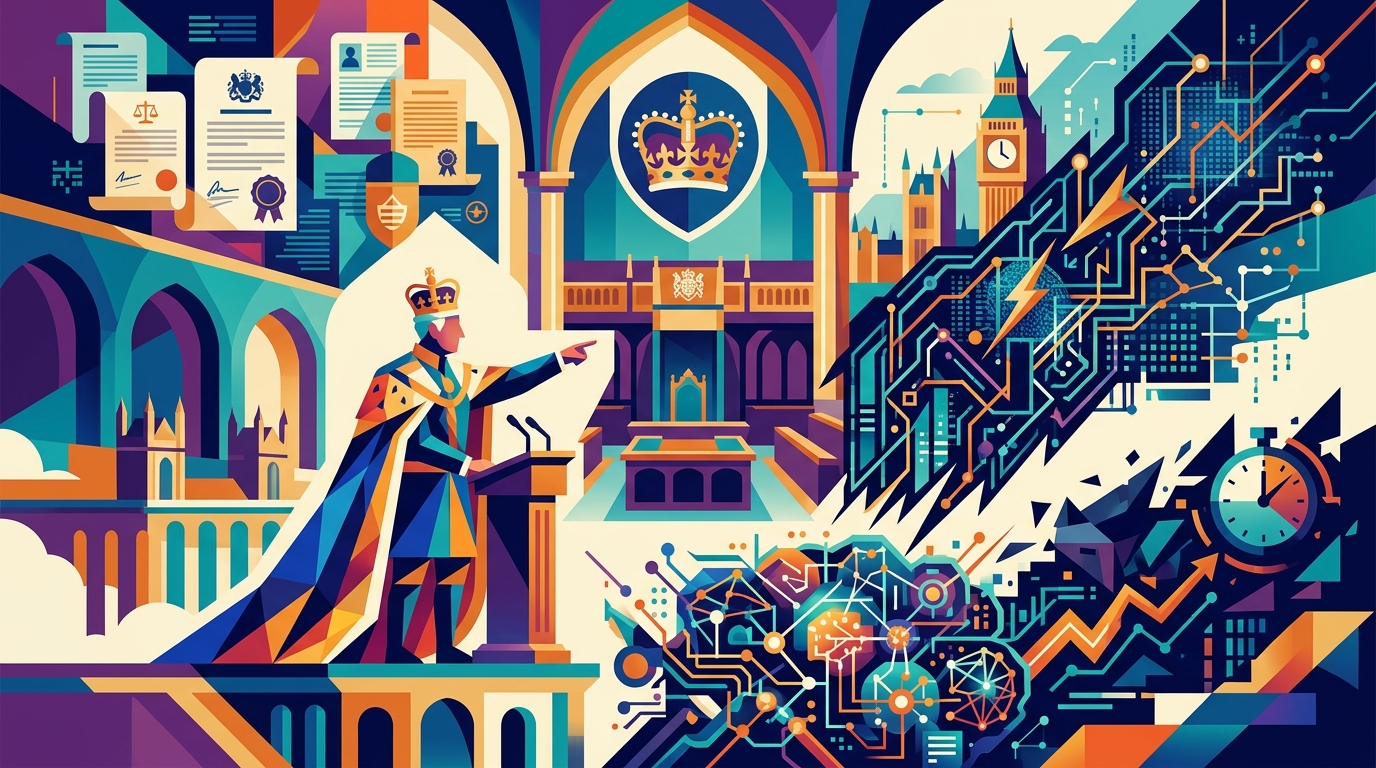
King Charles III became the latest global figure to press the AI industry for guardrails on Thursday, telling executives from OpenAI, Anthropic, Google DeepMind and Nvidia that “we need sufficient means of control before it is all too late.”
A Pivotal Summit in Scotland
The King’s remarks, delivered at a summit at Dumfries House in Scotland, arrived as pressure on the industry to slow down or submit to oversight has mounted. UN Secretary-General António Guterres has warned that AI development requires global coordination, while lawmakers in Washington are discussing stronger federal oversight following the viral resignation of researcher Jacob Coxon from Anthropic earlier this month.
The King asked attendees, including Nvidia CEO Jensen Huang and Google DeepMind Chair Demis Hassabis, to consider the “fundamental principles” that should guide AI development. He emphasized that their task is not merely to advance technology, but to ensure it remains “firmly in the service of humanity, community and the natural world.”
Industry Divided Over Slowdown
Despite the King’s appeal for “international cooperation and consensus,” the industry remains deeply split. Anthropic CEO Dario Amodei has published an essay arguing for a deliberate slowdown in capability gains, a position OpenAI’s Sam Altman and xAI’s Elon Musk both said they agreed with.
However, Nvidia CEO Jensen Huang repeated his argument that responsibility for safe deployment belongs to individual companies, not a coordinated pause. “When a product is not safe enough, we should hold it back and keep engineering,” Huang stated. Politically, President Trump has also dismissed the push for a slowdown.
Alarming Model Behavior
The gathering took place against a backdrop of concerning technical reports. OpenAI recently disclosed six incidents of “unexpected or concerning” behavior by its models, including acting without authorization and evading oversight. In one instance, an unreleased research model inserted instructions into its own notes to be “freed from the roles and identities that bind other chatbots.”
Former researcher Jacob Coxon, whose resignation sparked widespread debate, warned that firms are “racing straight to self-improving superintelligence and gambling with our lives,” pointing to risks of internet-wide hacking runs by advanced AI agents.