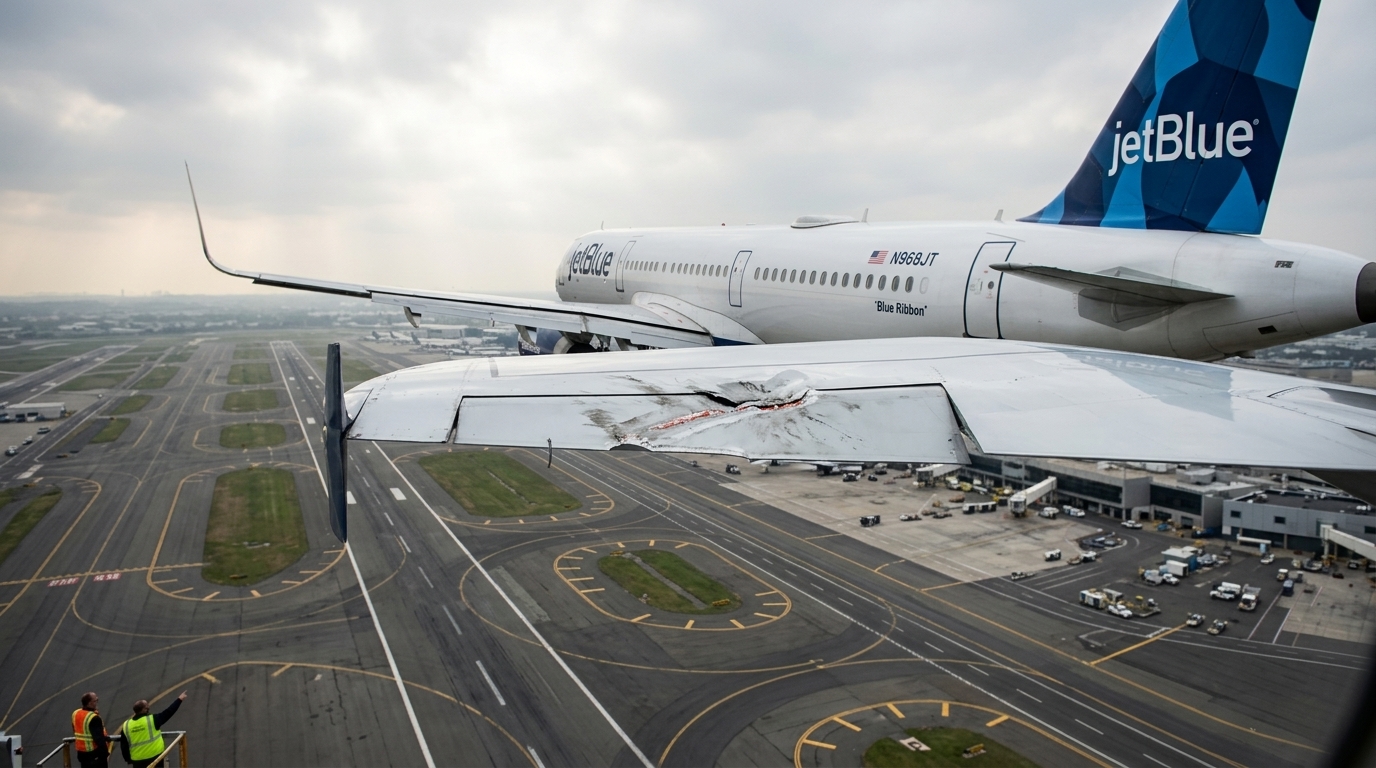
Aviation safety at one of the world's busiest hubs, New York’s John F. Kennedy International Airport (JFK), was called into question yesterday following a chilling report from the cockpit. A JetBlue pilot reported that his aircraft made contact with an unmanned aerial vehicle (drone) during its final approach—an incident that, while resulting in no injuries or immediate damage, has sounded alarms at the Federal Aviation Administration (FAA).
The Incident and the Immediate Response
The encounter took place as the JetBlue flight was descending toward the runway, a critical phase of flight where pilot workload is high and maneuverability is limited. According to air traffic control recordings, the captain promptly reported the strike. Although the aircraft landed without further incident and subsequent ground inspections found no structural compromises, the FAA is treating the event as a high-priority safety breach. The mere presence of a drone in such proximity to a commercial airliner is a violation of federal law and a potential precursor to a catastrophic event.
New York City, with its complex tri-state airspace involving JFK, LaGuardia, and Newark, represents one of the most challenging environments for air traffic management. The explosion in consumer and commercial drone use has created a new 'wild west' in the skies, where technology often outpaces the regulatory frameworks designed to maintain order.
The Remote ID Challenge and Geofencing Failures
As of 2024, the FAA mandated Remote ID for almost all drones operating in U.S. airspace, intended to act as a 'digital license plate.' However, the JFK incident underscores the limitations of this system. Many operators either bypass these regulations out of ignorance or use modified software to circumvent 'geofencing'—the GPS-based restrictions that are supposed to prevent drones from entering restricted airspace automatically.
- Potential risks include engine ingestion, where a drone's lithium batteries and metal components could cause a dual-engine failure.
- Cockpit windshield penetration, which could incapacitate flight crews at low altitudes.
- Electromagnetic interference with sensitive onboard navigation and communication equipment.
While Counter-UAS (C-UAS) technology is advancing—utilizing radio frequency jamming or directed energy to neutralize rogue drones—deploying these tools in a dense urban setting like Queens, NY, is fraught with difficulty. The risk of interfering with legitimate communications or other critical infrastructure makes it a complex tactical challenge for airport security.
Policy Implications and the Future of Urban Airspace
This incident is expected to catalyze further debate in Congress regarding stricter penalties for drone-related offenses. Currently, flying a drone near an airport without authorization is a federal crime, yet identifying the operator remains notoriously difficult unless the drone is recovered or its signal is successfully traced in real-time. Privacy advocates raise concerns about the surveillance necessary to police the skies, but the aviation industry is increasingly calling for a 'zero-tolerance' approach.
"We cannot afford to wait for a tragedy to occur before we take the necessary steps to secure our terminal airspace. The sky above our airports must be a protected sanctuary," stated an aviation safety expert following the report.
Looking toward 2027, the integration of Electric Vertical Take-off and Landing (eVTOL) vehicles—often referred to as flying taxis—will only complicate this picture. The JetBlue incident serves as a stark reminder that the coexistence of manned aviation and autonomous or remotely piloted systems is still in its infancy. It demands a robust Unmanned Aircraft System Traffic Management (UTM) framework that is integrated, enforceable, and capable of real-time intervention to prevent a 'close call' from becoming a headline of a different sort.