

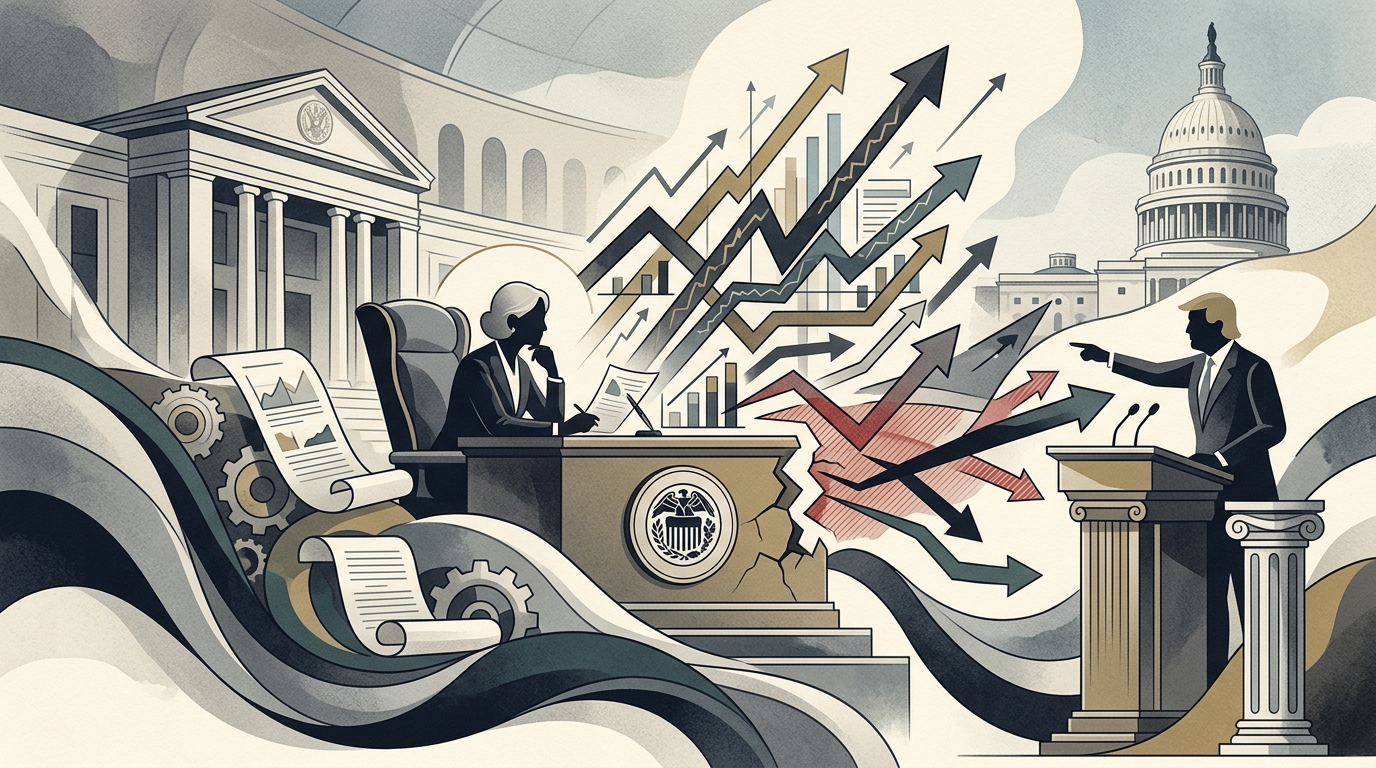
As we approach the conclusion of Jerome Powell’s tenure, the landscape at the U.S. Federal Reserve resembles a minefield. The succession leadership of the world’s most consequential central bank is no longer a standard technocratic process, but a head-on collision between economic orthodoxy, market demands, and Donald Trump’s aggressive political agenda. Today, in May 2026, this uncertainty affects not just the dollar, but the fundamental trust in the institutions that underpin the global economy.
Institutional Independence Under Siege
The independence of the Fed has been considered the "Holy Grail" of the American economy for decades. It allows central bankers to make difficult decisions—such as raising interest rates to combat inflation—without fearing the political cost of elections. However, the next Chair will be called to serve in an environment where the White House actively seeks a say in monetary policy.
Donald Trump has made it clear that he desires lower interest rates to fuel growth, regardless of the inflationary pressures his tariffs and fiscal spending might cause. The risk is obvious: if the new Fed Chair appears subservient to Trump’s demands, bond markets will react violently, driving yields higher due to fears of uncontrolled inflation. Conversely, if the new leader resists, they will find themselves in a perpetual war with the executive branch, potentially paralyzing decision-making.
The Market Paradox and the 'Fear of the Vacuum'
Wall Street investors hate uncertainty more than anything else. The transition from the "Powell era," characterized by relative predictability, to a new leadership that might lack the same institutional weight, is causing jitters. Markets are already pricing in a "risk premium" for the potential politicization of the Fed.
- The Fed's credibility is the only bulwark against systemic crises.
- A subservient central bank could lead to the devaluation of the dollar as a global reserve currency.
- Bond market vigilantes are ready to "punish" any move perceived as inflationary.
The new Chair will have to walk a tightrope. On one hand, the need to support growth during a period of geopolitical instability, and on the other, the need to convince investors that the Fed remains the "adult in the room." Any sign of weakness could trigger a massive exodus from U.S. assets.
The Shadow of the Past: From Burns to Volcker
History offers painful lessons. In the 1970s, Arthur Burns succumbed to Richard Nixon’s pressure for low rates, leading to the catastrophic hyperinflation of that decade. It took Paul Volcker’s iron fist and a painful recession to restore the bank’s credibility. The danger today is a repetition of the Burns mistake.
"Central bank independence is not a privilege for bankers, but a guarantee for the stability of citizens' purchasing power," analysts from Goldman Sachs noted recently.
In this context, the choice of the individual to succeed Powell is critical. If Trump chooses a loyalist instead of a seasoned economist with broad acceptance, a clash with the Fed's institutional establishment and international markets will be inevitable. Already, discussions in Congress indicate that the confirmation process will be the most politicized in U.S. history.
Conclusion: A Multi-Front Battle
The new Fed Chair will not have the luxury of a honeymoon period. They will be called to face a President who does not hesitate to publicly attack institutions, markets ready to collapse at the slightest misstep, and a global economy that relies on the strength of the dollar. The "war" mentioned by Fortune Greece is not just a metaphor; it is the new reality of the global financial order, where politics seeks to subjugate the mathematics of economics.





