

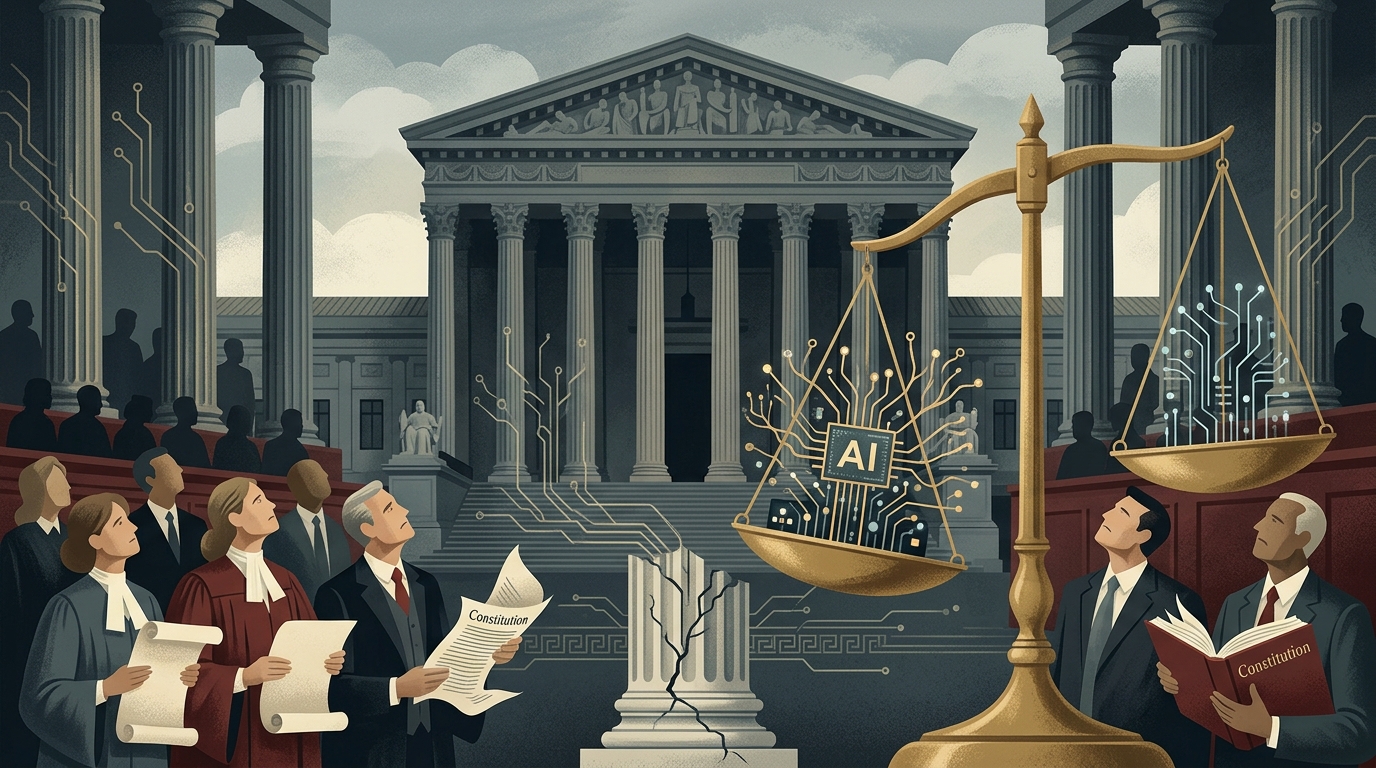
The recent intervention by Evangelos Venizelos, a prominent professor of Constitutional Law and former Deputy Prime Minister of Greece, regarding Artificial Intelligence (AI) is more than a technical analysis; it is a profound political and legal warning. In an era where technology evolves at a pace far exceeding the legislative capacity of states, Venizelos points to a critical realization: AI is not just a tool, but a paradigm shift that challenges the core of Western civilization and liberal democracy.
The Challenge to the Human-Centric Constitution
The Constitution, as it has been understood since the Enlightenment, is a human-centric construct. It is based on the assumption that the subject of law is the human being, endowed with will, judgment, and responsibility. Venizelos emphasizes that the advent of AI introduces a "non-human factor" into decision-making—one that lacks moral consciousness and operates based on statistical probabilities. This creates a massive vacuum in the attribution of accountability.
When an algorithm makes a decision affecting a citizen's fundamental rights—for instance, in the judicial system, healthcare access, or employment—the question arises: who controls the "black box"? Constitutionalism requires transparency and the justification of exercises of power. AI, due to its nature (deep learning), often produces results that even its creators cannot fully explain. This "opacity" directly clashes with the principle of the Rule of Law.
The Erosion of the Public Sphere and Democracy
Democracy is not merely the process of elections; it is the existence of a free and rational public sphere. Venizelos highlights the risk of algorithmic manipulation of public opinion. Through deepfakes and micro-targeting, the ability to shape political will shifts from citizens and political parties to those who control the data and the algorithms.
The problem is exacerbated by AI's potential to polarize societies, reinforcing "echo chambers" and making meaningful dialogue impossible. If truth becomes subjective and a product of AI-generated manipulation, then the very foundation of democratic legitimacy collapses. The citizen ceases to be a sovereign subject and becomes an object of data processing.
Digital Sovereignty and the Power of Big Tech
Another critical dimension touched upon by Venizelos is the shift of power from states to major tech giants. The traditional concept of national sovereignty is being tested, as the rules governing citizens' digital lives are not enacted by parliaments but by the terms of service of private corporations.
- The need for a "Digital Constitutionalism" that imposes rules on platforms.
- Ensuring "human-in-the-loop" oversight for every critical decision.
- Protecting personal data not just as a matter of privacy, but as a component of human dignity.
Venizelos does not argue against technology but advocates for its political and legal subordination to democratic values. The challenge for Europe, through the AI Act, is to lead this effort, ensuring that innovation does not come at the expense of freedom. In conclusion, Artificial Intelligence is a mirror of humanity; if we are not careful, it could become its prison.
"Artificial Intelligence tests the limits of human autonomy. The response must be political and constitutional, placing the human being back at the center of history."




