

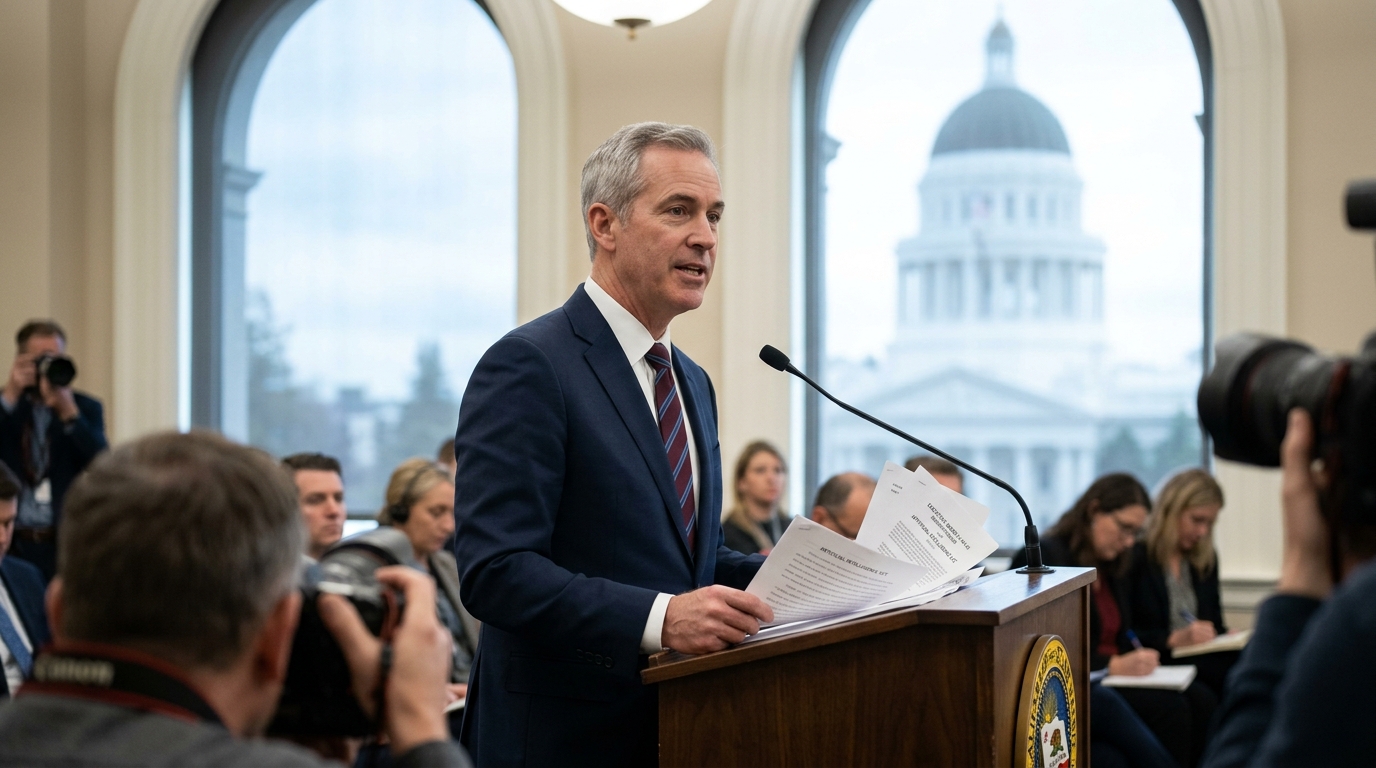
In the heart of Silicon Valley, where the technologies reshaping our world are born, Governor Gavin Newsom is embarking on one of the most ambitious political experiments of the decade: utilizing "digital democracy" to regulate Artificial Intelligence (AI). As humanity stands on the precipice of a new era, California—the world's fifth-largest economy—seeks to bridge the chasm between the technocratic elite and the average citizen.
This endeavor is far more than a mere public consultation. It is a structured platform employing consensus-analysis tools designed to capture the concerns, expectations, and ethical red lines of the populace. At a time when AI threatens to upend labor markets and saturate the digital sphere with misinformation, Newsom’s initiative poses a fundamental question: Can democracy keep pace with the velocity of technology?
The Platform of Participatory Governance
The "Digital Democracy" project is built upon technologies that facilitate mass participation without the noise and polarization characteristic of traditional social media. Instead of endless comment-section debates, citizens are invited to evaluate proposals and suggest solutions on topics such as algorithmic transparency, data privacy, and the implementation of AI in education and public administration.
According to sources within the Governor’s office, the system itself utilizes AI to cluster citizen viewpoints, identifying areas of consensus among individuals with disparate political backgrounds. "We don't just want to hear the loudest voices," a tech policy advisor stated. "We want to harness the wisdom of the crowd to help us draft legislation that stands the test of time."
The Stakes: From Labor to Existential Security
The scope of the project is vast, touching upon the most sensitive nerves of modern society. A central issue is the automation of labor. With Generative AI threatening professions ranging from software engineering to legal support, citizens are being asked to weigh in on whether "robot taxes" should be implemented or if guaranteed income programs should be established for those displaced by technology.
Furthermore, the initiative places significant emphasis on deepfakes and electoral integrity. With elections globally under threat from synthetically generated content, California aims to create a blueprint for protection that could be adopted by other states or even at the federal level. Citizen participation is deemed critical here, as they are the ultimate recipients—and potential victims—of digital manipulation.
- Regulating AI based on local community values.
- Addressing inequality driven by automation.
- Ensuring ethical use of technology by the state.
- Protecting privacy against Big Tech encroachment.
California as a Global Regulator
This is not the first time California has taken a leading role in tech regulation. The CCPA (California Consumer Privacy Act) served as the American counterpart to Europe’s GDPR. Now, with the digital democracy project, Newsom aims to spark a "California Effect" in AI. If the rules emerging from this process are adopted by the companies headquartered in San Francisco and Palo Alto, they effectively become the global rules of the game.
"Technology is not an inevitable force of nature; it is a tool that must be guided by human will," the initiative’s manifesto declares.
However, skeptics remain. Some question whether the average citizen possesses the technical literacy to judge complex issues like model alignment or the systemic risks of neural networks. The Newsom administration’s rebuttal is that policy is not about technical minutiae, but about values. And in a democracy, values are everyone's business.
This experiment will be closely watched by Washington and Brussels. If successful, digital democracy could become the antidote to technocratic isolation, transforming the fear of AI into a constructive dialogue about the future of our civilization.





