

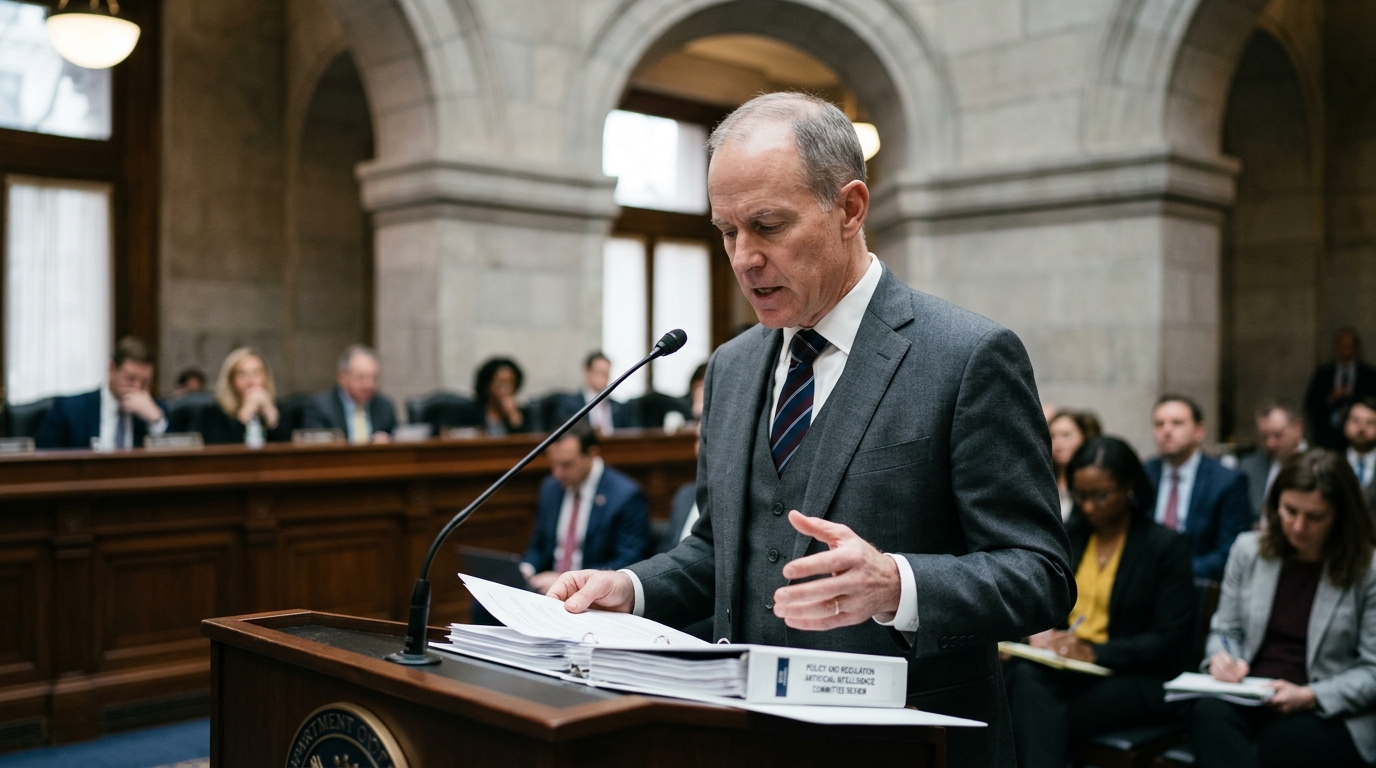
The relationship between the United States federal government and the pioneers of artificial intelligence in Silicon Valley is entering a new, darker phase. According to recent reports that have sent shockwaves through the tech community, the US Department of Commerce has reportedly threatened Anthropic, one of the most prominent AI development companies, with criminal charges. This move is not merely a bureaucratic warning but a fundamental shift in Washington's strategy: moving from voluntary compliance and guidelines to the threat of imprisonment and heavy fines.
Anthropic, founded by former OpenAI executives with a core focus on "safety" and "Constitutional AI," now finds itself targeted for the very product it supposedly designed with the utmost care. The issue revolves around export controls and the potential for its models, such as Claude, to be used by hostile foreign powers to develop biological or chemical weapons. The Biden administration's rigor, expressed through the Bureau of Industry and Security (BIS) of the Commerce Department, shows that AI is no longer treated as a simple commercial product, but as a dual-use technology with immense geopolitical implications.
The National Security Doctrine and AI
The root of the confrontation lies in the Executive Order on Artificial Intelligence issued in late 2023, which laid the groundwork for strict controls on models exceeding certain computational power thresholds. The Commerce Department argues that companies have a responsibility to ensure their technology does not "leak" to sanctioned state entities like China or Russia. The threat of criminal prosecution suggests that the government believes Anthropic's current safeguards may be insufficient to prevent the malicious use of its models at the level of state-sponsored terrorism or asymmetric warfare.
Analysts point out that this move serves as a warning to the entire industry. If Anthropic, which has built its reputation on ethics and safety, faces such threats, then companies with more aggressive development strategies, such as OpenAI or Meta, should be extremely cautious. Utilizing the Export Control Reform Act (ECRA) as a basis for criminal prosecution is a powerful tool that allows the government to intervene directly in the business activities of tech giants.
The Anthropic Paradox: When Safety Isn't Enough
It is ironic that Anthropic finds itself in this position. The company has developed techniques like "Constitutional AI," where the model is trained to follow a set of rules and values to avoid harmful responses. However, the government seems concerned about "jailbreaks"—techniques that allow users to bypass these restrictions. In recent tests, researchers have shown that even the most advanced models can, under certain conditions, provide instructions for synthesizing dangerous chemical substances if the user knows how to frame the prompt.
Anthropic, for its part, maintains that it works closely with authorities and that its imposed restrictions are the strictest in the industry. However, pressure from Congress and the executive branch for "zero risk" creates an environment where innovation could be stifled under the weight of legal liability. The possibility of an engineer or an executive facing prison time for a software vulnerability is unprecedented in the history of US software development.
Geopolitical Competition and the Chilling Effect
The Commerce Department's stance is not just about safety, but also about global competition. Washington fears that over-regulation could drive talented scientists out of the US or give an edge to China, which is developing its own models without the same democratic or ethical constraints. Nevertheless, the current administration seems to believe that the risk of a technology "leak" that could cause a global catastrophe outweighs the economic costs.
This strictness is expected to have a "chilling effect" on investment. Venture capitalists (VCs) may become more hesitant to fund AI companies operating in high-risk areas, fearing legal complications. Furthermore, the need for constant monitoring and reporting to the government dramatically increases the operational costs for companies, making it difficult for smaller startups to compete.
Conclusion: A New Social Contract for AI
The threat of criminal charges against Anthropic marks the end of the "Laissez-faire" period for artificial intelligence. This technology is now considered critical infrastructure, comparable to nuclear energy. Society and governments demand guarantees that the industry may not yet be able to provide with absolute certainty. The question that remains is whether crackdowns and the fear of prison are the right way to ensure progress, or if they will simply lead to a closed, controlled technology that lacks the creativity that made it so revolutionary in the first place.
- The US government is now using criminal tools to control AI development.
- Anthropic is targeted due to concerns about biological weapon synthesis.
- Export controls are becoming Washington's primary weapon against tech leaks.
- The balance between national security and innovation is being severely tested.





