

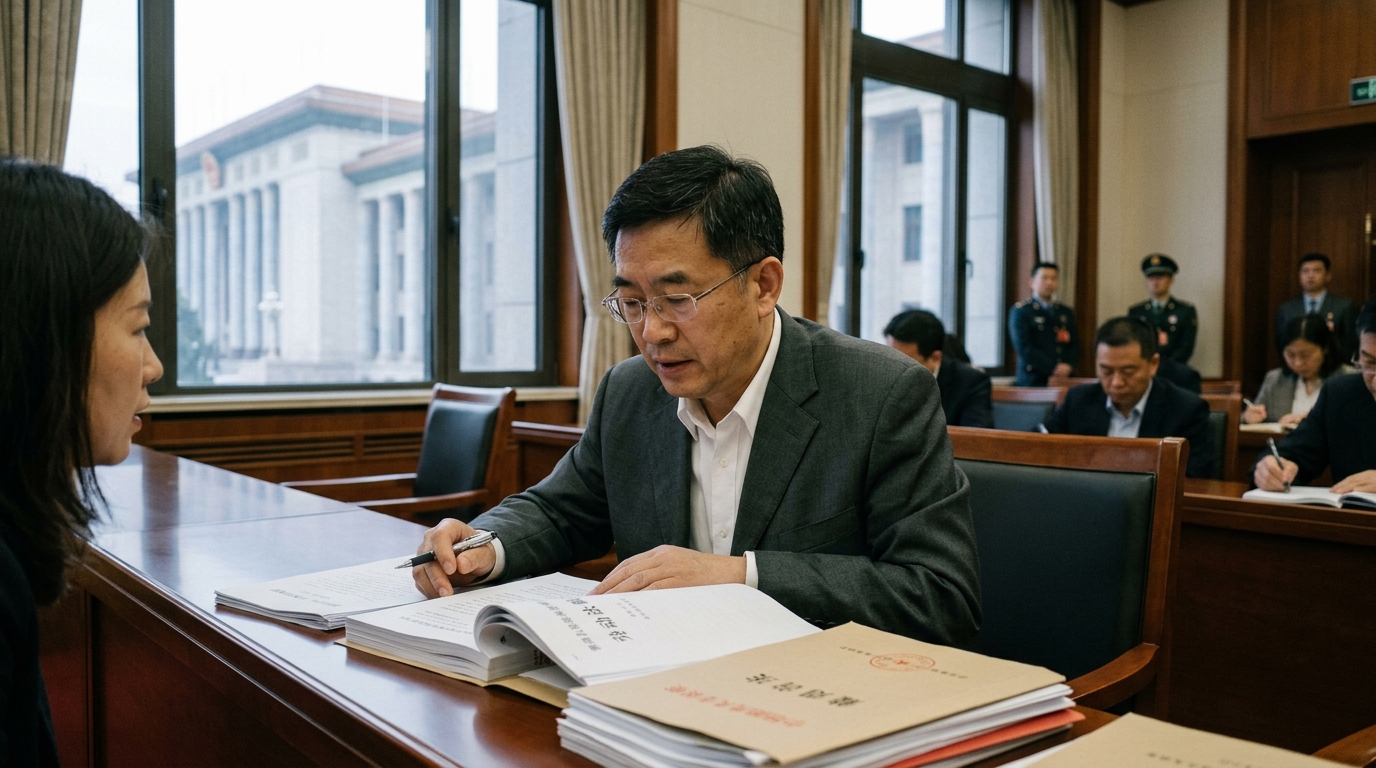
In an era where the global economy is bracing for an unprecedented restructuring due to Artificial Intelligence (AI), a judicial ruling from China has sent shockwaves through the corporate world. The Shanghai People's Court recently issued a landmark verdict, ruling that a company's adoption of AI systems does not automatically constitute an "objective change in circumstances" justifying the unilateral termination of employment contracts. This decision is not merely a legal victory for an individual worker, but a clear signal to the corporate sector: technological progress cannot be used as a pretext to circumvent labor rights.
The Case History and Legal Reasoning
The case involved a graphic designer at a technology firm who was dismissed on the grounds that his duties could now be performed faster and more cheaply by Generative AI. The company argued that this technological evolution rendered the job position redundant, falling under labor law provisions regarding "significant changes in the economic environment." However, the court held a different view. In its reasoning, it emphasized that the introduction of AI is an internal business decision aimed at improving efficiency, rather than an exogenous, insurmountable factor that makes the continuation of the employment relationship impossible.
The court highlighted that employers have an obligation to exhaust all possibilities for reskilling or relocating staff to other positions before proceeding with layoffs. This ruling highlights a critical distinction: AI should function as a tool to enhance human labor, not as a total replacement for it—at least not without a corresponding social and economic safety net.
Social Stability vs. Corporate Profit
Why would China, a country leading the AI race, choose to impose such restrictions? The answer lies in Beijing's obsession with "social harmony." Mass unemployment caused by an unchecked replacement of workers by algorithms is the Chinese leadership's greatest nightmare. While the state heavily subsidizes AI research to leapfrog the West, it simultaneously fears the social unrest that would stem from an army of unemployed white-collar workers.
- The ruling strengthens the bargaining power of workers in high-tech sectors.
- It forces companies to invest in staff training instead of opting for the easy solution of dismissal.
- It establishes a legal framework that will likely serve as a guide for similar cases in the EU and the US.
It is evident that the Chinese judiciary is attempting to walk a fine line. On one hand, it does not want to hinder the innovation that will make the Chinese economy more competitive. On the other, it recognizes that a violent transition to a worker-less economy would undermine the foundations of domestic consumption and political stability.
Global Implications: A Lesson for the West?
This news is causing a stir in Silicon Valley and European policy centers. Until now, the dominant narrative was that the market would self-regulate and that AI would create new jobs to replace those lost. However, market reality shows that the pace of change is far greater than the pace of workforce adaptation. The Chinese approach, though originating from a different political system, highlights the need for a "New Social Contract" in the age of algorithms.
"Technology is not a natural phenomenon, but a human choice. The decision to replace a human with a machine is ethical and political, not just economic," note labor law analysts.
In conclusion, the Chinese court's decision represents a milestone. It reminds governments and businesses that the digital transition must be human-centric. If AI is to bring prosperity, it cannot be built upon the ruins of labor dignity. The question remains whether Western democracies will dare to set similar limits on corporate arbitrariness or if they will allow "efficiency" to level decades of hard-won rights.





