

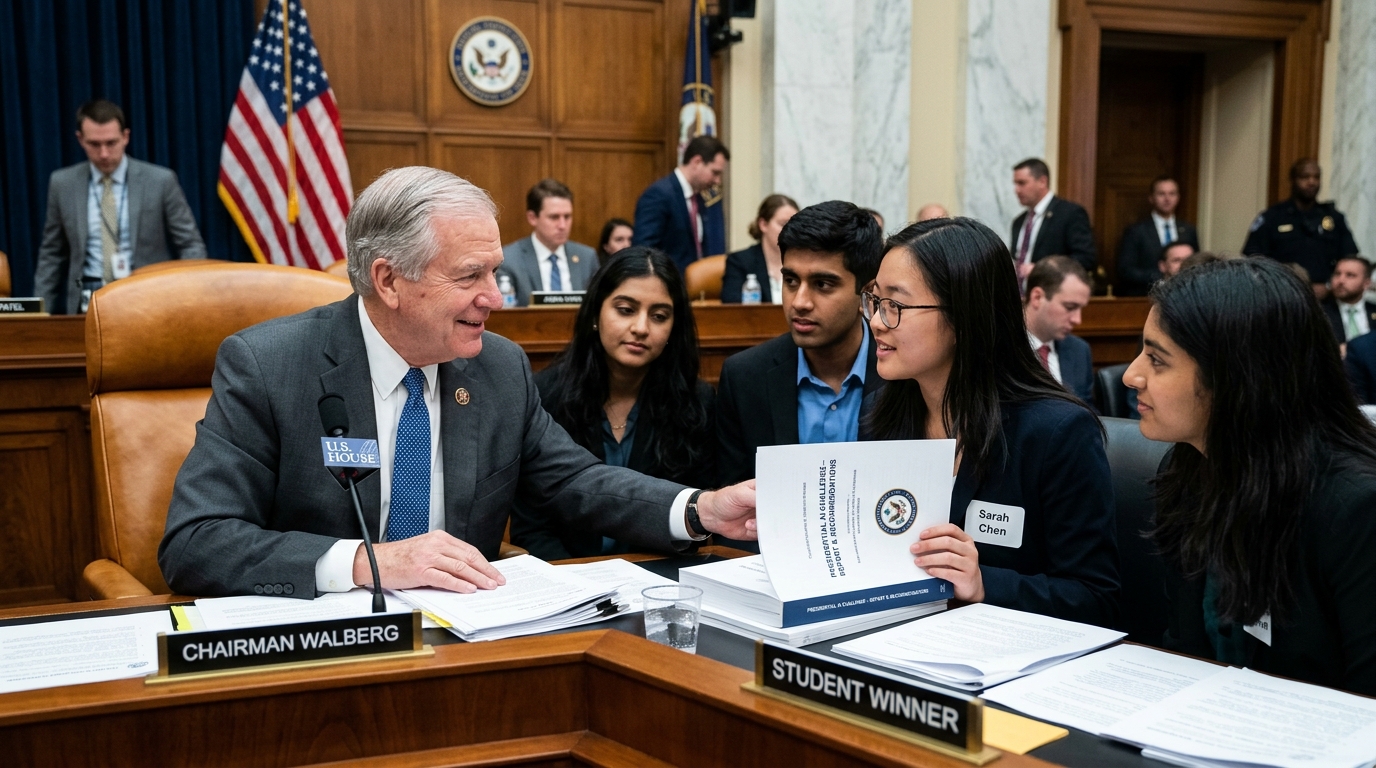
In the heart of American legislative power, the United States Capitol served as the backdrop for a meeting that many consider pivotal for the future of national competitiveness. Tim Walberg, Chairman of the Subcommittee on Health, Employment, Labor, and Pensions, welcomed the winners of the "Presidential AI Challenge for Students." This event, organized under the auspices of the House Committee on Education and the Workforce, was not merely a formal award ceremony but a strategic statement on the direction of American educational policy.
The New Generation at the Forefront of Innovation
The students who gathered on Capitol Hill are not just users of technology; they are creators. Their projects, ranging from disease diagnosis tools using machine learning to systems optimizing energy consumption in local communities, prove that Artificial Intelligence (AI) can be a powerful tool in the hands of the youth. Chairman Walberg, during his address, emphasized that understanding AI is no longer an optional skill but a fundamental requirement for tomorrow's labor market.
The Committee on Education and the Workforce is now intensely focused on how the U.S. education system can adapt to rapid changes. The students' visit served as a reminder that while legislation often lags behind technological progress, youth creativity does not wait. The winners had the opportunity to present their ideas to lawmakers, explaining not only the code behind their applications but also the ethical parameters they considered, such as data privacy and the prevention of algorithmic bias.
Political Strategy and National Security
Behind the smiling photos and award certificates lies a deep concern in Washington: the global race for AI supremacy. With China and the European Union investing billions in AI education and regulation, the U.S. feels the pressure to maintain its lead. Walberg’s initiative reflects a bipartisan consensus that investing in human capital is just as important as investing in semiconductor infrastructure.
According to political analysts, the focus on students is part of a broader effort to demystify AI for the general public. Rather than viewing technology as a threat to jobs, the committee seeks to present it as a "force multiplier" for the worker. However, the challenge remains: how to ensure these opportunities are accessible to all students, regardless of their economic status or the region where they live?
The Skills Gap and WIOA Reform
The discussion on Capitol Hill was directly linked to efforts to modernize the Workforce Innovation and Opportunity Act (WIOA). Walberg and his colleagues are exploring ways in which federal funds can be directed toward training programs that integrate AI. The presence of the students provided lawmakers with "living examples" of what is possible when STEM (Science, Technology, Engineering, Mathematics) education is combined with access to advanced computing tools.
- Educational Reform: Integrating data literacy into high school curricula.
- Public-Private Partnerships: Encouraging tech companies to offer internships to students who excel in such challenges.
- Ethics and Governance: Teaching the social implications of AI from an early stage.
Closing the event, Walberg noted that these students are not just the future, but the present of American innovation. The challenge for Congress now is to create the legislative framework that will allow these talents to flourish within borders, while ensuring that the transition to the AI economy is fair and inclusive. The meeting on Capitol Hill may have been a brief ceremony, but the questions it raised will occupy lawmakers for years to come.




