

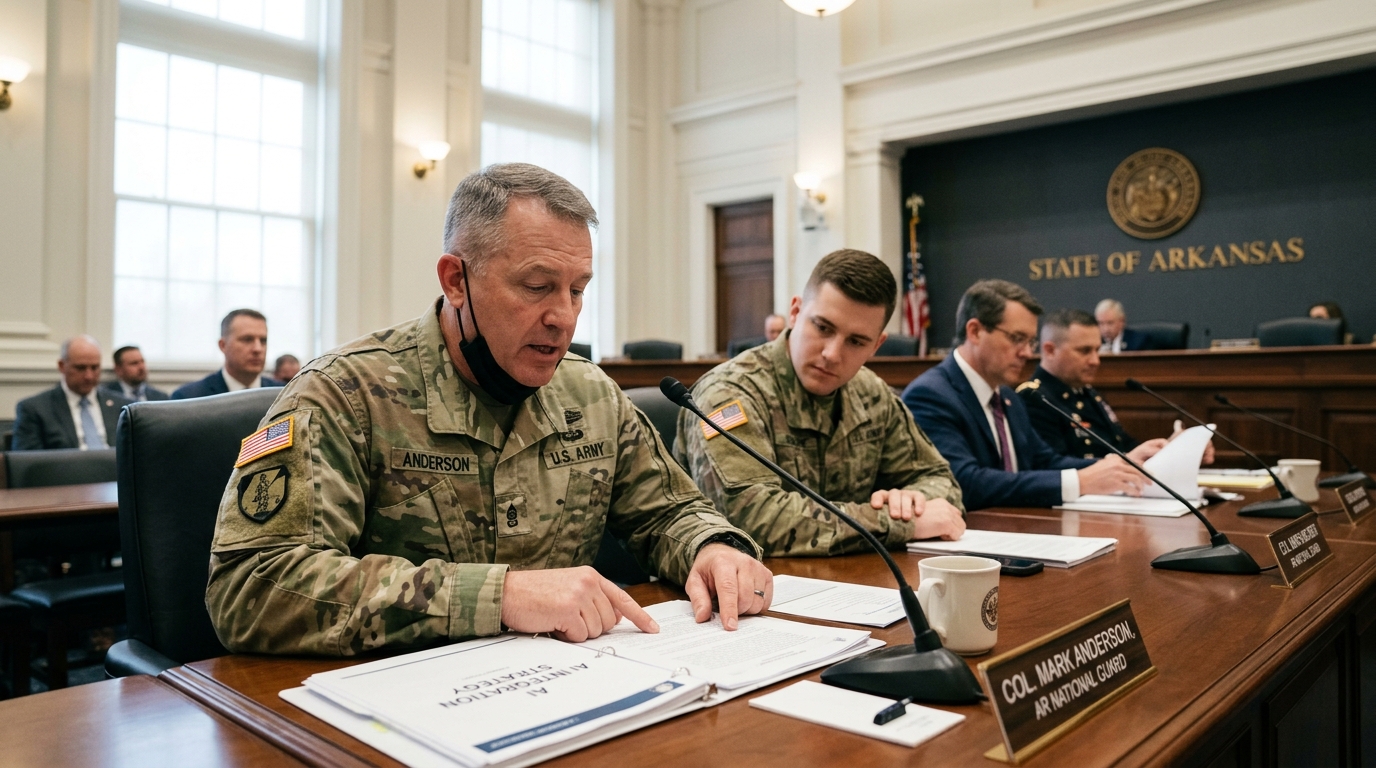
In an era where technological superiority is increasingly defined by lines of code rather than just the caliber of weaponry, the Arkansas National Guard (ARNG) is making a strategic move that places it at the vanguard of military innovation. The recent announcement regarding the adoption of Artificial Intelligence (AI) tools is not merely a software upgrade; it represents a profound shift in the doctrine of operational readiness and domestic security within the United States.
The Transition to Predictive Maintenance and Logistics
The primary application of AI within the Arkansas National Guard currently focuses on "predictive maintenance." Traditionally, military equipment—ranging from Humvees to Black Hawk helicopters—is maintained based on fixed schedules or after a failure occurs. This model is often costly and inefficient. By utilizing machine learning algorithms, the National Guard can now analyze vast amounts of sensor data to predict when a component is likely to fail before it actually does.
This approach does more than just save millions of taxpayer dollars; it ensures that the force is always mission-ready. In cases of natural disasters, such as the tornadoes or floods that frequently strike the region, response speed is a matter of life and death. AI allows commanders to know precisely which assets are available and what condition they are in, eliminating unpleasant surprises during a crisis.
Strategic Autonomy and State-Level Control
Arkansas’s move also highlights an interesting trend: the adoption of cutting-edge technologies at the state level, independent of major federal initiatives from the Pentagon. While the U.S. Department of Defense (DoD) is working on massive programs like JADC2 (Joint All-Domain Command and Control), individual National Guard units are beginning to develop their own solutions tailored to local needs.
"Artificial Intelligence is no longer a future science-fiction scenario; it is an essential tool for the modern citizen-soldier," sources close to the National Guard leadership state.
However, this decentralization brings its own set of challenges. Interoperability between the AI systems of different states remains a significant question mark. Furthermore, personnel training represents a massive hurdle. Traditional soldiers must now become familiar with data analysis and the interpretation of algorithmic outputs, transforming the National Guard into an organization that is increasingly reliant on information technology.
Ethical Dilemmas and the Decision-Making "Black Box"
Despite the logistical benefits, the use of AI in military contexts raises serious ethical questions. Although the Arkansas National Guard is currently focusing on maintenance, the line between "logistical support" and "operational decision-making" is often blurred. There is a risk that over-reliance on algorithms could diminish the critical thinking skills of human commanders.
Moreover, the transparency of algorithms—the so-called "black box" problem—is a point of contention. If an algorithm decides a unit is not ready for deployment based on flawed data, who holds the responsibility? The political leadership in Arkansas must establish strict ethical and accountability frameworks, ensuring that a human remains "in the loop" for all critical decisions.
Conclusions for the Future
The Arkansas National Guard’s initiative serves as a microcosm of the broader global AI arms race. As forces worldwide integrate automation, a military's ability to adapt technologically will determine its survival on the modern battlefield. For Arkansas, the gamble is twofold: to prove that AI can make the militia more effective without sacrificing the values and oversight that a democratic society demands from its armed forces.




