

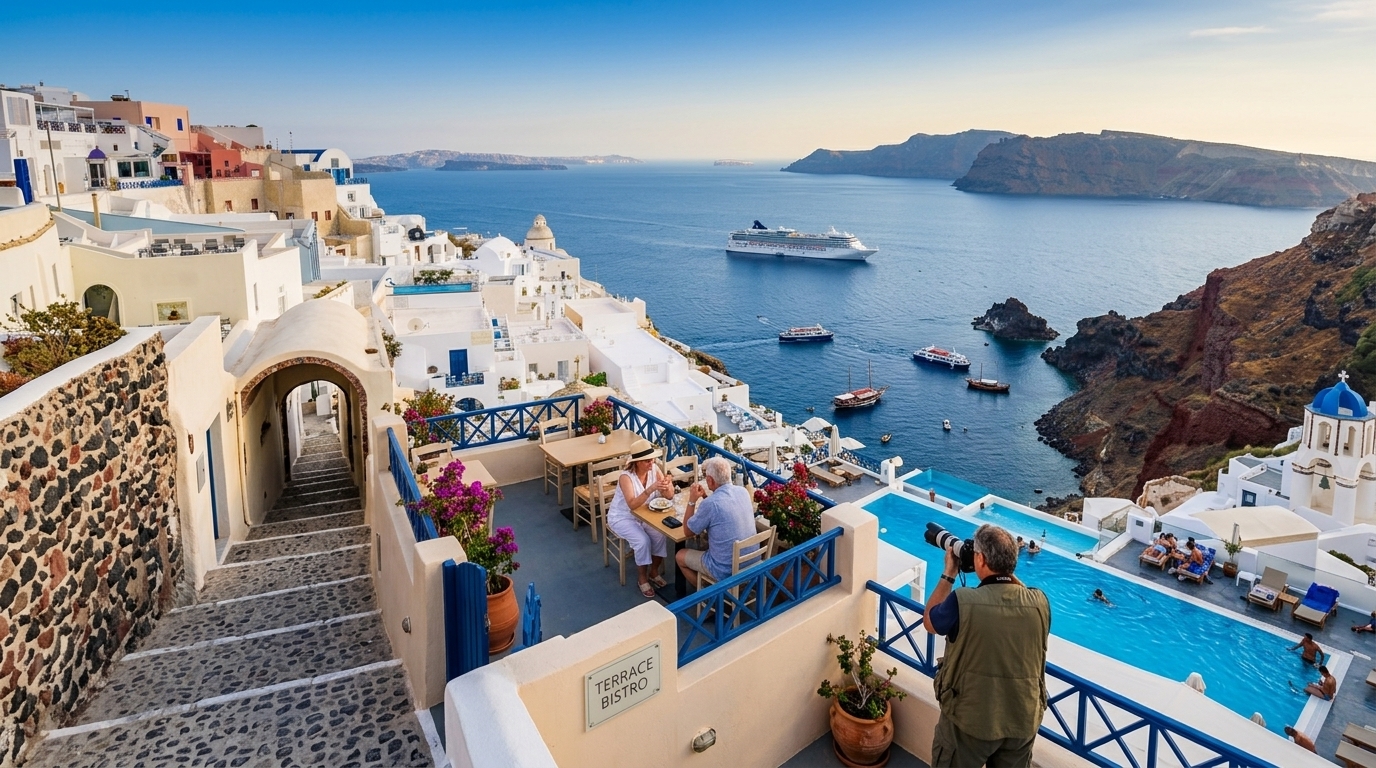
Santorini, the global ambassador of Greek tourism, stands at one of the most critical junctures in its modern history. The 2026 tourist season is unfolding with a mix of cautious optimism and deep concern. Geopolitical tremors in the Middle East, directly impacting travel flows from the United States and Asia, combined with the increasingly visible strain on the island’s infrastructure, create a scenario that demands immediate and bold action.
For decades, Santorini has been the 'golden egg' of the Greek economy. However, the image of overcrowded alleys in Oia and Fira during the disembarkation of thousands of cruise passengers has begun to erode the very product Santorini sells: exclusivity and unparalleled beauty. This year's dip in pre-bookings, while not catastrophic, serves as a loud wake-up call for the need to redefine the tourism model.
The Cruise Ship Dilemma and the 8,000-Passenger Cap
One of the most contentious issues facing the local community and stakeholders is the management of cruise tourism. After years of debate, the imposition of a daily cap of 8,000 passengers appears to be the only viable path forward. Santorini can no longer absorb the sheer volume of 'day-trippers' without degrading the experience of tourists staying in the island’s hotels, who often pay thousands of euros per night.
Cruise tourism provides significant revenue, but the cost to infrastructure—from the road network to waste management and water consumption—is disproportionate. Local authorities are pushing for a more rigorous berth allocation system to prevent the simultaneous docking of multiple mega-ships. The challenge lies in balance: how to limit numbers without damaging the island’s reputation as an accessible destination?
Infrastructure Under Siege
Santorini’s sustainability is not just measured by tourist numbers but by the resilience of its infrastructure. The island has long surpassed its 'carrying capacity.' The road network, designed for a different era, is suffocating under the weight of hundreds of tour buses and rental vehicles. Electricity and water supply, despite improvements, remain precarious during peak months.
“We cannot talk about luxury tourism when the island’s basic services are on the verge of collapse. Santorini needs a ten-year master plan, not fragmented solutions,” local business owners state.
Waste management remains another significant 'open front.' The need for modern recycling and sewage treatment plants is urgent, as the ecological burden on the caldera is now visible. Sustainability is no longer a buzzword; it is a prerequisite for the island’s survival.
Geopolitical Instability and the Changing Tourist Mix
Santorini is particularly vulnerable to international developments. The ongoing conflict in the Middle East has caused hesitation among American tourists, who are the primary source of income for high-end accommodations. Meanwhile, the economic slowdown in Europe is driving some travelers toward more affordable destinations or alternative Cycladic islands that have not yet reached 'saturation.'
The answer to this crisis seems to lie in the extension of the tourist season. Santorini possesses the unique advantage of being attractive even in winter, thanks to its extraordinary landscape and world-class viticulture. Promoting wine tourism and cultural tourism could alleviate the pressure on the summer months and provide a more stable and high-quality revenue stream.
In conclusion, Santorini is at a crossroads. The choice is between continuing a model of chaotic growth that leads mathematically to devaluation, or a strategic shift toward quality, flow control, and environmental protection. The sustainability bet is the greatest the island has ever been called upon to win.





