

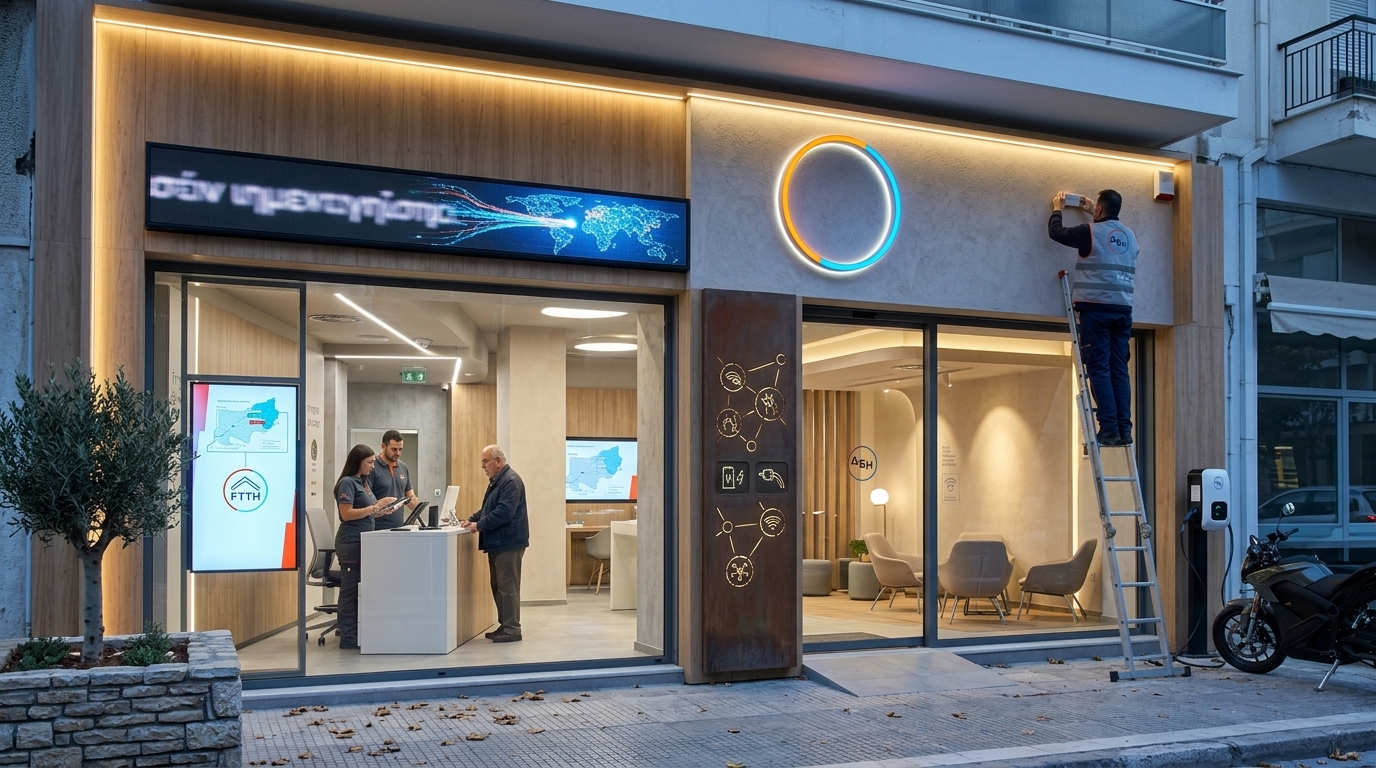
The digital revolution in Greece is gaining new momentum as PPC (Public Power Corporation), through its subsidiary PPC FiberGrid, accelerates the deployment of its fiber-to-the-home (FTTH) network. The recent announcement regarding the expansion of the service to new areas in Attica and the Peloponnese is not merely business news; it is a milestone for the modernization of the country's infrastructure. The new areas joining the network include Argyroupoli, Petroupoli, Nea Makri, Markopoulo, Paiania, Kallithea, Salamina, and Megalopoli.
The Aerial Fiber Strategy
PPC's competitive edge in the telecommunications sector lies in its utilization of the existing electricity grid. Instead of traditional, time-consuming, and costly trenching, PPC FiberGrid uses the HEDNO (DEDDIE) network for the aerial installation of fiber optics. This approach allows for rapid network deployment with lower costs and minimal disruption to the urban fabric. In Argyroupoli and Kallithea, two densely populated areas of Athens, the speed of implementation is critical to meeting the increased demand for reliable internet.
This strategy is not just technical but deeply economic. By repurposing PPC's utility poles, the company is transforming from a traditional energy provider into a multi-utility infrastructure giant. In Megalopoli, an area of particular significance due to the ongoing decarbonization process, the arrival of fiber optics offers new prospects for economic growth, enabling the attraction of digital nomads and strengthening local businesses.
Competition and the Wholesale Market
PPC's entry into the telecommunications market has caused ripples in the existing status quo. Operating primarily as a wholesale provider, PPC FiberGrid enables other providers (OTE, Nova, Vodafone) to offer high-speed services through its network. This fosters competition, potentially leading to lower prices for the end consumer. Salamina and Nea Makri, areas that often lagged behind in digital infrastructure due to geographical challenges, are now gaining access to speeds reaching 1 Gbps.
- Expansion into 8 new strategically important areas.
- Utilization of the aerial network for speed and cost-efficiency.
- Targeting 1.7 million households by the end of 2025.
- Enhancing digital convergence between Attica and the provinces.
This move is part of the broader government plan for the country's digital transition, as Greece has traditionally ranked low in the EU for fiber optic penetration. PPC's presence acts as a catalyst, forcing other market players to accelerate their own investments.
Social and Economic Dimensions
Beyond the numbers and technical specifications, the expansion of PPC Fiber has a strong social impact. In areas like Petroupoli and Markopoulo, access to high-speed internet is no longer a luxury but a basic necessity for education, remote work, and entertainment. PPC seems to understand that its role in Greek society is evolving. From lighting up homes, it is now taking on the responsibility of connecting them to the rest of the world.
"Fiber optics is the 'electricity' of the 21st century. Without it, economic growth is impossible," market executives note, highlighting the importance of investing in next-generation infrastructure.
However, challenges remain. Bureaucracy in licensing and the need for coordination with municipalities (as in the case of Paiania) can cause delays. Nevertheless, PPC's model appears to bypass many of these obstacles due to its ownership of the poles, giving it an undeniable comparative advantage. The challenge for 2026 is to maintain this pace of development so that Greece can stop being Europe's laggard in telecommunications.





