

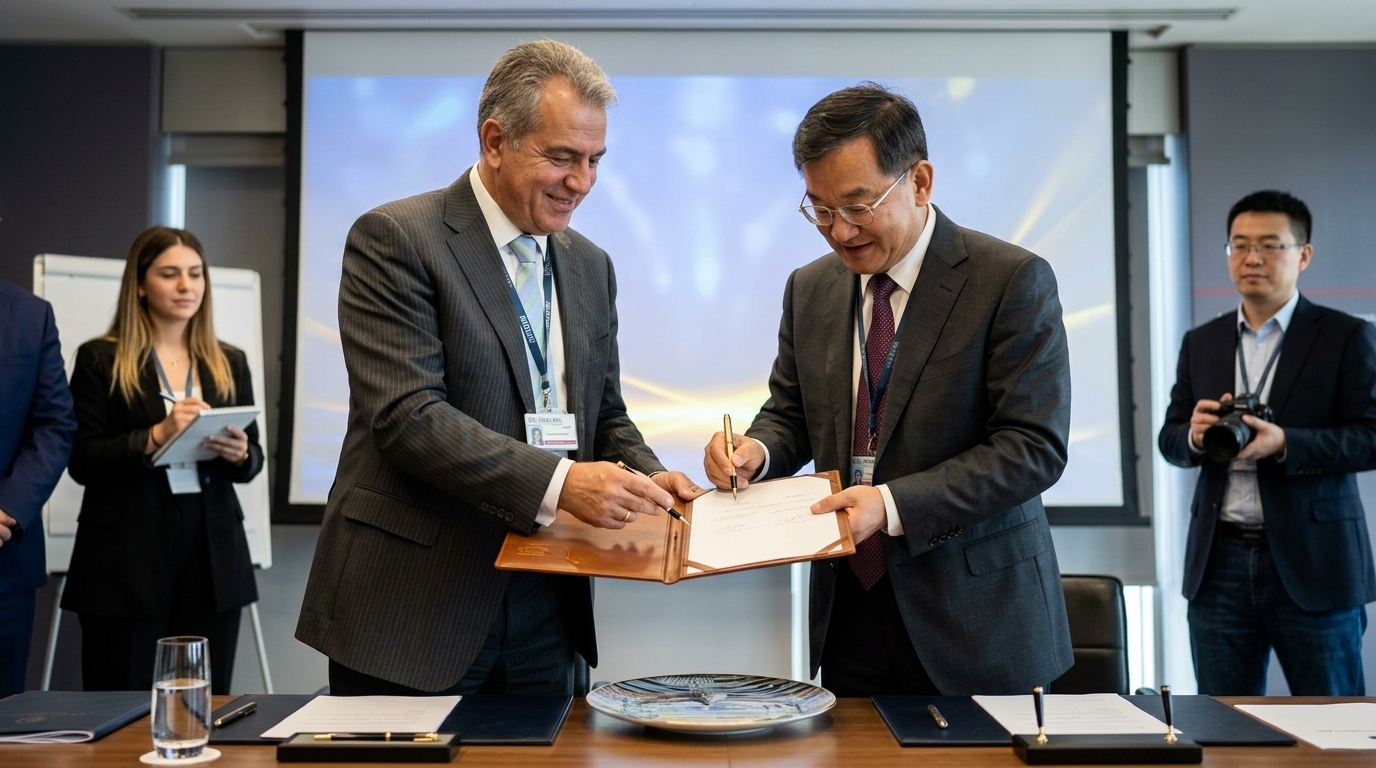
In a move that highlights Greece's evolving role as a communication bridge between East and West, Naftemporiki, the country's leading financial daily, has signed a Memorandum of Understanding (MoU) with the Chinese media giant, Dazhong News Group. This agreement, signed during a high-level visit by a delegation from China's Shandong Province to the newspaper's headquarters, represents more than a mere business partnership; it is a strategic alignment in the fields of information, technology, and cultural exchange.
Shandong Province, globally recognized as the birthplace of the great philosopher Confucius, is one of China's most significant economic and cultural hubs. The selection of Naftemporiki as a strategic partner underscores the trust Chinese organizations place in the credibility of the Greek financial press, at a time when bilateral economic relations are under intense international scrutiny.
The Strategic Significance of the Partnership
The MoU outlines a broad spectrum of collaborative actions, ranging from news content exchange to the joint production of journalistic investigations. The primary objective is to provide the Greek business community with comprehensive insights into opportunities within the Chinese market, while simultaneously projecting Greece's economic landscape to the vast audience of Shandong and China at large.
Both organizations have committed to working closely to foster cultural understanding. In an era often characterized by misinformation and geopolitical friction, direct communication between two major journalistic entities serves as a channel for truth and mutual respect. Naftemporiki, with its decades of expertise, will act as Shandong’s "window" to Europe, while Dazhong News Group will offer invaluable access to data and analysis regarding the world's second-largest economy.
Technology and AI: Powering Modern Journalism
One of the most compelling aspects of this agreement involves technological cooperation. With the rapid ascent of Artificial Intelligence (AI), real-time translation and content adaptation have become tangible goals. This partnership is expected to leverage advanced AI tools to bridge the linguistic divide, enabling an instantaneous flow of news from Chinese to Greek and vice versa, without sacrificing nuance or journalistic integrity.
Furthermore, the exchange of know-how in digital media and Big Data management will allow both groups to enhance their user experience. Naftemporiki has been consistently investing in digital transformation, and gaining access to the innovations of a Chinese conglomerate like Dazhong News Group provides a significant competitive edge in the domestic market. This synergy reflects the broader trend of media companies evolving into tech-centric information hubs.
Economic Implications and the "Belt and Road" Initiative
This collaboration fits into the broader framework of the "Belt and Road Initiative" (BRI), where Greece holds a pivotal position as the entry point for Chinese products and investments into the European Union. The connection between the Port of Piraeus and the industrial centers of Shandong is already robust; now, this connection gains a "voice" through the media.
Analysts believe that strengthening communication ties will facilitate smoother investment flows, as investors on both sides will have access to authoritative and specialized information. Understanding regulatory frameworks, consumer habits, and economic trends is essential for the success of any cross-border business venture, and the Naftemporiki-Dazhong partnership aims to fill exactly that information gap.
Cultural Diplomacy: From Socrates to Confucius
Beyond the spreadsheets and business protocols, the meeting of the two delegations carried a profound symbolic weight. Referencing Shandong as the land of Confucius serves as a reminder that the relationship between Greece and China is rooted in two of the world's oldest and most influential civilizations. Journalism, in this context, functions as a modern form of cultural diplomacy.
The agreement also includes the organization of joint events, forums, and journalist exchange programs, strengthening the bonds between the two peoples. At a time when the global geopolitical landscape is shifting rapidly, such initiatives prove that information and culture can serve as stable foundations for peaceful and productive coexistence between nations. As we move further into 2026, the success of this partnership will likely serve as a blueprint for other cross-continental media alliances.





