

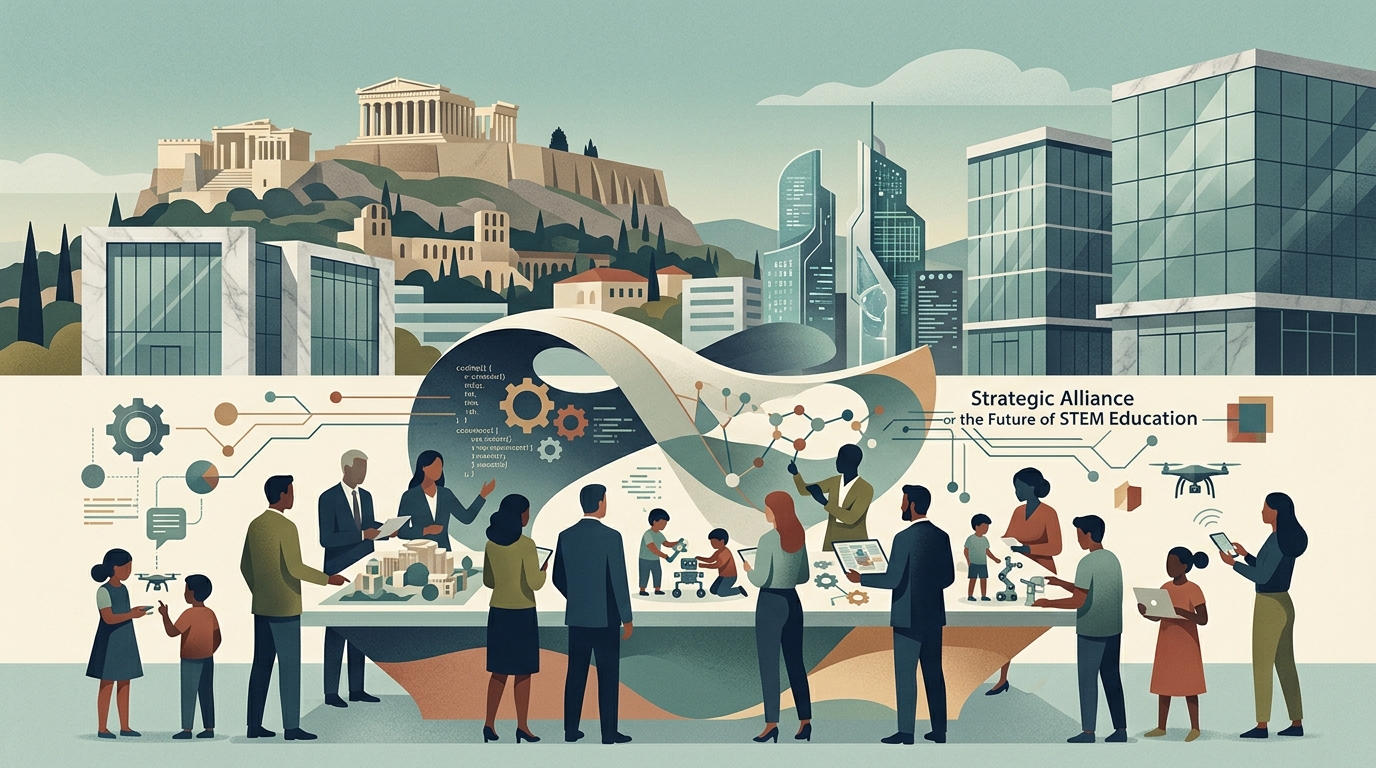
In an era where digital transformation is no longer an option but an imperative, the Greek educational system is taking a decisive step toward the future. The recent signing of a Memorandum of Cooperation (MoC) between the Ministry of Education, Religious Affairs, and Sports and the 'Together for Children' Association for the implementation of the 'STEM Education & Soft Skills' program represents a move of high symbolism and substance. Minister Sophia Zacharaki and the President of the Association, Alexandra Martinou, sealed a partnership that aims to redefine how students in Attica interact with technology and critical thinking.
The Synthesis of Technology and Human-Centricity
The program is not limited to simply teaching coding or robotics. Its innovation lies in its holistic approach: combining the hard skills of STEM (Science, Technology, Engineering, Mathematics) with soft skills. In today's professional arena, an individual's ability to program is just as important as their ability to collaborate, solve problems, and communicate ideas effectively. This initiative recognizes that technology without empathy and strategic thinking remains a hollow tool.
According to the cooperation framework, the program will initially be implemented in schools across Attica, offering students the chance to experiment with modern equipment while teachers receive the necessary support to integrate these methodologies into daily teaching. The involvement of 'Together for Children' ensures expertise derived from years of experience in child protection and education, adding a vital social dimension to the project.
The Role of the Third Sector in Public Education
This collaboration highlights a growing trend in Greece: the partnership between the state and non-governmental organizations (NGOs) or philanthropic foundations to fill gaps that the traditional bureaucratic system struggles to bridge quickly. The 'Third Sector' now acts as an innovation accelerator. 'Together for Children' provides not only resources but also a flexible implementation model that can be adapted to the needs of each school unit.
- Enhancing critical thinking through experiential workshops.
- Access to cutting-edge technology for students from diverse socioeconomic backgrounds.
- Teacher training in 21st-century pedagogical trends.
- Creating an environment that encourages teamwork and innovation.
However, the success of such programs depends on their duration and sustainability. Signing an MoC is just the starting point. The challenge lies in integrating these practices into the official curriculum and expanding them beyond Attica to avoid creating a 'digital divide' between the capital and the provinces.
Challenges and Perspectives
Despite positive intentions, the reality of Greek education remains complex. Infrastructure in many schools is outdated, and resistance to change is often a major hurdle. The 'STEM Education & Soft Skills' program must prove it can transcend the narrow boundaries of a 'project' and become part of the school's culture. Furthermore, the focus on soft skills is crucial in an age where Artificial Intelligence (AI) threatens to automate many technical tasks, making human qualities—such as ethical judgment and creativity—more valuable than ever.
'Investing in education is the only investment that pays interest indefinitely. Through this collaboration, we are not just giving computers to children; we are giving them the tools to build their own future,' noted sources from the Ministry.
In conclusion, the initiative by the Ministry of Education and 'Together for Children' is a promising sign. If it manages to inspire students and teachers alike, then we will have taken a substantial step toward a society that does not fear technology but uses it as a tool for prosperity and progress.




