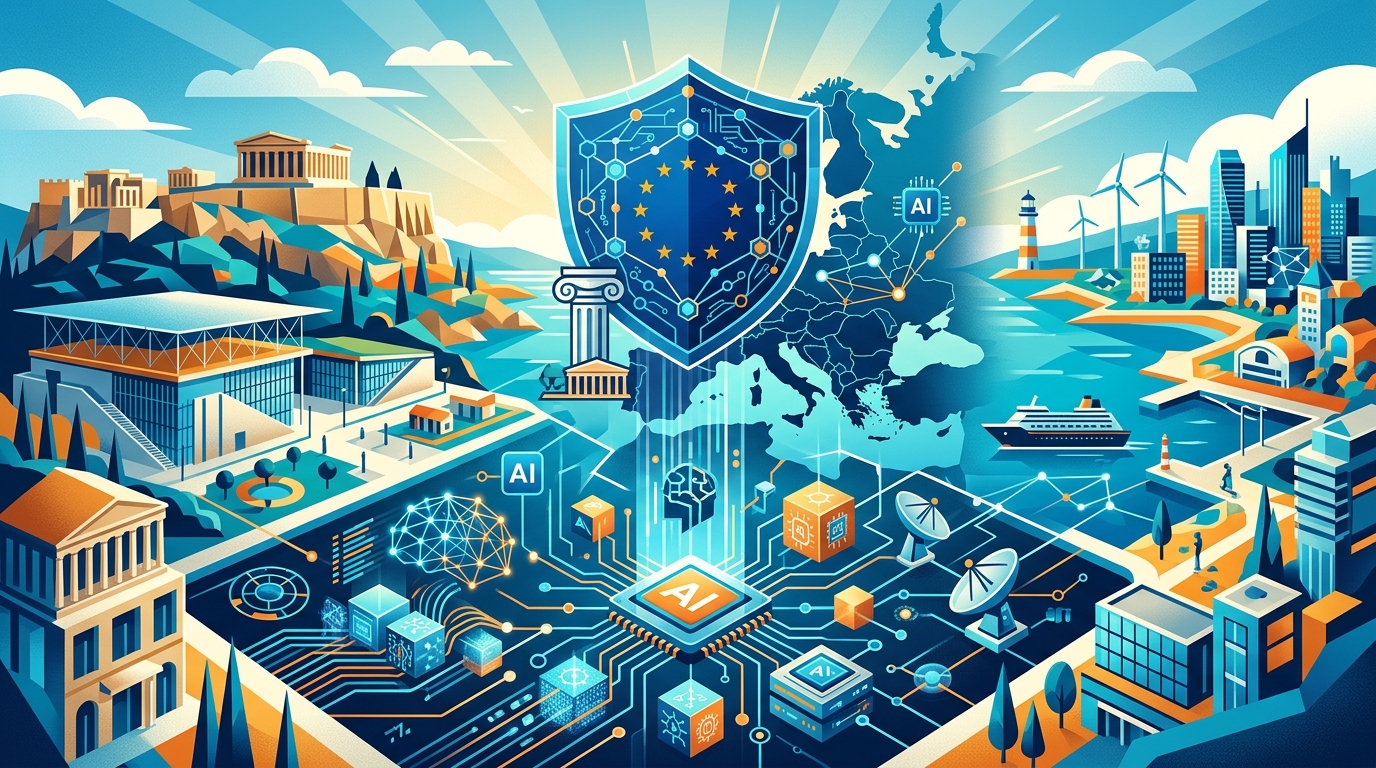
In an era where Artificial Intelligence (AI) is no longer a futuristic promise but a daily reality reshaping economies, education, and social cohesion, Kyriakos Pierrakakis has stepped forward with a warning that resonates far beyond Greek borders. Speaking on Vergina TV, the Minister of Education, Religious Affairs, and Sports—the man synonymous with the digital transformation of the Greek state—addressed a fundamental truth: the regulation of powerful AI models exceeds the capabilities of any single nation, or even an entire continent if it remains fragmented.
The Paradox of Scale and Regulatory Insufficiency
Mr. Pierrakakis emphasized that so-called "Frontier Models," such as those developed by giants like OpenAI, Google, and Anthropic, now possess computational power and data volumes that dwarf the infrastructure of many EU member states. "No country or continent can regulate powerful AI models alone," he stated, pointing to the necessity for a global, but primarily a cohesive European strategy. His concern lies in the fact that while Europe leads in legislation with the AI Act, it risks falling behind in innovation if regulation is not accompanied by a unified investment and strategic direction.
The Minister's analysis is based on the premise that AI is "border-agnostic." Data flows freely, and algorithms trained in California or Shanghai directly impact a student in Athens or a worker in Paris. Consequently, a fragmented approach by each EU member state would lead to a bureaucratic labyrinth that stifles local startups without effectively touching global players.
Education as a Bastion and Accelerator
As Minister of Education, Kyriakos Pierrakakis inextricably links technological progress with educational reform. According to him, the answer to the AI challenge is not merely legislative but cognitive. Greece, he noted, must prepare future generations not just to use AI, but to understand its ethical and operational parameters. "Education is our defense against misinformation and our tool for productivity," he remarked.
- Integration of AI tools in classrooms for personalized learning.
- Upskilling educators in new digital competencies.
- Creation of national datasets to support the training of models in the Greek language, ensuring cultural sovereignty.
Pierrakakis stressed that if Europe fails to develop its own Large Language Models (LLMs) reflecting its values and history, it will be forced to "import" ethics and culture from other regions, which would have long-term consequences for social cohesion.
Digital Humanism: The European Identity
At the heart of his argument lies the term "Digital Humanism." The Minister argues that Europe must become the global pole that combines technological prowess with respect for human rights. However, this requires a "common strategy" involving shared cloud and supercomputing infrastructure, as well as a single data market.
"It is not enough to be the world's regulator. We must also be the creators. Regulation without innovation leads to dependence, and innovation without regulation leads to chaos," he noted pointedly.
This intervention comes at a critical juncture as the EU seeks to balance the strict enforcement of the AI Act with the need to boost competitiveness against the US and China. Pierrakakis, drawing from his experience in digitizing the Greek state, proposes a model where the state acts as an accelerator, providing the framework and security while allowing the private sector and academia to lead creation.
In conclusion, the Minister pointed out that while Greece has made leaps, the road ahead remains long. The country's participation in European AI cooperation schemes is of strategic importance, as it allows a nation of Greece's size to have a voice in global developments. The message is clear: in the age of AI, isolation is a recipe for failure, and unity is the only path to sovereignty.