

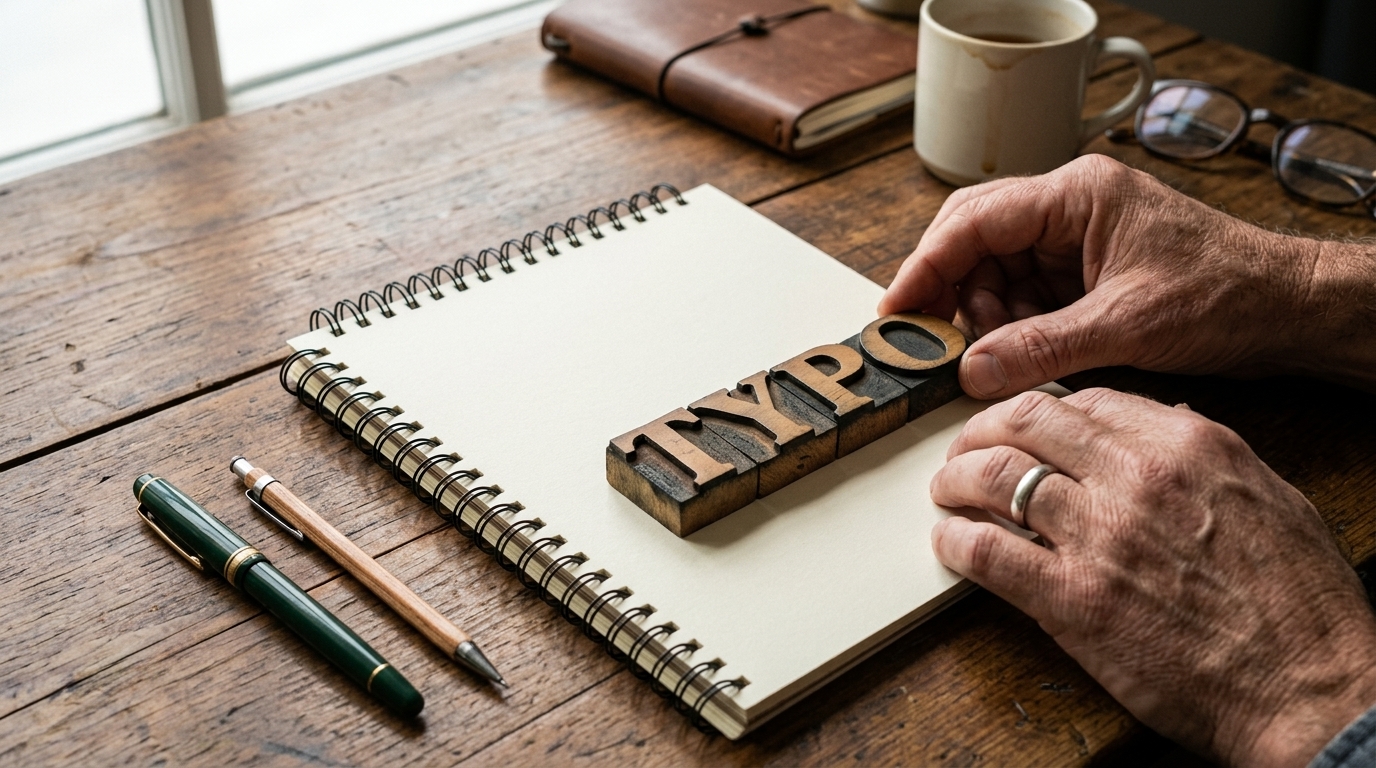
For decades, the spelling error was the ultimate enemy of professionalism. A misplaced vowel, a forgotten double consonant, or a wrong accent in a CV or a formal email was enough to condemn the sender to the realm of sloppiness. Orthography was the social filter that separated the diligent from the careless. However, as we move through 2026, the rise of Generative AI has completely upended this hierarchy, turning the mistake into an unexpected 'luxury' and a symbol of authenticity.
The Cold Perfection of Algorithms
ChatGPT, Claude, and Gemini don't get tired, they don't rush, and most importantly, they don't make typos. Their ability to produce text with flawless syntactic structure and grammatical precision has created a new standard of communication. But this perfection comes at a price: uniformity. AI-generated texts often carry a 'sterile' feel, a lack of personal style, and a flow that feels too polished to be human.
In this context, the appearance of a typo now functions as a sort of 'digital fingerprint.' When we read a message with a small imperfection, our brain receives a subconscious signal: 'A human wrote this.' The imperfection becomes proof that behind the words is a biological entity that was in motion, perhaps in a hurry, and didn't use an algorithm to filter its thoughts. It is a return to 'raw' communication.
The Strategy of 'Controlled Imperfection'
This shift has not gone unnoticed by communication experts and marketing gurus. We are now witnessing the phenomenon of 'strategic imperfection.' Brands wanting to project a more human and approachable persona on social media are consciously choosing not to correct minor errors in their posts or are adopting a more relaxed, almost oral language. The goal is to avoid the 'uncanny valley' of AI, where something looks so perfect that it ends up triggering distrust.
In Greece, where the language is multi-layered and orthography is historical, the phenomenon takes on special dimensions. The use of 'Greeklish' (Greek written with Latin characters), although it had receded in recent years, is making a comeback in certain contexts as a declaration of 'non-robotic' identity. Even the choice of specific idioms or the deliberate omission of accents in quick messages serves as a communication code that AI struggles to mimic naturally, despite its continuous improvements in the Greek language.
The Social Cost of Automation
However, turning the error into a luxury carries risks. If we begin to view correctness as an exclusive trait of machines, we risk devaluing the importance of education and linguistic culture. The ability to write correctly should not be seen as 'mechanical,' but as a skill that reflects the structure of thought. The paradox is that while AI can correct our mistakes, it cannot understand the depth of meaning behind them.
"The error is the crack through which the light of humanity enters our digital daily lives," note digital culture analysts.
In the future, we might see AI tools that add 'artificial typos' to make content appear more human—an ironic development that will force us to seek new criteria for authenticity. Until then, the next time you send an email with a small typo, don't rush to apologize. You may have just given your recipient the most sincere proof that you are still here, alive and real.
Conclusion: A New Linguistic Ethic
The era of ChatGPT forces us to redefine what we consider 'quality' text. If quality is defined only by technical excellence, then the machines have already won. But if quality is defined by connection, emotion, and the personal stamp, then human imperfections remain our last bastion. The spelling error is no longer a flaw; it is a declaration of independence from the algorithm.





