

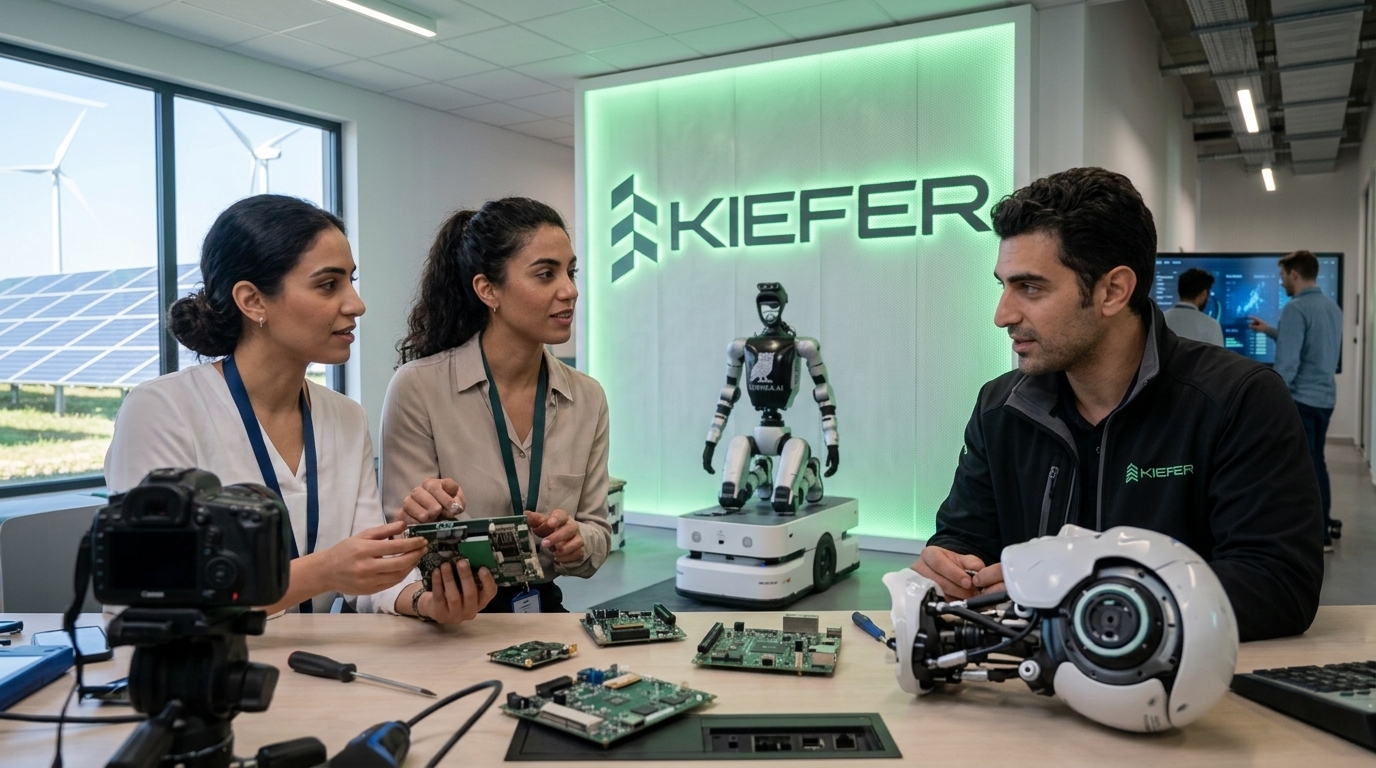
The era when artificial intelligence was considered a distant privilege of Silicon Valley giants is long gone. Today, the battle for "digital sovereignty" is fought at a local level, and in Greece, Kiefer seems to be taking on a role that goes beyond the narrow confines of a traditional energy company. With an ambitious plan that includes building proprietary data centers, developing specialized large language models (LLMs), and integrating advanced robotics, the company is attempting to create a fully vertically integrated AI production chain on Greek soil.
Energy as the Foundation of Artificial Intelligence
The paradox of artificial intelligence is that, while it is an intangible technology, its physical resource requirements are colossal. AI models require massive computing power, which in turn consumes vast amounts of energy. This is where Kiefer's strategic advantage lies. With deep roots in the Renewable Energy Sources (RES) sector, the company can power its digital infrastructure with "green" electricity, reducing both operating costs and environmental footprint.
Creating high-performance data centers in Greece is not just a construction challenge; it is a geopolitical move. In a world where data is the "new oil," storing and processing it within national borders offers security and speed. Kiefer is investing in infrastructure capable of hosting the latest generation of GPU clusters, allowing for the training of models that understand the nuances of the Greek language and reality.
The Greek LLM and Cultural Specialization
A central point of Kiefer's strategy is the development of language models that are not mere translations of English-speaking algorithms. The Greek language, with its rich inflection and complex syntax, is often "misinterpreted" by general models like GPT-4. Kiefer aims to create an ecosystem where AI can serve the public sector, legal science, and domestic entrepreneurship with accuracy approaching 100%.
- Training on Greek texts, legislation, and historical archives.
- Reducing "hallucinations" regarding local issues.
- Ensuring data privacy in compliance with GDPR.
This approach allows the company to offer "AI as a Service" solutions to businesses that are hesitant to trust their sensitive data to overseas servers. Vertical integration, from energy production to the user interface (UI), creates a closed, secure, and efficient circuit.
Robotics: AI in the Physical World
Kiefer's strategy doesn't stop at the computer screen. Expansion into applied robotics is the next logical step. Utilizing the computing power of its data centers, the company is developing solutions for production automation, critical infrastructure surveillance, and energy park management. Robotic systems equipped with computer vision can identify faults in photovoltaic panels or optimize the supply chain in real-time.
"Artificial intelligence is not a tool; it is the new environment in which every business will operate in the future. Whoever controls the infrastructure, controls their future," market executives note, commenting on Kiefer's move.
Challenges and the Future of Greek Innovation
Despite the optimism, the road is not without obstacles. Competition from global hyperscalers (Microsoft, Amazon, Google) is formidable. However, Kiefer is betting on flexibility and local expertise. The challenge of finding specialized personnel remains, but the creation of such an ecosystem can act as a magnet for the repatriation of Greek scientists (Brain Gain).
In conclusion, Kiefer is not just building data centers; it is building the digital highways on which the Greek economy will travel in the coming decades. The connection between energy and information is a strategic choice that places Greece on the high-tech map, no longer as a mere consumer, but as a creator.





