

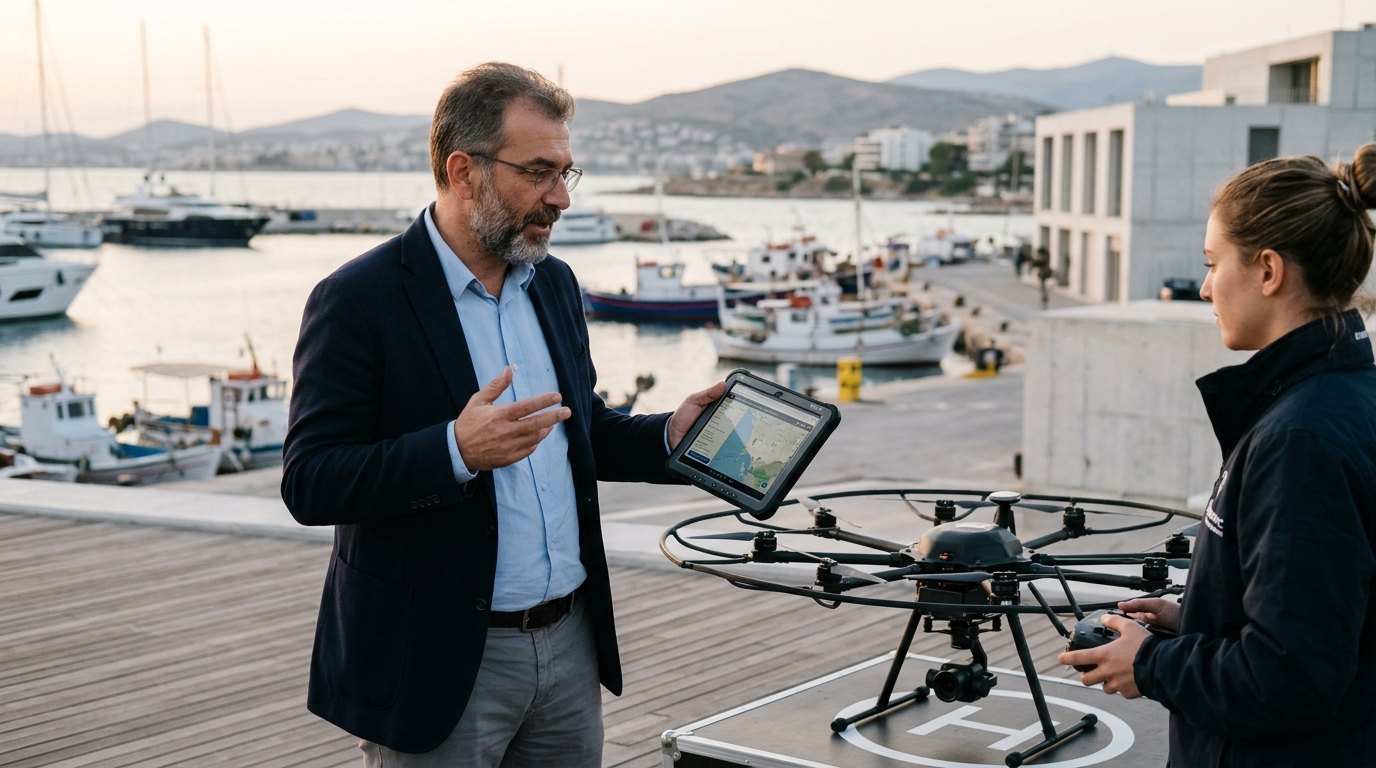
The sea has always been the vital space of Hellenism, but also a field of constant challenges. Today, technology is stepping in to solve one of the most critical problems in navigation: locating people at sea during emergencies. A Greek researcher, leveraging the capabilities of Artificial Intelligence (AI), is developing a specialized rescue drone capable of identifying shipwreck victims with precision that surpasses the human eye, even under adverse weather conditions.
The Technology Behind the Drone's Eye
The system is not merely a camera transmitting footage to an operator. The heart of the innovation lies in 'Edge AI'—on-board computing. The drone is equipped with high-power processors running Deep Learning algorithms in real-time. This means data analysis occurs on the flight vehicle itself rather than a remote server, eliminating delays caused by long-distance signal transmission.
The algorithms have been trained on thousands of hours of visual material, learning to distinguish human forms, life jackets, or even the reflection of a flashlight from wave foam and solar glints. The system utilizes multispectral cameras, combining visual imagery with thermal imaging. This allows for the detection of human body heat, which appears as a 'hot spot' against the cold marine environment, even in total darkness.
Autonomy and Operational Efficiency
One of the biggest hurdles in Search and Rescue (SAR) operations is time. In cases of hypothermia, every minute counts. Traditional assets, such as helicopters and Coast Guard vessels, have high operating costs and require significant deployment time. An AI drone can take off immediately from a coastal base or even a ship's deck.
The drone autonomously follows predefined search patterns, which adapt dynamically based on currents and wind speeds. When the AI system identifies a potential target, the drone descends to a lower altitude for confirmation, immediately transmits precise GPS coordinates to the operations center, and can even deploy a self-inflating life raft or a location beacon.
Greek Added Value and the Global Context
The development of such technologies by Greek scientists highlights the high caliber of domestic research potential. In a country with thousands of kilometers of coastline and hundreds of islands, the need for effective surveillance and rescue is a national priority. This specific research is not only relevant to the Coast Guard but has applications in commercial shipping, tourism, and border protection.
However, the challenge remains the transition from the laboratory to mass production. Integrating these systems into official rescue protocols requires rigorous certification and cooperation with state authorities. Furthermore, ethical and data protection issues arise, as continuous aerial surveillance with AI must be strictly confined to its humanitarian role.
The Future: Drone Swarms and Collaboration
The next step in the Greek researcher's work is the utilization of drone 'swarms.' Instead of a single unit, a group of 5-10 drones will be able to 'comb' vast sea areas simultaneously, communicating with each other to fill gaps in coverage. This collective intelligence will allow for the location of survivors in timeframes previously thought impossible, turning the Aegean into a safer sea for everyone.





