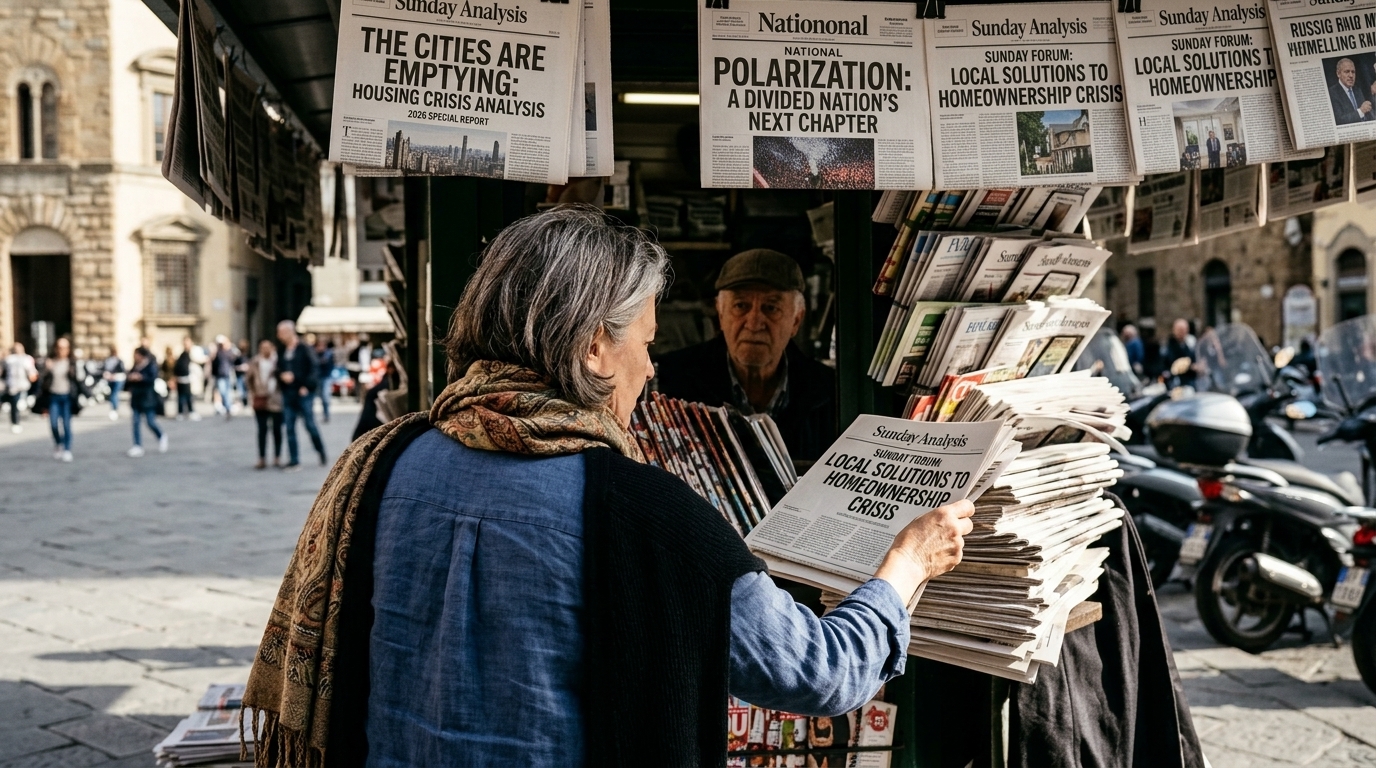
Sunday in Greece remains traditionally the day of political reflection and journalistic analysis. Today, June 28, 2026, the newspaper front pages are not merely a record of current events but a mirror of the deep social and economic fissures running through the country. As we navigate the mid-2020s, the issues dominating public discourse have shifted from pure fiscal management to the survival of the middle class and the stability of the political system.
The Housing Crisis at the Forefront: 'Apogevmatini' and Social Pressure
The Sunday edition of 'Apogevmatini' chooses a headline that strikes at the heart of the single biggest problem facing the average Greek in 2026: "All the Money on Housing." This is not just journalistic hyperbole; it is a reflection of a reality where housing costs now absorb over 40% of disposable income for the majority of the population. The government, under pressure from polling data, appears to be focusing its efforts on subsidy policies and "social reciprocity" programs, attempting to stem the tide of discontent.
The newspaper's analysis focuses on new regulations for short-term rentals (Airbnb), tax incentives for owners to open closed apartments, and an ambitious renovation program for old buildings. However, the question remains: are these measures enough to reverse a decade of underinvestment in housing? The real estate market in 2026 is at a breaking point, with sale prices remaining at staggering heights, fueled by international demand and the "Golden Visa," despite various institutional modifications.
Political Storm: 'Dimokratia' and the End of an Era
On the opposite end, 'Kyriakatiki Dimokratia' opts for an extremely aggressive headline: "Mitsotakis is Over." The newspaper, known for its opposition stance, attempts to predict the end of New Democracy's dominance, citing internal party friction and a generalized sense of social fatigue. 2026 finds the political system in a phase of realignment, where traditional parties struggle to maintain cohesion against emerging forces and voter dissatisfaction.
The report speaks of "secret polls" and "behind-the-scenes maneuvers" for succession, while emphasizing scandals that, according to the paper, have eroded public trust. This rhetoric reflects the intense polarization characterizing Greek social media and public discussion, where political confrontation has once again taken on a personal character, reminiscent of earlier, more turbulent decades.
Economic Rationalism or Populism? 'Eleftheros Typos' and 'Money Trees'
'Eleftheros Typos tis Kyriakis' intervenes in the debate with a critical look at opposition promises, speaking of "Self-delusions and money trees." This is a term that has taken root in Greek political discourse since the memorandum era, used to point out a lack of fiscal seriousness. The newspaper argues that proposals for generous wage increases and mass public sector hiring, heard from the left of the political spectrum, lack a financial basis and risk leading the country into new adventures.
- The conflict over fiscal space ahead of the 2027 budget.
- Warnings from Brussels regarding deficits and debt.
- The need for reforms that will boost productivity rather than just consumption.
This approach highlights Greece's great dilemma in 2026: How can social justice be combined with fiscal discipline in an environment of rising interest rates and geopolitical uncertainty? The "battle of the front pages" is, in reality, a battle over which narrative will prevail at the next ballot box.
"Sunday press journalism in Greece remains the last bastion of analytical thought in a world overwhelmed by ephemeral tweets and algorithmic news."
In conclusion, today's front pages reveal a country in transition. The housing crisis is not just an economic problem but a time bomb at the foundations of social cohesion. Political tension, on the other hand, shows that the period of "stability" is now being openly challenged, with citizens seeking tangible solutions to their daily deadlocks. June 28, 2026, will be remembered as the moment Greece was called to choose between managing decline and searching for a new vision.