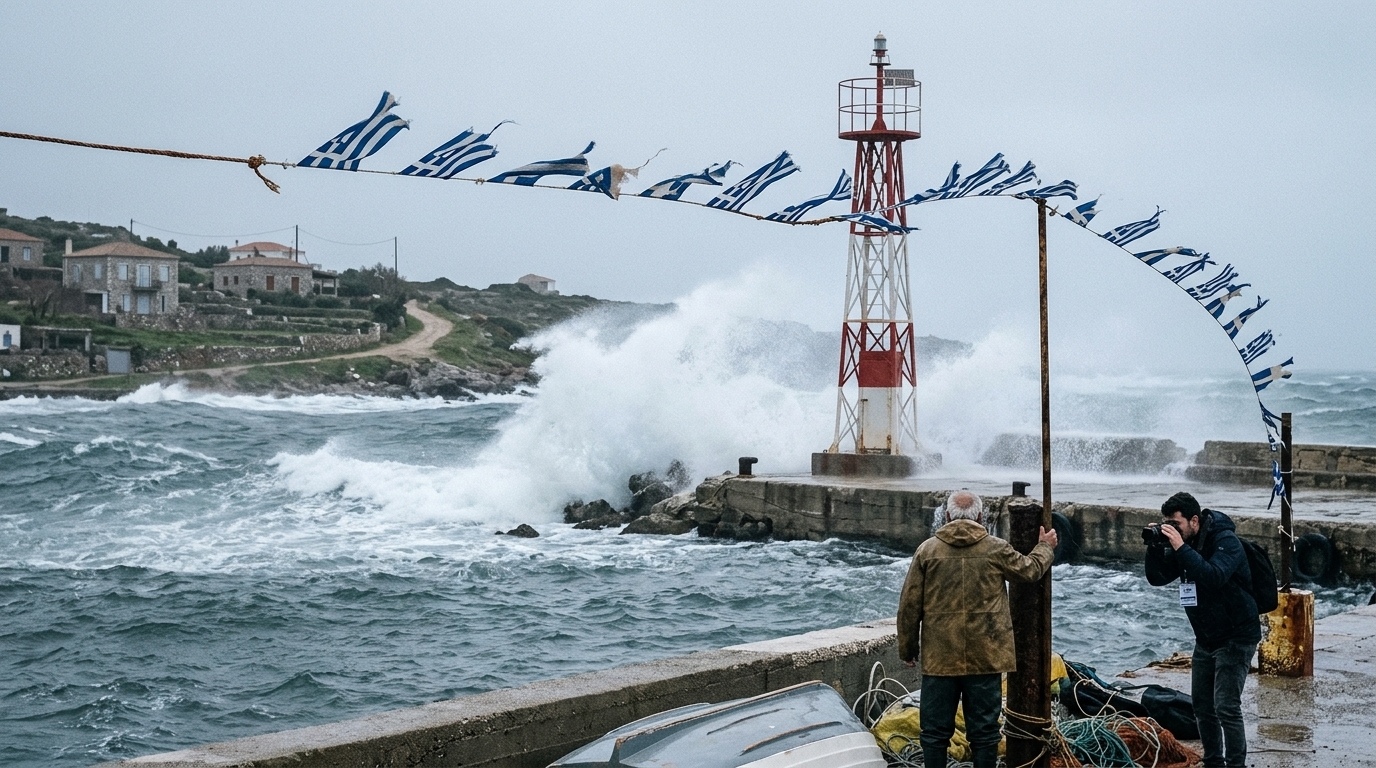
Sunday, June 28, 2026, marks a challenging day for Greece as the country finds itself trapped between a rising thermal wave and the fierce 'Meltemia' winds of the Aegean. According to the National Meteorological Service (EMY), while the mainland swelters under temperatures exceeding 37-38°C, the Aegean Sea is bracing for northerly winds reaching up to 8 on the Beaufort scale. This meteorological duality creates a high-stakes environment for civil protection and local communities alike.
The Mechanics of the Aegean Wind Tunnel
The Etesian winds, locally known as Meltemia, are a seasonal fixture of the Eastern Mediterranean. They are caused by the pressure gradient between the Balkan high-pressure system and the thermal low over the Indo-Persian region, often extending towards Cyprus. In 2026, this gradient appears particularly steep. For tourists on islands like Mykonos, Naxos, or Santorini, these winds provide a much-needed cooling effect, but for maritime safety and fire prevention, they are a significant hazard.
In contrast, the mainland remains relatively shielded from these winds, leading to stagnant, hot air masses. Cities like Athens, Larissa, and Serres are facing high discomfort indices. Meanwhile, the northwestern regions and Crete are expected to see 'thermal instability' during the afternoon hours. This typically manifests as sudden, localized downpours and thunderstorms. While these rains might seem beneficial, they often bring 'dry lightning,' which is a notorious cause of wildfires in remote mountainous terrains where human intervention is difficult.
Wildfire Risk and Civil Protection Strategy
The Ministry of Climate Crisis and Civil Protection has placed several regions on 'Orange Alert' (Category 4). The combination of high temperatures, low humidity, and gale-force winds is the 'unholy trinity' of firefighting. When winds reach 8 Beaufort, traditional aerial firefighting—using Canadair planes or helicopters—becomes extremely hazardous due to severe turbulence and the rapid shifting of fire fronts.
- Strict bans on entry to forested areas and national parks are in effect.
- Drone patrols have been doubled in the 'fire-prone' zones of Attica and Evia.
- The Coast Guard is on standby for potential ferry cancellations or rerouting due to sea conditions.
The economic implications are also noteworthy. Greece’s tourism sector, which is the backbone of the national economy, must navigate these extremes. Ferry disruptions can lead to logistical nightmares for thousands of travelers, while the visual of smoke on the horizon—as seen in previous devastating summers—can harm the country's brand as a safe destination. Professional associations are urging businesses to prioritize guest safety and adhere strictly to fire prevention protocols.
A Climate in Transition: The New Normal
What we are witnessing in June 2026 is no longer an anomaly; it is the manifestation of the 'New Normal' in the Mediterranean basin. The shifting climate has effectively moved the peak summer conditions of July into June. The lack of significant rainfall during the past winter has left the Mediterranean 'maquis' vegetation desiccated, providing ample fuel for any stray spark.
"We are no longer just forecasting weather; we are managing a continuous crisis. The infrastructure of the past is struggling to keep up with the volatility of the present," says a senior climatologist at the Athens Observatory.
The resilience of the Greek state is being tested. Beyond the immediate response, there is a growing consensus that long-term adaptation—such as undergrounding power lines to prevent sparks and reforestation with fire-resistant species—is the only way forward. For today, however, the focus remains on vigilance. Citizens and visitors are urged to avoid any outdoor activity that could cause a fire and to stay hydrated as the heat peaks.
As the sun sets over the Aegean, the howling winds will serve as a reminder of nature's untamed power. The Greek summer remains a period of unparalleled beauty, but in the era of climate crisis, it demands a new level of respect and preparedness from everyone on its soil.